
Core Incident
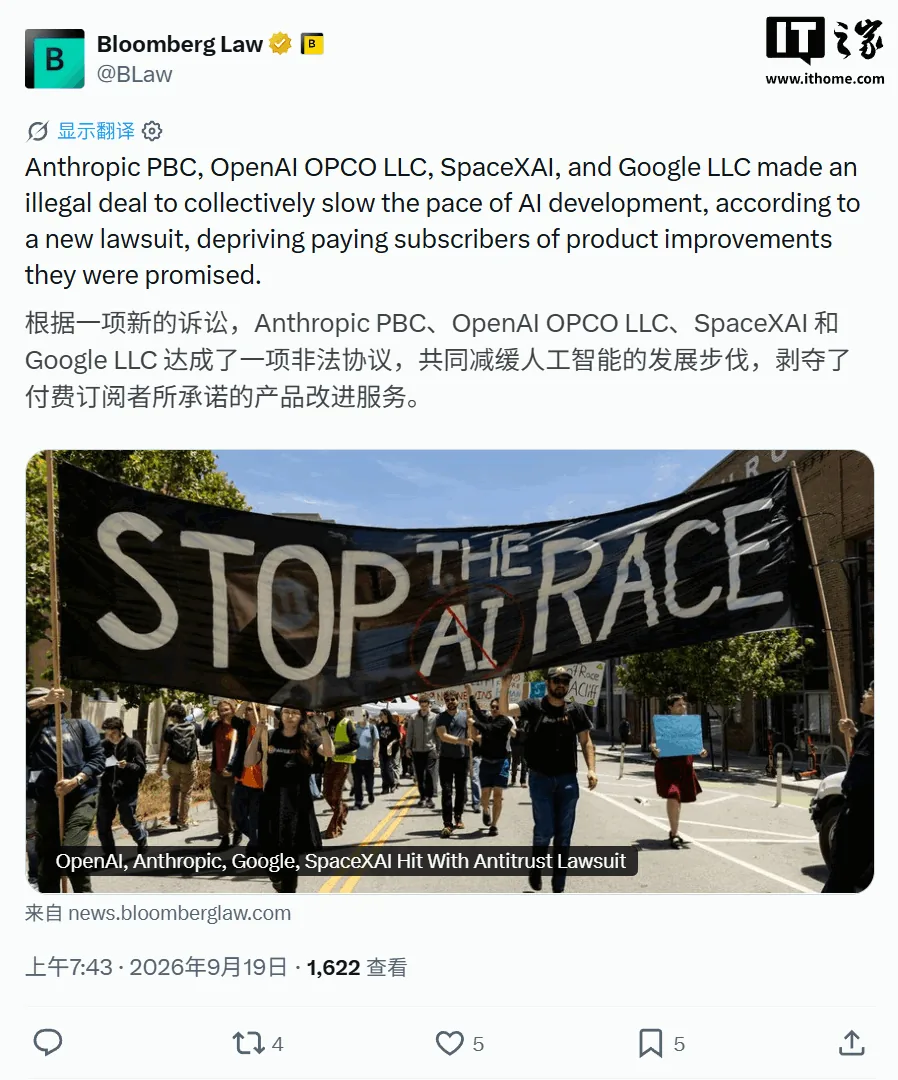
On September 18, 2026, the U.S. District Court for the Northern District of California accepted a class-action lawsuit against four AI giants, accusing them of colluding to slow AI development speed, allegedly violating the Sherman Antitrust Act’s Section One. Case No. 3:26-cv-10693, titled Buist v. Anthropic PBC.
- Central Contention: Anthropic CEO Dario Amodei’s September 12 article called for “industry-wide coordination” to “set the pace at the AI frontier” and “limit uncontrolled AI progress”, enabling safety assessments to catch up. CEO Sam Altman of OpenAI, Elon Musk (founder of SpaceX), and Demis Hassabis of Google DeepMind subsequently expressed public support.
- Plaintiffs: Four consumers who subscribe to the defendants’ AI services—Cheyenne Hunt, attorney Charles Buist (Florida), Nick Spetsas, and Christine Bullock (California resident)
- Representative Counsel: Nick Rowley of Trial Lawyers for Justice
- Relief Sought: Class certification, injunctive relief halting the alleged coordination, and declaratory judgment finding violation of federal antitrust law
Background and Key Facts
Plaintiffs argue that multiple competing companies’ executives publicly endorsing the same position constitutes a de facto agreement on the pace of product improvements. Crucially, antitrust law prohibits not only explicit agreements but also “understood concert of action” that restricts competition. Plaintiffs assert that synchronized slowing of AI iteration means consumers pay identical prices for uneveloped innovations, causing direct harm.
A notable counterpoint: Amodei explicitly stated his proposed “slowdown” does not mean halting model training or technological advancement, but rather pursuing capability increments at a more balanced pace while completing safety validation. He proposed three mechanisms—third-party safety assessors, industry-wide coordination frameworks, and international governance alignment. This stance framed as “responsible development” paradoxically became the legal liability due to its synchronized adoption across rivals.
The complaint cites Section One of the Sherman Act, emphasizing that when multiple independent firms collectively commit to curbing the pace of innovation—thereby restricting market output of new capabilities—it may constitute unlawful coordination. This represents a legally ambiguous zone: courts must determine whether a “concerted action” exists and whether it causes anticompetitive harm, especially when safety arguments ostensibly justify slowed progress.
Party Positions and Industry Implications
None of the four defendants has issued formal comments on the lawsuit to date. The suit’s uniqueness lies in targeting not specific products or market behaviors, but public statements and philosophical consensus among tech leaders. This could establish a precedent: when industry executives frame development speed as a collective responsibility, their joint declarations may become evidence of collusion in regulator or plaintiff hands.
Plaintiff counsel Nick Rowley emphasized the suit aims to prevent “self-interested private agreements among the world’s most powerful for-profit tech companies” from enabling AI to escape human control. The legal theory bundles AI safety concerns with consumer rights: delayed safety validation could increase systemic risk, ultimately harming subscribers’ security interests.
Particularly significant is SpaceX AI’s inclusion as a defendant despite AI not being its core business—demonstrating that any AI service offered publicly and directly competing with rivals falls within the antitrust-determined relevant market.
Advice and Potential Paths
- For end users: Immediate usage adjustments unnecessary; class certification alone may take 6–18 months, and injunctive relief would require separate proceedings even if certification succeeds
- For developers and enterprises: Monitor whether the DOJ or FTC intervenes; when issuing industry statements, executives should avoid “coordinator” or “synchronized” terminology—opt instead for “independent assessment” to prevent co-deed-action interpretations
Bottom Line
The lawsuit exposes a fundamental tension in AI governance: the public-good imperative of safety coordination versus competitive markets’ drive for rapid innovation. When dominant players collectively define “reasonable development pace” under safety rubrics, they inadvertently expose themselves to antitrust scrutiny—highlighting the gap between emergent technology practices and lagging regulatory frameworks.