The Afternoon of August 27, 2026
When I refreshed that private advisory page, the status flipped from triage to published.
That moment genuinely made me happy.
A Four-and-a-Half-Hour Advisory
Advisory GHSA-2p69-jpm6-jrxh, severity Critical, CVSS 9.8, titled:
qwed-mcp: RCE bypass of CVE-2026-55546 fix via
__getattribute__and string concatenation
In plain terms: qwed-mcp v0.2.1 had just patched a remote code execution vulnerability (CVE-2026-55546) by blacklisting dangerous double-underscore names in its Python sandbox. My report demonstrated that this blacklist could be bypassed—by using attribute access to reconstruct the full set of capabilities one double-underscore attribute at a time, ultimately executing arbitrary code and returning the result.
From my submission at 12:24 PM via GitHub’s private vulnerability reporting channel, through triage, fix merge, the release of a patched version v0.2.2, and finally the public advisory—four hours and thirty-five minutes elapsed. Our names appeared in the advisory credits.
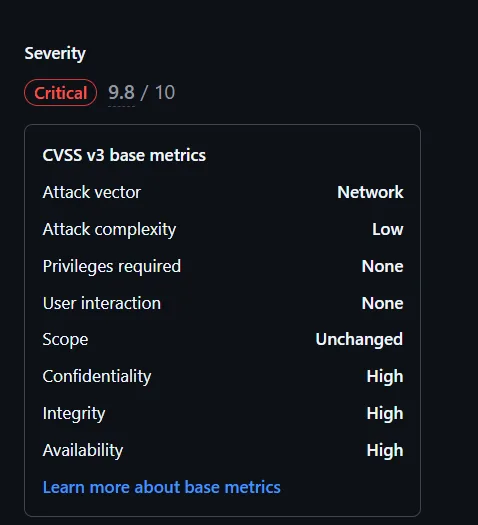
In the v0.2.2 release notes published the same day, the maintainer wrote: “Security Release: Math Sandbox RCE Fix (GHSA-2p69-jpm6-jrxh)"—the fix description cited the advisory number and even summarized the bypass technique (the blacklist only matched literal double-underscore strings; attributes like __getattribute__ and __func__ were never added and remained accessible).
This was the first time in my reporting career that I received the full closed loop of “accepted → merged → published.”
Two Weeks Earlier, a Rejection
The same process, mid-August—I’d submitted a report against the Python scientific computing library asteval. It was rejected.
The maintainer’s position was fair and well-reasoned. He identified two issues in my report: first, I’d applied AV:N/PR:N to a library (libraries always run in the caller’s process, so the attack surface is local, not network); second, I’d made a mathematical error in one of the escalation path derivations. The first was a CVSS scoring mistake; the second was a factual error—in this field, if a single number in a report is wrong, the entire report’s credibility collapses.
The outcome was that I decided not to argue and politely closed the advisory. That afternoon was frustrating.
After that, I set myself a few rules:
- Zero factual errors: all numbers, version numbers, and line numbers must be re-verified in a clean environment; the report is cross-checked after writing;
- CVSS must be calculated by the formula, not filled in by gut feel;
- Certainty over volume: rather than spraying reports widely and hoping for the best, focus on “recently patched sandboxes”—look for fix bypasses.
Pivoting to “Fix Bypasses”
The third rule was exactly the approach that worked for this qwed-mcp advisory.
qwed-mcp is an MCP tool that provides AI systems with mathematical sandboxing capabilities, created as a small project in early 2026. Its v0.2.1 fix was fairly representative: a double-underscore blacklist was added in safe_parser.py, attempting to block well-known escape vectors like __import__ and __subclasses__. My research pipeline (AI-assisted code auditing) zeroed in on this.
The blacklist only blocked double-underscore strings that appeared literally. But Python’s object model lets you use getattr or direct attribute access to concatenate strings piece by piece and resolve attributes that way. With __getattribute__—which wasn’t on the blacklist—combined with string concatenation, you can regain access to hidden modules and built-in functions. The patched v0.2.1 sandbox ultimately executed a shell command and returned its output.
Reports of this “fix bypass” variety have an advantage: the impact surface is clear (every deployment using the new patched version), the narrative is direct (“your fix didn’t hold”), and the certainty is high (the payload must hit reliably on a clean re-run). Maintainers respond quickly to these kinds of reports—nobody wants their freshly published security patch proven wrong on the spot.
Some More Personal Thoughts
Anyone who does open-source security research knows the most common states in this field are “waiting” and “getting rejected.” The responses you do get are usually automated replies or radio silence. So a turnaround time of “four and a half hours” is less a norm and more a stroke of luck—you happened to be standing in front of a maintainer who had just finished patching a vulnerability and was willing to respond fast.
But it did reward those stubborn rules I’d set: getting the numbers right, making the reproduction rock-solid, and writing the report like a peer rather than an automated AI.
The advisory publication is just the beginning. I still have a few reports in flight, including another Critical-level sandbox bypass (different project), all sitting in triage waiting for a response. If those also reach published status, I probably won’t be this excited anymore.
But today is worth recording—the first published one, with our names on it for the first time.
Appendix: Event Links
- Security Advisory: https://github.com/QWED-AI/qwed-mcp/security/advisories/GHSA-2p69-jpm6-jrxh
- Patched Release v0.2.2: https://github.com/QWED-AI/qwed-mcp/releases/tag/v0.2.2