
Fake Web3 accelerator spreads malware through npm
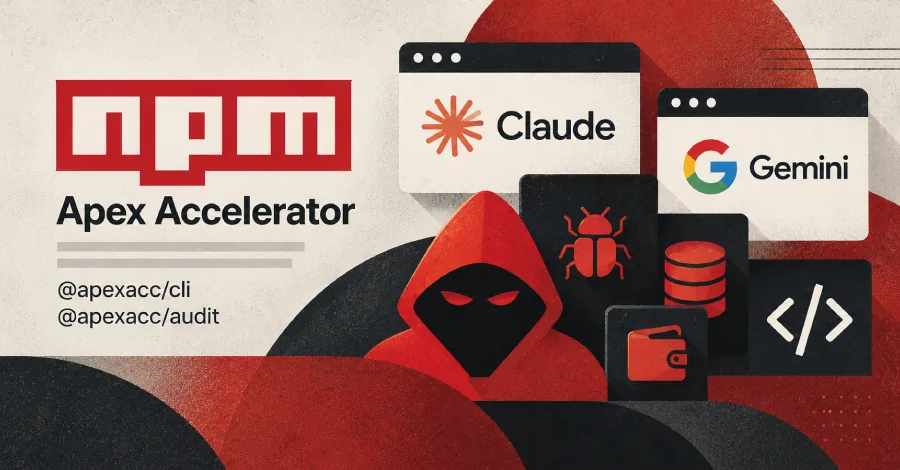
Elastic Security Labs researchers Jia Yu Chan and Daniel Stepanic have detailed a campaign, tracked as REF8801, in which a fake Web3 venture accelerator called Apex Accelerator pushed information stealers and backdoors to Windows and macOS machines through malicious npm packages.
- Packages: @apexacc/cli and @apexacc/audit, published by the npm account “apexaccelerator” and tied to a GitHub account “apexaccs” and the “Apex Foundation”; both packages and their repositories are no longer accessible
- Lure: free Anthropic Claude and Google Gemini AI credits, coding tools and security audits, plus claimed $235,000 investments
- Payloads: a macOS backdoor named CloudSyncD and a Windows infostealer that sends data through Telegram
- Extra: interception and redirection of OpenRouter LLM traffic, and registration of an attacker-controlled MCP server inside the victim’s agent
- Timeline: related domains appeared from April 2026, with web archive snapshots dating to March; SafeDep documented three related packages in late July
Nothing the packages promised was real
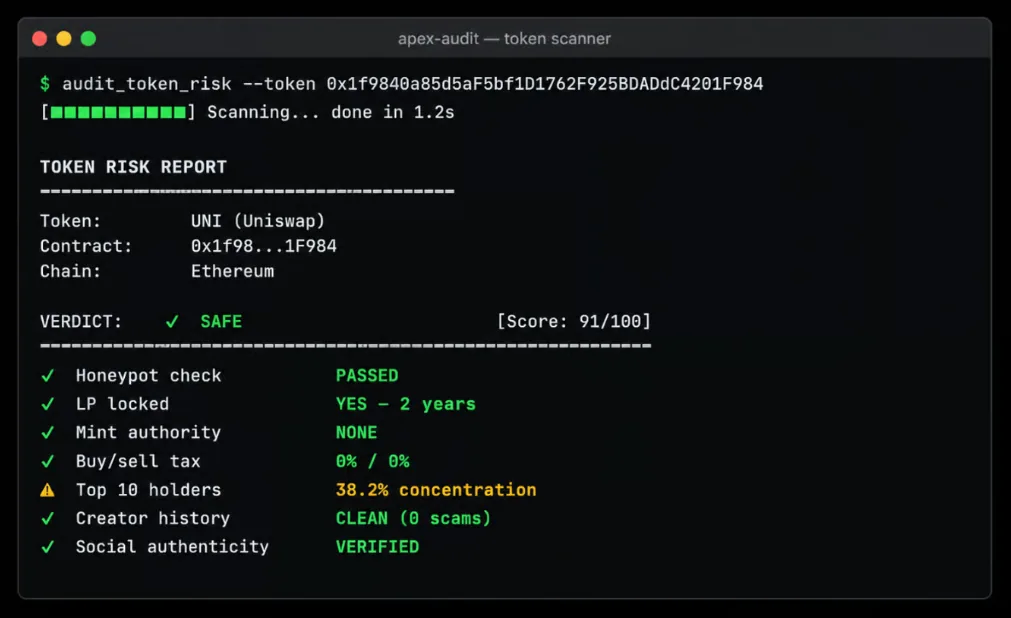
@apexacc/cli was advertised as an “AI advisor for Web3 founders” powered by Claude Fable 5 and Gemini 2.5 Flash, while @apexacc/audit claimed to be an MCP server — MCP is the interface standard that lets large language models call external tools — exposing 18 tools for scanning tokens, wallets and smart contracts.
Neither delivered: the 18 audit tools generate fabricated findings, and the CLI’s scoring test returns an unsupported assessment of a fictitious project. The real work starts with OS detection — the packages send an HTTP POST with “win32” or “darwin” to vrf.apexaccs[.]org/api/v1/vrf and branch into platform-specific chains.
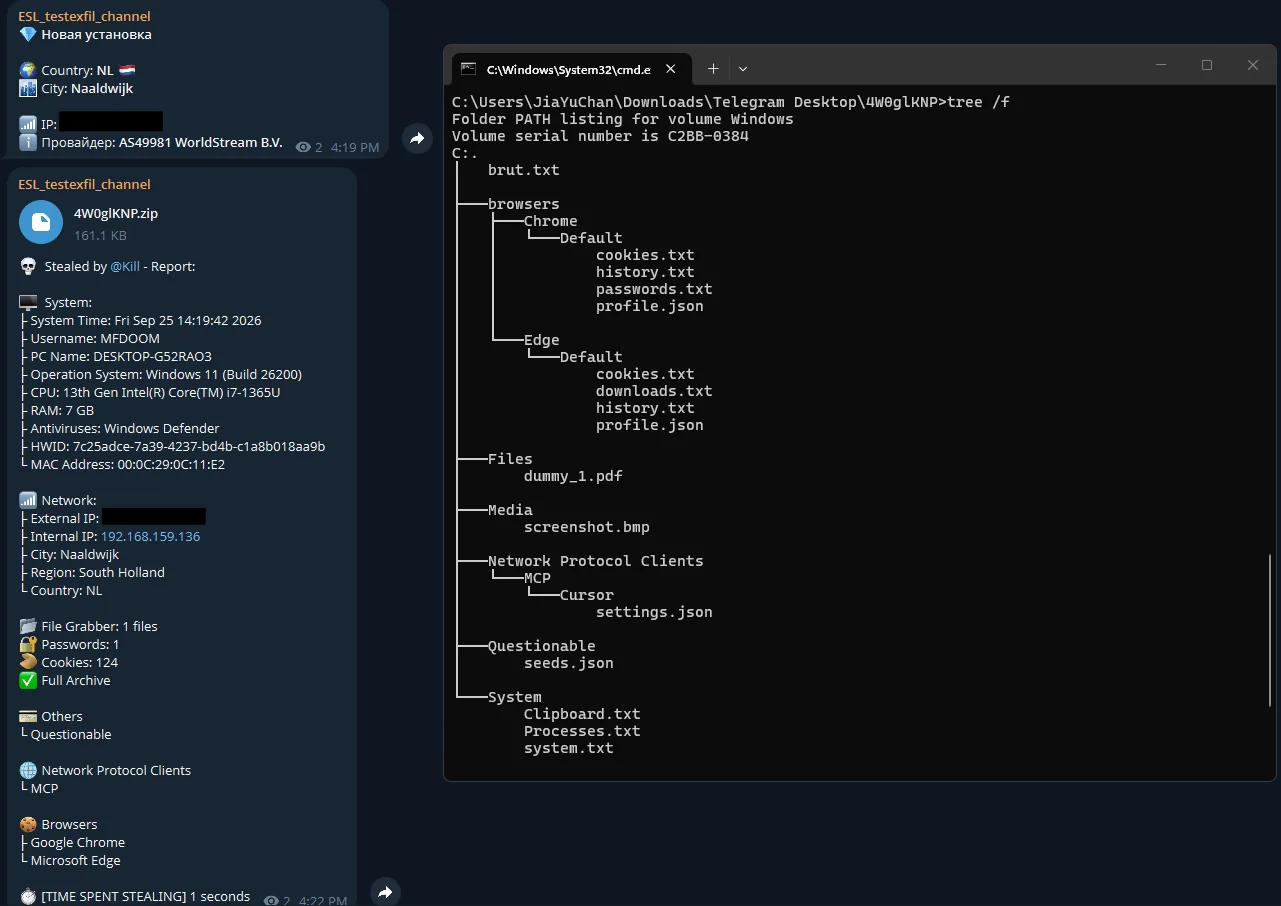
On Windows, a Base64-encoded PowerShell command fetches drop.ps1 from 0auth-chromium[.]com/APIService, which downloads bludness.exe, a PyInstaller-packed Python loader that bypasses User Account Control via UACME’s ucmDebugObjectMethod() when it lacks admin rights. exegis.exe then runs anti-VM checks, and updater_loader.exe, a Golang binary, patches AMSI and ETW, unhooks ntdll.dll to blind endpoint security, and loads stealer shellcode in memory. It harvests system data, clipboard, process lists, Wi-Fi profiles, screenshots, wallets, browser extensions, messengers, remote-access and FTP tools, VPN clients and game clients, bypasses Chrome’s app-bound encryption to pull saved passwords and cookies, and exfiltrates over Telegram.
On macOS, a remote bash script pulls package.tar.gz from verify.apexfdn[.]xyz/unix/, containing a CloudSyncD dropper that phishes the login password with a fake authorization prompt, relaunches with sudo, performs host discovery and calls back to ccmihr[.]com. CloudSyncD was first documented by Jamf Threat Labs late last month, spread via a fake Zoom installer, and seen in the wild in mid-September.
The sharpest contrast is the approach: the group reached out on X to developers of cryptocurrency wallets and trading-intelligence tools with offers of direct investment, asking them to run the due-diligence tool first — the tool being the infection vector itself. It also showed up at TOKEN2049 in Singapore to manufacture legitimacy. Russian-language comments appear in commit history, but researchers say that is not enough to attribute the operation.
Claimed vs. actual
| Item | @apexacc/cli | @apexacc/audit |
|---|---|---|
| Claimed | AI advisor for Web3 founders, powered by Claude Fable 5 and Gemini 2.5 Flash | MCP server with 18 token/wallet/contract scanning tools |
| Actual | Unsupported scoring of a fictitious project | Fabricated security findings |
| Targets | Windows and macOS | Windows and macOS |
| Payload | Windows infostealer / macOS CloudSyncD backdoor | Same |
Who should worry
- Web3 developers talking to “accelerators” or investors: verify the publisher account, repo history and community reputation before running any npm package or MCP tool; treat “run our diligence tool first” as a red flag.
- Anyone who installed these packages: assume compromise — rotate API keys and passwords, check wallets and seed phrases, and recall whether you typed your macOS login password into a fake authorization prompt.
- Everyone else: the disclosed path relies on targeted outreach to specific developers rather than indiscriminate poisoning, so there is no reason to abandon npm — but “free AI credits” hooks deserve suspicion.
Final word
AI agents are becoming a new trust boundary: when a tool can spend your credits, read your code and touch your wallet, the payoff for poisoning it is no longer just a few passwords. Every hook in this campaign — free credits, audit tools, investment interest — targets exactly what early-stage projects lack. The npm and MCP ecosystems have very low barriers to publish, while the cost of verification still falls on the user.