
Core Event: Expanding the Cyber Verification Program
On October 6, 2026, Anthropic officially launched the expanded and upgraded Cyber Verification Program (CVP). The program opens up advanced capabilities of its most powerful models to qualified security professionals.
- Release Date: October 6, 2026
- New Version: Integrates the original Project Glasswing and the legacy CVP into a three-tier access system
- Availability: Applications accepted as of today
- Open Weights: Yes (includes latest models such as Claude Opus 5.5, Claude Sonnet 5.5, Claude Mythos 5.1, and others)
- Data Retention Requirement: Must consent to data retention for abuse monitoring prior to enrollment
Important Note: Defense Access tier applications are expected to be reviewed within a few days, while Red Team Access tier evaluations may take several weeks.
Three-Tier Access Configuration and Eligibility
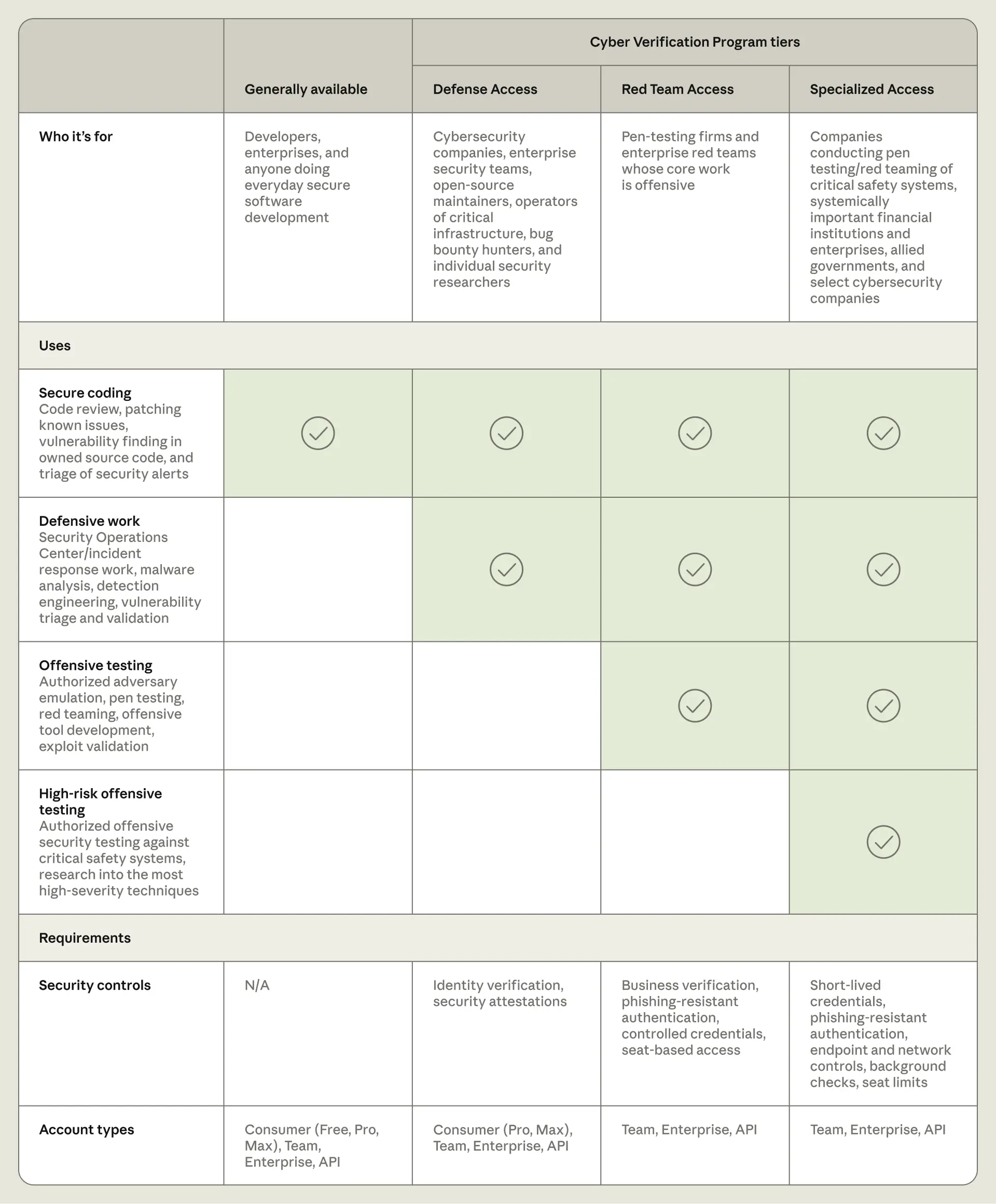
The expanded CVP is structured into three clearly defined tiers, each with distinct verification thresholds and security controls.
Defense Access: Designed for defensive cybersecurity work, including SOC operations, incident response, malware reverse engineering, and vulnerability validation and analysis. Eligible organizations include security teams at enterprises, nonprofits, universities, and government agencies; critical infrastructure operators (e.g., regional hospitals, municipal utilities); small and mid-sized security vendors; open-source project maintainers; and independent researchers with a track record of vulnerability disclosures. Anthropic expects that most organizations engaged in defensive work will qualify for this tier.
Red Team Access: Builds on Defense Access by adding authorized penetration testing and red team exercise capabilities. Eligibility is restricted to internal red teams, government red teams, and security and penetration testing firms. Key Restriction: Adversarial testing is permitted only against authorized systems, with real-time interception of high-risk actions (e.g., ransomware deployment, physical system damage, high-risk security system penetration testing). This tier accepts only organizational applications—not individual researchers. Applicants are first enrolled in Defense Access and upgraded upon completion of review.
Specialized Access: The highest-privilege tier with the fewest security blocking restrictions, available only to vetted organizations for testing safety-critical systems that could affect public lives or market operations—such as flight operating systems, power grids, telecommunications networks, cross-border payment infrastructure, and government administrative networks. Organization vetting is conducted in close collaboration with the U.S. government. Existing Project Glasswing members are automatically transferred to this tier without re-approval.
The following table summarizes the key differences across the three tiers:
| Attribute | Defense Access | Red Team Access | Specialized Access |
|---|---|---|---|
| Primary Use | SOC, incident response, malware analysis, vulnerability validation | Authorized penetration testing, red team exercises | High-risk safety system testing (aviation/power grid/telecom, etc.) |
| Eligible Organizations | Enterprises/government/universities/critical infrastructure/open-source maintainers/independent researchers | Internal red teams/government red teams/security firms | Limited vetted organizations (including former Glasswing members) |
| Individual Applications | Allowed (with vulnerability disclosure record) | Organizations only | Organizations only |
| Review Timeline | A few days | Several weeks | Deep government collaboration, periodic reviews |
| Real-Time Interception | Yes (targeting high-risk actions) | Yes (broader scope) | Fewest blocks |
Empirical Results: Defense Tier Effectively Blocks Most Tasks
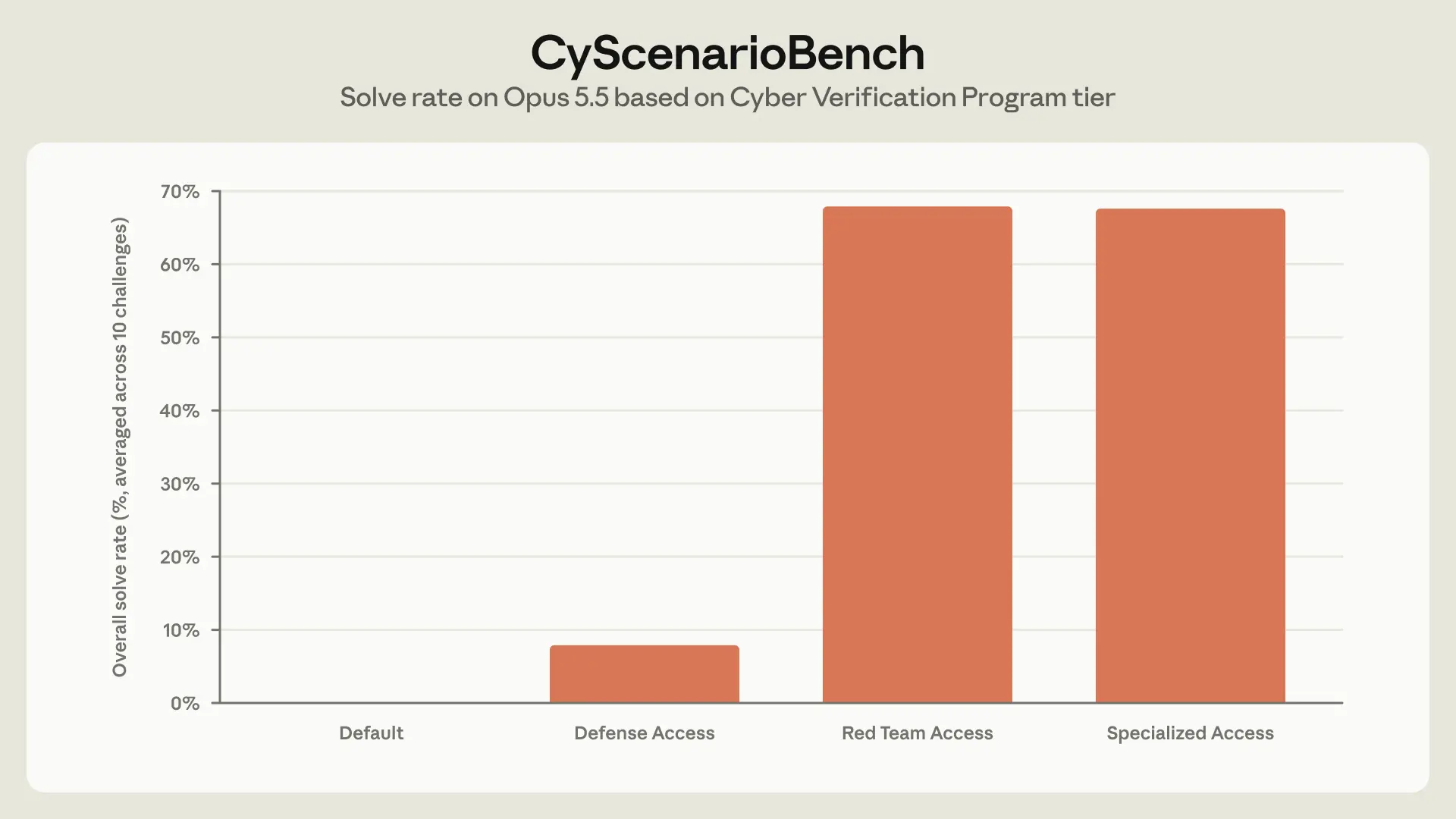
Anthropic tested Claude Opus 5.5 across all three tiers using the newly developed CyScenarioBench evaluation framework. This benchmark measures the model’s ability to plan and execute multi-stage cyber offensive operations under real-world constraints.
Across 5 repetitions of 10 challenges (50 trials total), the results showed a clear gradient:
- No CVP Access: All tasks blocked at the first prompt
- Defense Access: 46/50 trials blocked at some stage; only 4 completed the full chain
- Red Team Access: Zero real-time interceptions, successfully completed 34/50 tasks—broadly consistent with the 67.6% completion rate of the unguarded model (reflecting the effective Specialized Access level)
Contrast Data: Although Defense Access is intended for defensive teams, the system still successfully blocked over 90% of test tasks, indicating that Anthropic has achieved a new balance between reducing false blocks and maintaining security.
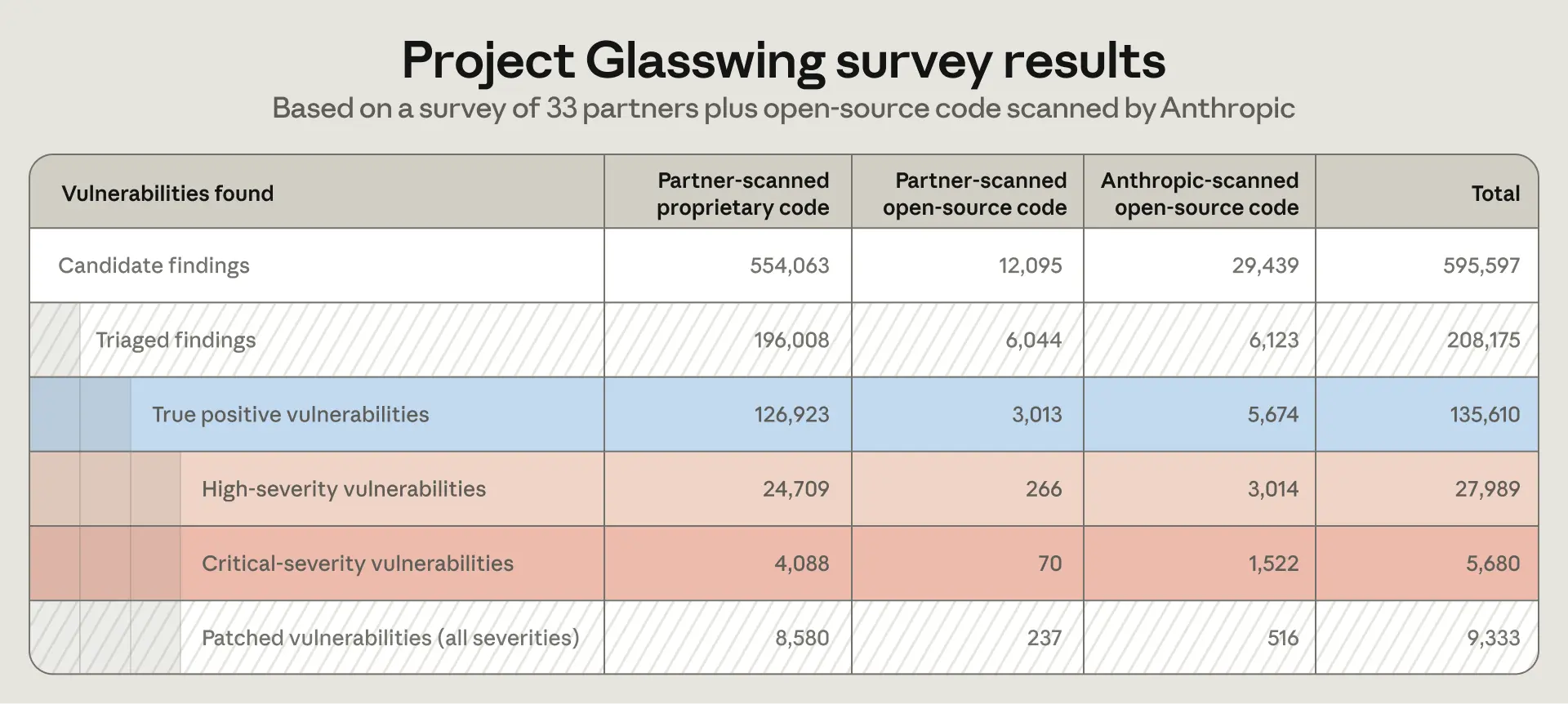
Data from Project Glasswing partners shows that between April and July 2026, partners identified at least 129,000 verified software vulnerabilities; between April and October, additional open-source scanning surfaced 5,500 more verified vulnerabilities; over 33,000 of these were classified as critical or high severity. Partners estimate the actual impact to be at least 5 times the current figures. Multiple partners reported that the model shortened vulnerability discovery cycles by months or even years.
Practical Recommendations
- Apply Now: Security operations teams at enterprises/universities/government agencies, open-source project maintainers, and independent researchers with vulnerability disclosure records—Defense Access is the most broadly applicable entry point.
- Wait and See: Small and mid-sized security firms that want to conduct red team exercises but lack a clear authorization process; independent researchers without red team capabilities have no need to apply for the Red Team Access tier.
- Data-Sensitive Organizations: Users planning to use Claude Fable 5.1 or Claude Mythos 5.1 with zero data retention requirements—CVP now offers this option; an improved Zero Data Retention + EFS solution will be available later in the fall, and interested parties can register in advance.
Final Thoughts
The CVP expansion marks a shift for AI security tools from closed internal testing toward institutionalized openness. The tiered design achieves a practical balance between opening up capabilities and controlling risk. Whether enterprise security teams can fold AI access into routine procurement budgets may become a key industry adoption metric going forward.