The Detention
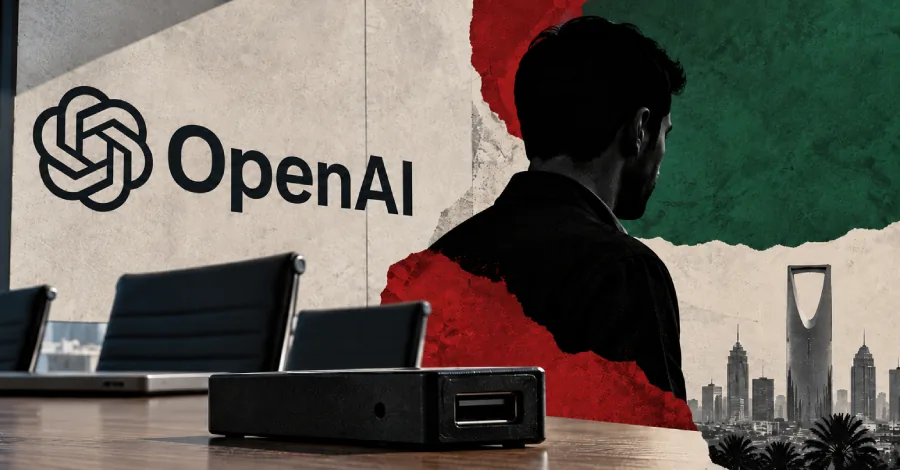
A U.S. court on Monday granted the government’s request to detain Abdulrahman Alfozan, a 35-year-old Saudi national and former OpenAI engineer, ahead of trial. Prosecutors allege he placed a concealed recording device behind a television in an executive conference room at OpenAI’s San Francisco office to capture sensitive conversations. Detention means he will remain in custody rather than be released on bail while the case proceeds.
- Who: Abdulrahman Alfozan, 35, Saudi national; joined OpenAI around July 2025 as an engineer at a $385,000 annual base salary.
- Charge: Using or endeavoring to use an electronic, mechanical, or other device to intercept oral communications. Maximum sentence if convicted: five years.
- Why detained: Prosecutors cite ample resources, apparent support from a foreign government, and the absence of an extradition treaty between that government and the U.S.
- Key dates: He was in contact with a Saudi royal family member on Oct. 5, 2026, four days before his arrest. He had a one-way ticket to Riyadh for Oct. 12 with his wife and son; his wife and son left the U.S. without him.
The Device and the Tradecraft
According to the filings, the device was inserted into a USB port on the back of a TV in the executive conference room. Alfozan allegedly modified it to prevent data transfer between the device and the TV and encrypted the contents of its microSD card, making it closer to an offline recording box than a normal peripheral.
The preparation is what stands out. Prosecutors say he used his wife’s personal ChatGPT account to research how to build a continuous audio recorder that could capture microphone audio and save compressed WAV recordings to an SD card. He also used an OpenAI productivity agent—an AI assistant that can query internal information and help complete tasks—to determine which meeting rooms OpenAI leadership and executives used and where they met external partners, and spent considerable time near the room where the device was later installed.
A search of his residence and a preliminary review of his devices turned up more evidence: electronic components similar to those in the customized devices; iPhone photos from Sept. 22-28, 2026, showing another concealed recording device and what appear to be input/output panels on TVs and other electronics in various OpenAI buildings, including a second conference room where sensitive meetings took place; a deleted September 2026 note with links to recording devices, including products from Seeed Studio; and browsing history showing a folder called ‘Saudi Gov Docs’ accessed on Oct. 4, 2026. The filing also says he used the OpenAI productivity agent to ask about Saudi Ministry of Communication and Information Technology (MCIT) business and government engagements between July 6 and Sept. 21, 2026.
Saudi Contacts and the Contrast
A Sunday court filing revealed that Alfozan was in frequent WhatsApp contact with a member of the Saudi royal family throughout 2025 and 2026. The most recent contact was Oct. 5, 2026, four days before his arrest. The royal family member told him Saudi Arabia was launching an AI initiative and wanted him to join; in May 2026, the individual said ‘Saudi needs you more then [sic] the US!’ and Alfozan replied ‘100,’ indicating agreement. The individual repeatedly asked when he planned to leave OpenAI, and Alfozan said he would not do so until his stock vested.
The contrast is sharp in two ways. First, the timeline: he was still in contact on Oct. 5 and was arrested on Oct. 9, a four-day gap. Second, the tools: he allegedly used his wife’s personal ChatGPT account to research recording techniques and OpenAI’s own productivity agent to scout executive meeting rooms. For a $385,000-a-year engineer waiting on stock vesting, the allegation is not just about a hidden recorder; it is about turning the company’s own AI tools into reconnaissance aids.
Prosecutors also say Alfozan planned to fly to Riyadh with his wife and son on a one-way ticket on Oct. 12, 2026. Although he was arrested three days earlier, his wife and son had already left the U.S. The day before her departure, his wife told FBI agents that her U.S. visa was expiring and that she and her son were permanently moving back to Saudi Arabia. Prosecutors cite this in arguing he is a flight risk and say the investigation is ongoing.
What Security Teams Should Do
For ordinary users, this is a criminal insider-threat case, not evidence that AI assistants are listening to every meeting. There is no need to panic-uninstall tools; watch the case as it develops.
For organizations with executive conference rooms, government-affairs teams, deal negotiations, or sensitive model assets, two steps are worth taking now. First, add the back of meeting-room TVs, USB ports, power strips, and ceiling corners to physical security checks, especially in rooms used by executives and external partners. Second, apply least-privilege access and audit logging to internal AI assistants that can answer questions about room usage, calendars, and personnel—so that ‘which room does leadership use?’ does not become a low-cost intelligence query.
Final Word
The core issue is not whether AI can eavesdrop, but how a person can chain existing tools into an intelligence pipeline. The lesson for enterprises is to fix physical security and internal access auditing; the lesson for the industry is that the more an AI assistant can answer ‘who is meeting where,’ the more it must be treated as a sensitive system.