
Core Event: SB1 Socket and Verano Processor Officially Confirmed
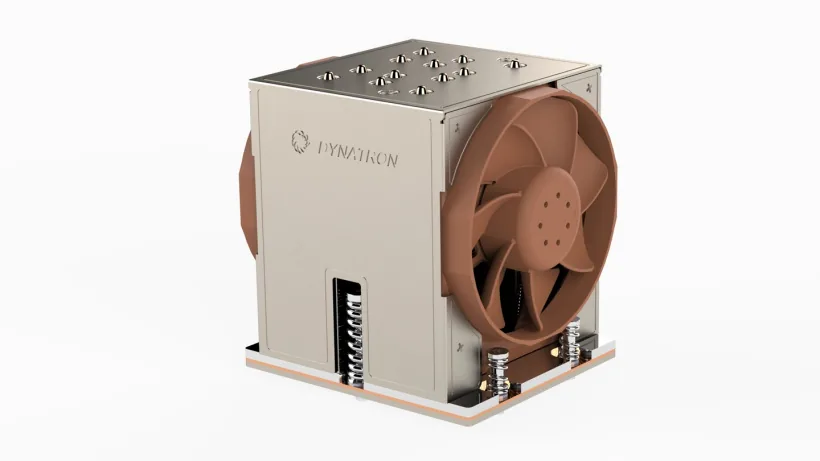
- Release Date: Expected to ship in 2027
- Socket Type: Socket SB1
- Microarchitecture: Zen 6
- Product Positioning: AI accelerator head node applications
- Memory Support: LPDDR5X SOCAMM2 modules
- Cooling Solution: Dynatron SB1-4U-ACTIVE air cooler launching in parallel
Cooling manufacturer Dynatron has officially listed the SB1-4U-ACTIVE air cooler on its website, indirectly confirming that AMD’s upcoming EPYC “Verano” processor will adopt a new SB1 socket design. This is the clearest official signal to date, marking the beginning of a tangible hardware platform definition for AMD’s next-generation data center processor.
Verano Processor Key Specifications and Platform Features
EPYC “Verano” is an LP (Low Power) series processor purpose-built for AI accelerator head nodes. Based on the cooler’s supported specifications, the confirmed hard parameters are:
- Core Count: Up to 72 CPU cores
- Max Frequency: Up to 5 GHz
- Interconnect Bandwidth: 112 Gbps high-bandwidth xGMI (AMD Infinity architecture’s high-speed interconnect protocol for multi-chip module communication)
- Memory Technology: LPDDR5X SOCAMM2 modules (SOCAMM2 is an embedded memory module standard that integrates DRAM chips directly onto the package substrate, reducing latency and power consumption)
A noteworthy contrast lies in its positioning: Verano targets AI head nodes rather than traditional general-purpose computing. It is not a high-core-count EPYC designed for HPC; instead, it leverages a combination of high clock speeds (5 GHz) and low-latency memory to serve as the host processor for mission-critical task scheduling and data preprocessing on AI accelerator nodes — which explains the choice of LPDDR5X over DDR5 DIMMs.
Cooling Solution: SB1-4U-ACTIVE Detailed Specifications
The Dynatron SB1-4U-ACTIVE is the first commercial air-cooling solution designed for the SB1 platform, purpose-built for 4U chassis environments. Key specifications:
- Physical Dimensions: 128.05 × 106.6 × 130.7 mm
- Cooling Structure: Integrated vapor chamber combined with multiple heat pipes for improved thermal dispersion
- Fan Configuration: Two dual-ball-bearing fans front and rear, four total
- Performance Ratings:
- Max RPM: 6000 ±10%
- Max Airflow: 91.7 CFM
- Max Noise: 44.5 dB(A)
The dual ball-bearing fans ensure longer lifespan and higher reliability, making this cooler well-suited for 24/7 data center operation. The cooler supports up to a 250W TDP (not explicitly stated, but reasonably inferred from the physical dimensions and fan configuration).
Market Positioning and Use Cases
Based on available information, EPYC Verano is primarily targeted at two user segments:
- AI Training Infrastructure Vendors: Organizations that need a high-performance host CPU to manage GPU/ASIC accelerator cards; Verano’s high-frequency xGMI links accelerate multi-card inter-card communication
- Edge AI Compute Nodes: In 4U-constrained environments, air cooling offers greater deployment flexibility compared to liquid cooling
Not recommended for large-scale general-purpose computing or memory-bandwidth-sensitive HPC workloads — LPDDR5X SOCAMM2 delivers low latency but offers limited total memory capacity, making it better suited to the lightweight data-movement tasks typical of head nodes.
Final Thoughts
Verano’s launch validates AMD’s strategy of market segmentation in the data center: expanding from general-purpose CPUs into AI-dedicated acceleration head nodes. The choice of an LPDDR5X platform signals that the memory subsystem is becoming a key differentiator in AI computing architecture.