
Suppose two videos each receive 10,000 plays. One gains eight followers; the other gains 80. Equal play counts do not mean equal follower conversion. Yet those two numbers are not enough. Were the subjects, lengths, audiences, paid promotion, and observation windows comparable? Will the new followers watch the next video? Will people who join a group stay? This is an illustrative scenario, not a measured result from this account.
Following the earlier analysis of Douyin’s recommendation algorithm, this article takes the next step: choose a specific audience, meet its needs through a repeatable set of content, and maintain the relationship through continued delivery. Use automation to shorten production and review cycles. For the first stage, I suggest practical AI tool tests for a defined audience, paired with relevant technology explanations. Creators who prefer narrative can choose history through maps or reviews of decisions in extreme environments. Do not launch every category at once. This is an operating recommendation for an individual or small team, not a ranking of platform success rates.
Research date: October 24, 2026. Official public materials establish the limits of what we know about platform mechanisms and capabilities. The choices of category, publishing cadence, experiment counts, and growth calculations are proposals to test. I have not accessed your Douyin analytics and have no basis for promising a viral video within days or 100,000 new followers a month.
1. What Operating Decisions Can We Derive from the Algorithm?
Douyin’s official “Understanding Recommendation Systems from Scratch” explains distribution through a content pool, retrieval, and ranking. It describes predicting user feedback from behavior, attributes of the recommended objects, and context.[1] This supports improving the match between content and a specific audience. It does not establish a universal completion-rate threshold that a video must pass.
Several statements in the previous article need tighter wording: the absence of public evidence for fixed traffic-pool thresholds does not prove that distribution lacks exploration or controls; two-tower models and Wide & Deep are explanatory examples, not a complete inventory of production models; and public material does not establish that shares always receive a higher weight than likes. The official transparency center also presents topics on content understanding, large models for high-quality content, and next-generation recommendation systems. It is therefore inaccurate to summarize the platform as unable to understand content or assess quality.[1][2]
| Evidence-supported understanding | Proposed operating response | What to observe |
|---|---|---|
| Recommendations involve matching users with content | Make the first batch serve the same audience and related problems | Which questions lead to continued viewing and follows |
| Feedback has multiple dimensions | Examine viewing, follows, saves, shares, and negative feedback together | Whether growth comes with disappointment, complaints, or unfollows |
| The explanatory material provides no universal promotion threshold | Establish a baseline for your own comparable videos | Medians, variation, sample sizes, and observation windows |
| Request signatures concern access mechanisms | Do not confuse scraping capability with an operating advantage | Whether the data is authorized, reliable, and interpretable |
These actions are hypotheses informed by public principles. Do not present “post three times a day,” “warm up an account for seven days,” or “publish at a particular minute” as reverse-engineered algorithm rules. Posting times can be tested against audience schedules; they should not be described as ranking switches without an experiment.
2. Decide Whom to Serve Before Deciding What AI Should Make
AI can be a production tool or a content subject. Those are different positioning choices. Someone who enjoys AI dramas may have no interest in learning a node-based workflow. Someone following technology news may not need a complete editing project.
The table below offers qualitative judgments about audiences and production costs, not platform traffic statistics. Categories can share an account when they have a strong common audience and promise. There is no evidence here that mixing in one additional subject necessarily causes a ranking penalty.
| Direction | One-sentence promise and series example | Work that can be heavily automated | Work requiring human judgment | Suitable group deliverables |
|---|---|---|---|---|
| Practical AI tool tests | Help operations staff complete a task: “Three ways to clean the same spreadsheet” | Test preparation, organizing screen recordings, subtitles, result tables | Real execution, failed cases, conditions of use | Templates, weekly tasks, feedback on submissions |
| Technology creator / AI technology news | Help a defined reader understand what changes: “Which part of your work does this update affect?” | Aggregating feeds, deduplication, version comparisons, first drafts | Original announcements, dates, availability | Source indexes, reproduction exercises, weekly digests |
| AI drama episodes | Give viewers a character and story worth following | Storyboard drafts, asset retrieval, voice generation, subtitles | Plot, character consistency, asset rights | Episode discussion, character discussions, behind-the-scenes material |
| AI drama production tutorials | Help creators deliver a particular shot | Project templates, step recordings, parameter logs | Reproducibility, actual time and cost | Project files, exercises, peer feedback |
| Film commentary / analysis | Explain character choices and visual storytelling | Research organization, transcription, timecodes, rough edits | Independent analysis, plot accuracy, basis for using clips | Watchlists, analytical outlines |
| Cave exploration explainers | Explain how environmental constraints affect decisions | Timelines, terrain diagrams, subtitles, reference cards | Incident sources, locations, separating inference from fact | Source indexes, terrain and documentary discussions |
| Diving exploration explainers | Explain constraints in underwater incidents | Route diagrams, event sequences, terminology cards | Environmental and equipment descriptions, specialist review | Reading materials, case discussions |
| War / history explainers | Explain causes with maps and historical sources | Map animation, timelines, source indexes | Places and dates, disputed accounts, verification of battlefield claims | Source packs, reading paths, map resources |
| Other educational topics | Explain a type of phenomenon to a defined audience | Diagrams, formula demonstrations, citation records | Subject accuracy, units, reasoning, uncertainty | Experiment records, reading groups, exercises |
Work backward from what the group can deliver. If you can consistently provide office templates, choose subjects for office users. If your strength is historical sources and maps, serve history enthusiasts. A large group acquired through entertainment dramas will not naturally become a group with strong demand for tool tutorials.
A solo creator can start with two recurring formats. One answers common questions and builds a searchable library; the other responds to new developments and tests audience interest. For example, pair “AI for real work tasks” with “How this week’s updates affect those tasks.” Allocate production time according to capacity first, then adjust using evidence.
3. A 30-Day Launch: Deliver Four Rounds of Experiments
The schedule and counts below are planning suggestions. Follow the actual account prompts for registration, profile setup, and publishing. There is no need to fabricate browsing, follows, or engagement to “warm up” an account. Start with an avatar, name, bio, consistent covers, and series numbering. The profile should explain whom you serve, which problems you solve, and what viewers can expect next.
| Period | Concrete work | Deliverable | Basis for the next decision |
|---|---|---|---|
| Days 1–3 | Review about 15 accounts serving the same audience; record unresolved questions in comments; write the positioning; prepare an asset register | 20 candidate questions, two recurring formats, plans for three pinned videos | Can a specific example fulfill the promise? |
| Days 4–10 | Produce about six videos: three questions with two approaches each, primarily comparing openings | First content batch and 24/72-hour snapshots | Which questions and approaches deserve another attempt? |
| Days 11–17 | Produce about six more, repeating the stronger structure with new examples; change one main factor at a time | A repeatable series and records of failures | Is the median improving, or is there only one viral outlier? |
| Days 18–24 | Continue validated formats; test relevant resources or activities as a next step; operate one group if the account has access | Acquisition sources, first meaningful actions, support records | Is the promised group experience happening, and can the administrator support it? |
| Days 25–30 | Review content and members that have completed their observation windows; set the following month’s schedule | Keep/change/stop list and unit costs | Is increasing output or adding a second format justified? |
Rate candidate questions as high, medium, or low on four dimensions: evidence of demand, distinctive evidence you can provide, production cost, and scope for a continuing series. Prioritize real questions supported by demonstrable evidence that you can keep producing. There is no need to invent a precise scoring model.
This is not a strictly randomized A/B test. Similar videos published at different times still encounter different audiences and competition. Call them paired operating experiments. Do not repeatedly repost the same asset to try to hit a “traffic pool.” Repeat the approach with new examples to distinguish a reproducible capability from luck.
Three pinned videos can serve distinct purposes: a representative piece demonstrates ability, a guide explains the series, and a delivery overview explains the group. If group functionality is unavailable, use a frequently asked question or upcoming plan for the third video. An example bio: “Reproducible AI office tests for small teams. One real task each week. Failed results included.” This is easier to understand than ten popular tags crowded into a profile.
Before publishing each video, complete this experiment statement:
For [target audience], this video answers [specific question], supported by [screen recording / diagram / source]. It tests only [one variable]. Compare it with [similar content] over [the same observation window]. If [a factual error / unclear asset rights] appears, stop publication and correct it.
4. Give People a Reason to Return Before Asking for a Follow
A video should answer one question completely. Following provides continued access to similar value; joining a group enables deeper practice or discussion. Hiding the answer in a group prevents the video itself from fulfilling its promise.
The timings below are script drafts. Adjust them to the subject and actual retention curve.
4.1 AI Tools and Technology News: Evidence Before Judgment
A 60-second tool test could work like this: show two outputs from the same task in seconds 0–5; explain the input and evaluation criteria in seconds 5–15; show key steps and failures in seconds 15–40; explain conditions of use in seconds 40–52; then identify the next test, such as “Next time, we will test overlapping speakers.” If the real results show no difference, report that honestly instead of manufacturing a winner for dramatic effect.
A news format can consistently answer four questions: What happened? What does the original source say? Who is affected? What remains unknown? Record the publication date, announcement date, and product availability date separately. “Three changes this update brings to a subtitle workflow” establishes a more sustainable professional promise than an untested claim that an occupation is about to disappear.
4.2 AI Drama: Maintain Interest Through Characters and Payoffs
An episode can follow “character goal → obstacle → choice → consequence.” Leave a future choice open at the end, but make meaningful progress within the current episode. Maintain an asset register covering the story world, character appearance, voices, and relationships. Check it before generation instead of reinventing characters in each episode. Put production tutorials in a distinct format or account, organized around “problem shot → repair process → before/after comparison → project requirements.”
Variables to test include whether to open with conflict or background, episode length, and how to preview the next episode. Do not assume shorter or more intense is automatically better. Examine subsequent viewing, follows, and feedback together.
4.3 Film, Caves, Diving, War, and History: Explain Causes Through a Timeline
A reusable structure is “time and place → known conditions → key decision → outcome → disagreements in the evidence.” Plan-view diagrams can aid cave and diving explanations; maps and timelines suit war and history; specific shots and character actions suit film analysis. Give each segment of narration corresponding visual evidence, instead of relying entirely on stock footage and a synthetic voice.
Label simulated visuals as “illustration” or “reconstruction,” rather than presenting them as footage from the scene. Preserve uncertainty around unverified casualties, military outcomes, or personal motives. Incident reviews explain events; they do not replace professional training. Having your own film analysis does not automatically resolve the rights to use clips. Record asset licenses, intended uses, and sources separately.[3]
4.4 Series You Can Start Developing
| Series | Three candidate questions, pending research and production | Promise behind the follow |
|---|---|---|
| AI Work Lab | How can a messy table be cleaned? How can meeting action owners be checked? Which constraints disappear from a long-document summary? | Continued comparisons of similar tasks, including failed results |
| AI Update Interpreter | Is the new capability available yet? Does an existing project need changes? How should the cost difference be calculated? | Connect each update to a real task |
| AI Drama Workshop | How can a character remain consistent across shots? How can failed lip sync be handled? Where does an episode actually require rework? | Resolve one production problem per installment |
| Choices in Film | How is a mistaken judgment set up? Why use different shots in the same scene? How does a supporting character alter the main story? | Explain storytelling through specific scenes |
| Extreme Environment Files | What was unknown at the time? How did terrain constrain actions? Where do later reports contradict one another? | Sources, diagrams, and explicit uncertainty |
| History Through Maps | How did geography affect supply? Why do two sources disagree? What are historical places called today? | Deliver maps, dates, and sources together |
5. Make Account Metrics Look Better by Improving Content and Measurement
“Better-looking” data here means genuine improvements in viewing and conversion, a clear profile, and trustworthy reporting. Purchased plays, bought followers, and bulk human-like comments make the numbers harder to interpret. Douyin’s community convention also restricts abnormal engagement and data manipulation.[3] That should not be embellished into an unsupported claim that buying followers once necessarily causes a permanent ranking penalty.
| Metric | Consistent definition | What it can help diagnose |
|---|---|---|
| Early retention / average watch time | Use the definitions actually available in analytics; record video length | Whether the opening promise is clear and the explanation drags |
| Completion rate | Compare similar length ranges over the same observation window | Structure and pacing; it cannot represent satisfaction alone |
| Follow conversion | Attributable new follows ÷ corresponding viewers; if only plays are available, explicitly report “new follows per 1,000 plays” | Whether the subject provides continuing value |
| Save / share rate | Separate actions from unique people; retain the platform’s denominator definition | Practical value and reasons for sharing, interpreted in context |
| Group join conversion | Deduplicated new members attributable to an entry point ÷ visitors to that entry point | Whether the promise matches the entry point |
| New-member D7 membership retention | Members still in the group after seven days ÷ new members who have reached seven days | Whether people leave; remaining in a group is not the same as being active |
| New-member D7 activity rate | Members completing a predefined meaningful action on day seven ÷ new members whose observation period is complete | Participation in tasks, discussions, or activities |
| Cost per meaningful member | Corresponding production, promotion, tool, operations, and labor costs ÷ new meaningful members | Whether expansion is economically worthwhile |
Define a “meaningful action” first: submitting work, answering a topic question, or participating in an activity, for example. Do not lower the standard afterward to improve the report. Here, the D7 activity window is the seventh full 24-hour period after joining, from hour 144 to hour 168; record membership status at hour 168. Group members by joining week and wait until the entire cohort has completed its observation window before comparing results. If you instead count activity during days 5–7, name the metric “days 5–7 activity rate.” Without verifiable group reading data, do not treat silent members as having read content or participated. Leave missing values blank and record only observable actions.
Keep snapshots at 24 hours, 72 hours, and seven days. Videos younger than seven days do not enter seven-day comparisons. Separate organic and paid traffic. For comparable subjects and length ranges, report the median, range, and sample count. A difference between 2/200 and 4/200 follow conversion does not directly prove that a strategy doubled performance. Test more new examples first.
| Observed pattern | Check first | Change only this in the next round |
|---|---|---|
| Exposure exists, but people leave quickly | Whether the title matches the opening and the visuals are immediately understandable | Show the result first or make the question explicit |
| People watch for a long time but rarely follow | Whether the video satisfies only one-time curiosity and whether the series promise is clear | Establish a continuing format through new examples |
| Many profile visits, few follows | Whether the bio, pinned pieces, and recent videos fulfill the same promise | Reorganize profile information and pinned content |
| Many follows, weak subsequent viewing | Acquisition sources, subject changes, and unrelated giveaway campaigns | Return to a sequence of questions for the original audience |
| Many joins, little participation | An oversized promise, hard-to-find materials, or a difficult first step | Reduce the first task and provide clear navigation |
| The group is active, but the creator is exhausted | Repeated questions and membership beyond service capacity | Add an FAQ, fixed support hours, and admission batches |
These are investigation priorities, not automatic diagnoses. For low play counts, first check visibility settings, review notices, sound and visuals, duplication, and rights issues; then investigate the subject and audience. Do not attribute every fluctuation to suppressed reach, or delete failed examples to manufacture a better average.
6. Douyin and WeChat Groups: Two Ways to Continue the Relationship
Douyin groups can support discussion and updates within the platform. WeChat groups can support continued practice through existing, voluntary contact channels. Function availability, creation requirements, capacity, and entry-point placement depend on the account’s actual interface at the time. I did not find sufficiently stable first-party evidence to present “a few hundred followers unlock group creation” as a universal threshold.
Douyin’s open platform provides mini-program-related group management, messaging, and authorized private messaging capabilities. Each capability requires its corresponding permission. Proactive private messaging specifically requires a released mini-program owned by a business entity, a linked business or institutional account belonging to the same entity, and proactive authorization from the recipient. This is not a general group-bot API for ordinary personal accounts.[4][5] The public convention restricts unauthorized or clearly abnormal automation. The ability to generate content does not confer permission to create unlimited accounts, send unsolicited private messages, or add people to groups automatically.[3]
Path A: In-platform content → an actually available profile or official group entry → Douyin group. Once the video has delivered its answer, explain the additional offering: “We will discuss this week’s spreadsheet exercise and failed cases in the group. It is for people who want to try the task themselves.” If the entry point is unavailable, start with answers in comments and series navigation. Do not claim a capability you do not have.
Path B: An existing, compliant, voluntary WeChat contact channel → WeChat group. For example, someone registers for an event on your own blog and explicitly chooses to participate through WeChat. Explain the group’s purpose, frequency, and exit options, then use the platform’s available joining process. Whether an off-platform entry point is permitted in a particular Douyin context requires checking that context’s rules and the account’s permissions. A user’s unsolicited question does not imply that every form of redirection is allowed. Coded phrases, obscured QR codes, and bulk private messages are not part of this plan.[3]
Do not force both paths into “join the Douyin group, then add WeChat, then recruit three friends.” Some users only need discussion within the platform; others want continued practice. A person present in both groups cannot count as two distinct new acquisitions. WeChat’s external-link rules also restrict making sharing a prerequisite for service and incentivizing sharing. Do not assume personal-WeChat auto-add, group-invitation, or bulk-messaging operations can be delegated to a third-party tool without Tencent authorization.[7][8]
6.1 Make One Group Produce Results You Can Show
A welcome message can use this structure:
This group discusses [subject]. We publish [deliverable] [frequency]. Start with the pinned index, then try [one small task] today. You do not need to invite friends or like a post to receive materials already promised. You can leave whenever you wish. Please put questions in [designated place / scheduled support session].
A possible weekly schedule: one task on Monday, a collection of common questions on Wednesday, and member results shared with consent over the weekend. An AI group can deliver reusable files and test records; an AI drama production group can provide shot exercises; history, cave, and diving groups can maintain fully sourced reading indexes. Do not routinely request phone numbers, employers, or unrelated information simply for administrative convenience.
Four concrete actions can support faster expansion: make a mature series an entry point, turn group results into the next public piece, run an activity with a creator serving the same audience, and let satisfied members recommend the group voluntarily. Agree on the subject and deliverables before collaborating, and let members register for themselves. Do not transfer another group’s membership list, exchange address books, or require reposting. Track acquisition from content, partnerships, and paid promotion separately to learn which sources bring people who stay.
6.2 Estimate Meaningful Scale with a Funnel
Every figure below is hypothetical and assumes reliable attribution and deduplication:
10,000 unique viewers × 5% entry-page visit rate × 20% join rate × 40% D7 activity rate = 40 new members active on D7
Holding the other inputs constant, increasing the join rate from 20% to 30% produces 60 people. Increasing D7 activity from 40% to 60% also produces 60. This illustrates arithmetic, not evidence that either improvement is achievable. If analytics provide only plays, or you cannot connect viewing, visits, and joins, report the stage counts separately. Do not substitute plays for people and multiply them into a supposedly measured funnel.
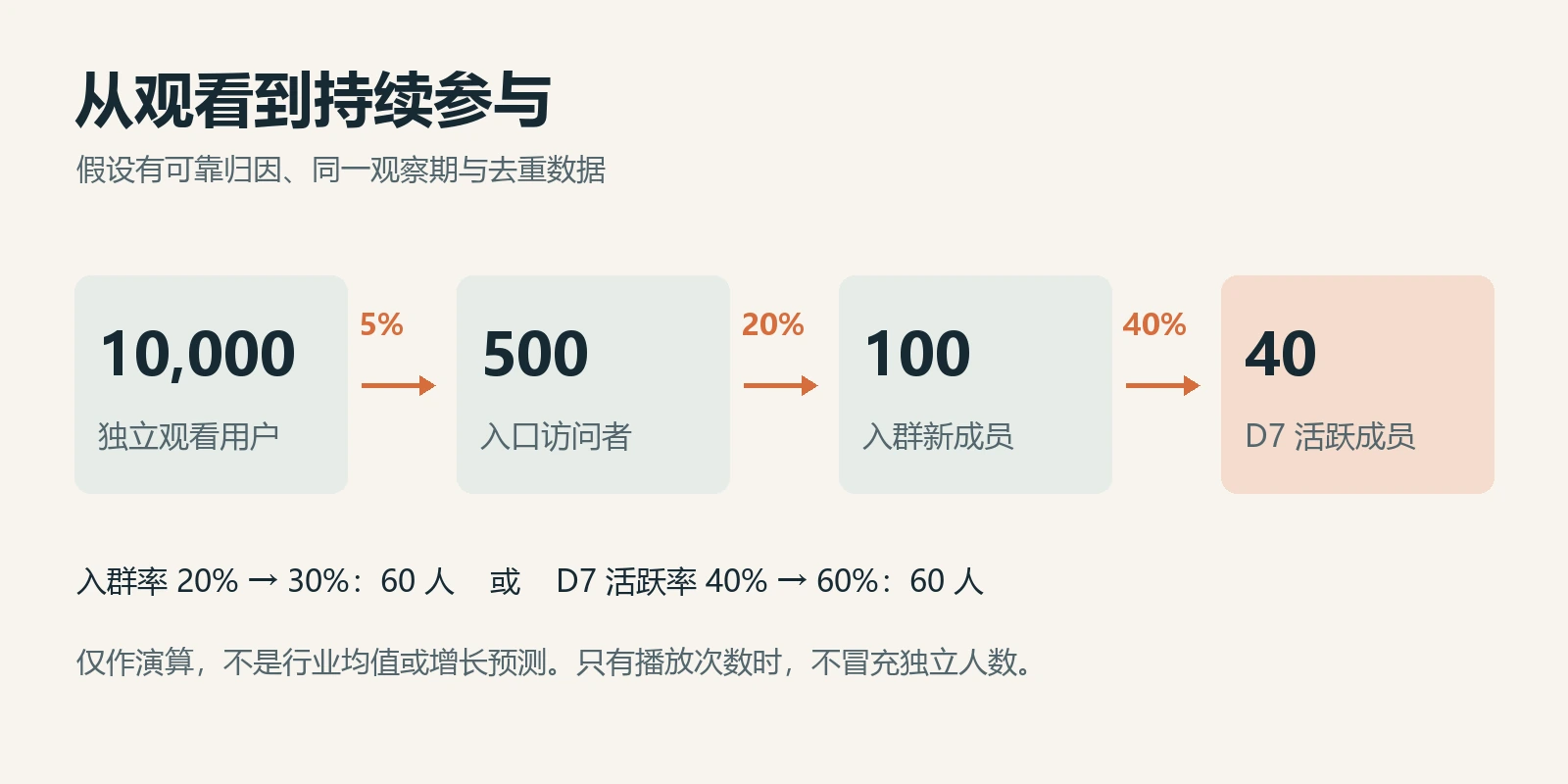
Expansion also depends on service capacity. Suppose you have 300 minutes a week for new-member support and each person requires five minutes on average. About 60 new members would use all that time. Support for existing members is additional. An automated welcome message does not eliminate subsequent support costs.
Paid amplification can be a later experiment. First demonstrate that the content attracts relevant followers and meaningful group actions. Then test actually available official advertising products with a spending limit. Decide whether to continue using an acceptable cost per meaningful member, and record paid acquisition separately. Do not promise that one ad purchase can revive an account.
7. An Automation Pipeline with Traceable Outputs
A proposed workflow:
Topic queue → source and fact cards → outline and script → asset-rights register → storyboard / voice / subtitles → automated checks → human review → authorized publishing → analytics snapshots → next topic round
Automation gains come from reuse. One piece of sourced research can become a short video, a diagram, a group reading card, and a long blog article. Reorganize each for its channel and audience, instead of mechanically pasting the same text everywhere. Make each short video explain one point clearly, with a script that corresponds to actual visuals and evidence.
| Stage | Work that can be automated | Required check before release |
|---|---|---|
| Collection | Feeds, deduplication, topic clustering, version-change alerts | Whether the source is original and acquisition and use are permitted |
| Writing | Outlines, first drafts, source lists, subtitle drafts | Key facts are supported, inferences labeled, and hands-on testing is not fabricated |
| Production | Template rendering, aspect ratios, subtitle alignment, audio-level and black-frame checks | Visuals match narration, characters remain consistent, and asset rights are traceable |
| Review | Missing sources, stale links, absent labels, unusual durations | Human review of news, history, exploration claims, and sensitive visuals |
| Publishing | Scheduling and uploading within granted platform access | Correct account, title, cover, synthetic-content declaration, and permissions |
| Analysis | Organizing permitted analytics exports, computing defined metrics, anomaly alerts | Correct attribution and denominators, without converting missing values to zero |
| Group support | Indexes, FAQs, and task reminders within authorized capabilities | Escalate disputes, privacy issues, complaints, and complex questions to a person |
There is no permanently best model or tool stack. Stabilize the inputs and outputs first: fact cards, scripts, shot lists, asset permissions, subtitles, final videos, publication receipts, and analytics snapshots. Models and editors can change while delivery interfaces and review standards remain consistent.
A reusable content record:
| |
Generated and synthetic content also requires attention to labeling. China’s “Measures for Labeling Artificial Intelligence-Generated and Synthetic Content,” issued by the Cyberspace Administration of China and other authorities, took effect on September 1, 2025. They address visible and embedded labels and users’ proactive declarations, among other requirements.[6] Preserve source and generation records, use the platform’s declaration functionality, and do not remove existing labels. With AI reconstructions of historical events, accidents, or war scenes, viewers must be able to distinguish illustrations from authentic records.
A clear automatic stop condition is useful: if a fact card lacks support, asset-use rights are unclear, human review has not passed, or publishing permission is unavailable, leave the item in the pending queue. Automation does not require lowering the review standard merely to meet an output quota.
8. Answer Five Questions Before Expanding the Next Round
- Does the same audience demonstrate similar needs across multiple videos, rather than responding to a single trending event?
- Over consistent observation windows, are viewing and follow conversion improving repeatably, with failed examples retained?
- Does the Douyin or WeChat group deliver a clear promise, and do new members take observable actions?
- Including labor, tools, promotion, and rework, is the cost per meaningful member acceptable?
- If another batch of content and members is added, can source verification, video review, and group support still be completed?
For example, suppose that after two rounds of new examples, only one video has unusually high plays, while follows and meaningful group actions have not improved alongside it. Keep that result as an individual case and continue testing at a small scale. Do not immediately reproduce it in bulk or launch a network of accounts. If several comparable videos repeatedly bring relevant followers and the group fulfills its promise, gradually increase the schedule, with cost and service-capacity limits set in advance.
If one answer reveals a clear weakness, focus next month’s experiment on that stage. Without a reliable growth baseline, complete the first round with one account, two recurring formats, one content register, and one actually available community entry point. Keep the evidence behind each decision so you know what automation should expand.
References and Evidence Limits
The following sources were consulted on October 24, 2026. Official capability pages may change; check the account’s permissions before use. The existence of a documentation page does not mean access has been granted.
- Douyin Safety and Trust Center: “Understanding Recommendation Systems from Scratch”, March 30, 2025. Supports the explanation of matching and recommendation flow, not fixed thresholds or growth promises.
- Douyin Algorithm Transparency Center. Used to verify publicly discussed mechanisms and the scope of content-understanding research, without treating explanatory model examples as a complete deployment inventory.
- Douyin Community Self-Discipline Convention. The Chinese version retrieved for this research states an effective date of October 12, 2026. Sections 32, 34, and 35 inform the boundaries around automation, redirection, and data manipulation.
- Douyin Open Platform: Overview of Mini-Program Private Messaging and Group Chat Capabilities. Explains applications for group-management, group-message, and private-message permissions; it does not establish that ordinary personal accounts have access.
- Douyin Open Platform: Proactive Private Messaging for Mini-Programs. Explains conditions including a business-owned mini-program, an operator account, and proactive user authorization.
- Measures for Labeling Artificial Intelligence-Generated and Synthetic Content, the Chinese government’s reproduction of the CAC’s full text. Dated March 7, 2025; effective September 1, 2025. Article 10 concerns user declarations and labeling.
- WeChat External Link Content Management Specifications. The page states that it was updated and took effect on October 23, 2025. Section 2.1 concerns incentivized sharing; this is not interpreted as a ban on all voluntary sharing.
- Tencent WeChat Software License and Service Agreement. Section 8.2.1.6 concerns unauthorized third-party tools and automated operations. A separate version publication date was not established in this research.
This article does not rely on course-sales claims about account-launch thresholds, unverified viral success stories, or forecasts of account growth and earnings. The experiment templates, funnel parameters, service-hour estimates, and publishing cadence are proposals in this article, not reverse measurements of platform mechanisms.