
DoorDash Launches SMS-Based AI Ordering Assistant
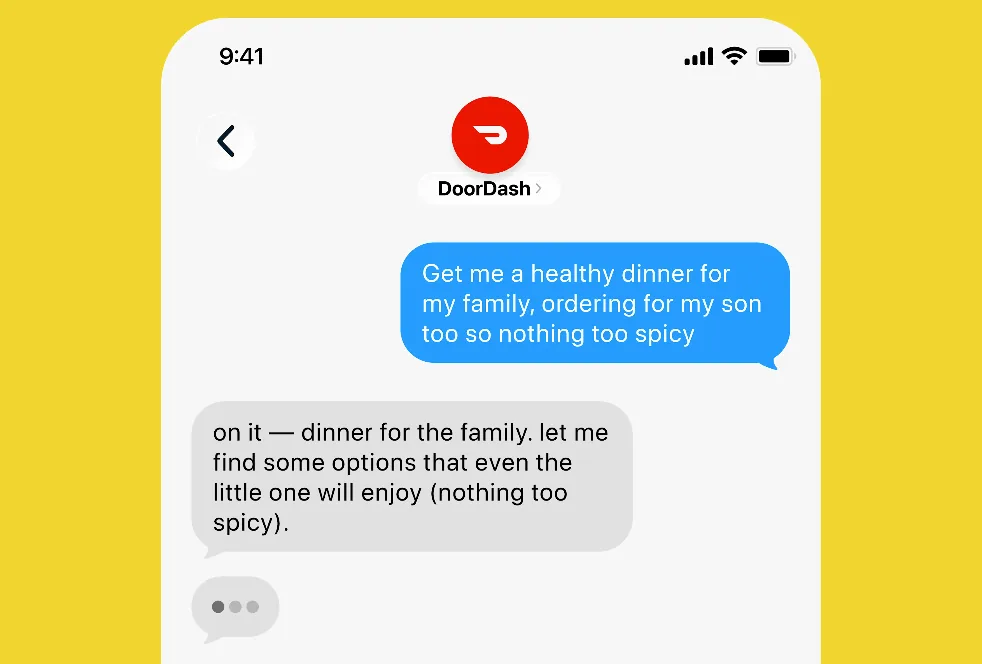
On September 30, DoorDash officially launched an AI ordering agent that interacts via text message, allowing users to place delivery orders by chatting directly with the system through Apple Messages. The feature is currently in beta, with U.S. users able to join a waitlist for early access.
Key details:
- Launch date: September 30, 2026
- Available channel: Apple Messages (iOS users)
- How to access: Join the waitlist on the official website
- Feature scope: Personalized recommendations, group order management, and local restaurant search
Natural Language Interaction: From “Order My Usual” to Mixed Orders

The agent’s core capability lies in understanding casual, conversational language. A user can simply text “order my usual” and the system will identify their recurring Friday night order and re-place it automatically. This semantic understanding bypasses the layered menu navigation of traditional apps.
DoorDash emphasizes that users can also request specific dishes or ask for local recommendations. The agent performs three actions: searches for nearby restaurants matching the criteria, generates a recommended menu based on the user’s needs, and sends real photos of the recommended dishes directly via text message.
For group dining scenarios, the system supports mixed order processing. Users can communicate multiple people’s ordering needs in a single message — for example, “Zhang wants a vegetarian stir-fry, Li wants a double spicy burrito, and I’ll take a classic burger” — and the AI will integrate different dietary preferences and quantity configurations to compile the order.
Core Strategy: Differentiated Competition and Delivery Technology Advancing in Tandem

The launch of this AI assistant is clearly aimed at countering competitive pressure from Uber Eats and Grubhub. Market analysts have long noted that user retention costs for food delivery platforms are climbing, and DoorDash is attempting to build a moat by lowering the barriers to user decision-making and operation — the traditional ordering path requires opening the app -> entering keywords -> browsing menus -> secondary filtering -> confirming selections, whereas the new flow compresses all of that into a single conversation.
Notably, the AI assistant does not require a standalone app installation. Instead, it is built on top of Apple Messages, a platform users already use extensively. This “zero additional installation” design eliminates the user learning curve, but it also raises challenges for cross-platform compatibility (such as Android Messaging). DoorDash has not yet announced a deployment timeline for Android.
On the same day, DoorDash announced that it would begin autonomous drone delivery testing at selected restaurants in Northern California. This marks the second phase of its unmanned logistics network: ground-based robots have already been piloted in certain gated communities, while aerial delivery will expand to suburban multi-story residential areas.
Technical Background: What Is an “AI Agent”?
Here, “agent” refers to an AI system capable of goal decomposition and tool invocation. Unlike traditional chatbots that passively respond to questions, an agent can proactively:
- Receive semantic instructions and break them down into components (e.g., time, location, cuisine type)
- Query the order database to match user history and behavior
- Initiate external API calls to look up nearby restaurants and menu information
- Generate multi-step execution plans and continuously track feedback
Who Should Try It?
Recommended to try now:
- iOS users who primarily reside in urban areas (reliant on local restaurant data coverage)
- Frequent repeat orders of fixed meal combos (the system’s “identify usual” feature depends on high-frequency historical orders)
- Those who don’t mind non-real-time responses (text message interaction involves gateway processing delays)
Recommended to wait:
- Those who frequently order from niche restaurants (specialty or non-platform-registered merchants may have insufficient coverage)
- Those with strict time-sensitive needs (both drones and the AI assistant are in beta)
- Android users (no明确的 adaptation timeline available)
Final Thoughts
The food delivery industry has shifted from price-subsidy competition to service-efficiency competition. AI agents are elevating the act of ordering from “in-app browsing” to “conversational service,” which could reshape the interaction paradigm of the mobile internet era. However, long-term effectiveness still depends on the depth of local merchant supply and the authenticity of food photos — the former determines coverage breadth, and the latter affects the user trust threshold.