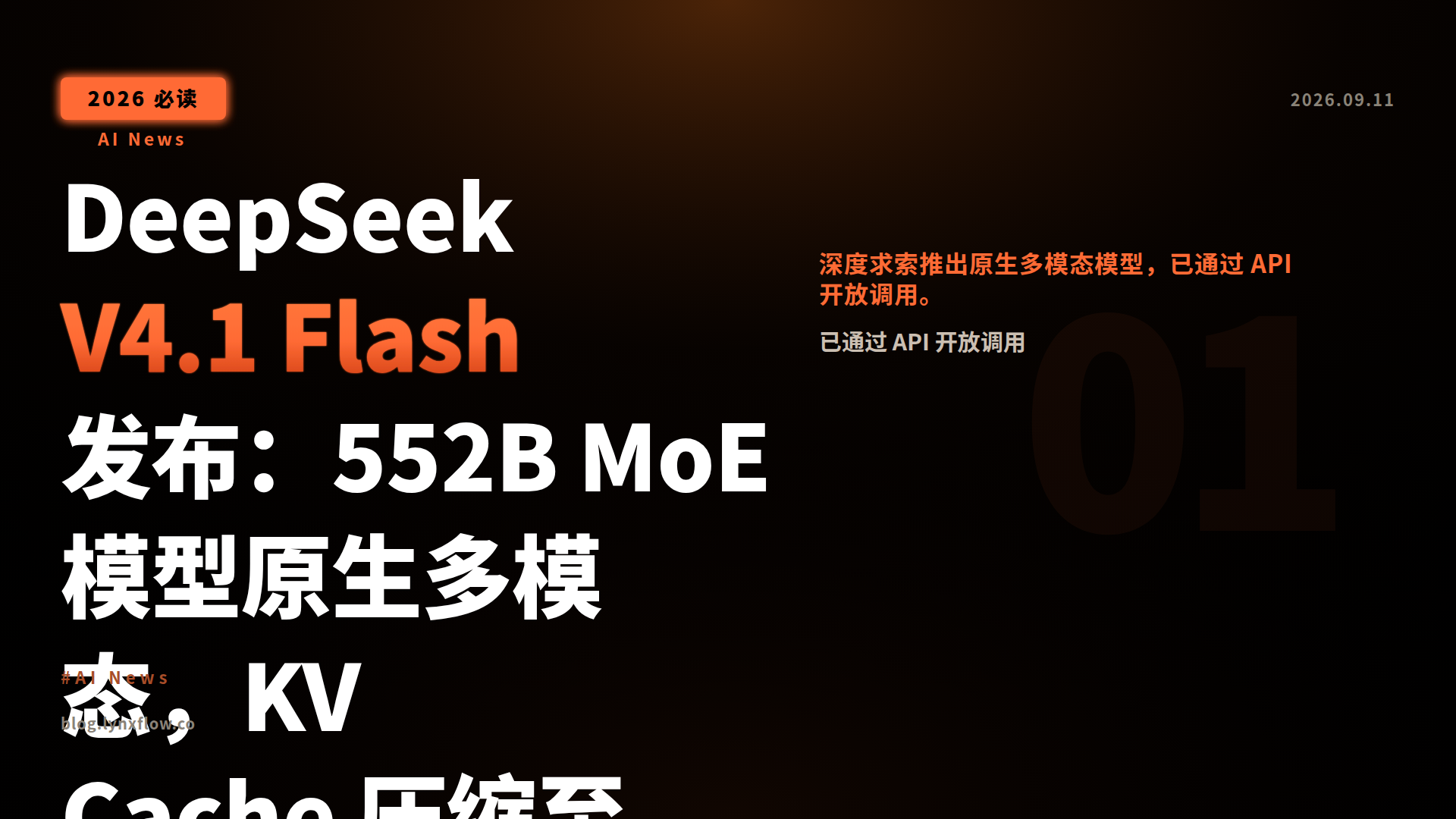
DeepSeek V4.1 Flash Officially Released with Upgraded Multimodal Capabilities
On September 10, DeepSeek officially released the DeepSeek V4.1 Flash model. As the smallest member of its new model architecture series, it features native multimodal visual understanding capabilities and is now available through the DeepSeek API. Users can switch the model name to deepseek-flash to access the latest V4.1 Flash.
Key details:
- Model type: 552B parameter MoE (Mixture of Experts) model
- Activated parameters: 8B for input activation, 16B for output activation
- Architecture: Causal-Encoder-Decoder asymmetric structure
- Performance: Following new pretraining and larger-scale reinforcement learning post-training, it surpasses multiple flagship models including DeepSeek V4 Pro in benchmark tests
- Storage requirements: Compared to the previous generation, HBM requirements are reduced to 1/4 and SSD requirements to 1/8
- Compatibility: V4 Flash and V4 Flash Vision Exp have been taken offline; the original model names will temporarily route to V4.1 Flash
Architecture and Performance: Focused on Cost and Throughput Efficiency
The Causal-Encoder-Decoder architecture of V4.1 Flash is designed to push the capability ceiling, improve inference speed and throughput, and scale to larger parameter sizes. Its input and output employ an asymmetric design: only 8B parameters are activated for input, while 16B are activated for output, aiming to reduce inference costs for models of comparable scale.
Another key highlight is KV Cache compression. According to information released by DeepSeek, V4.1 Flash reduces HBM requirements to 1/4 and SSD requirements to 1/8 compared to the previous generation; relative to the first-generation model, the KV Cache is reduced to 1/437 of its original size.
For Agent-type tasks, the cost of context cache hits is typically a significant component of overall usage costs. A smaller KV Cache is expected to lower resource overhead for workloads such as long-chain tool calls and continuous context processing, while also reducing storage pressure on the deployment side.
Disclosed Model Information
| Item | DeepSeek V4.1 Flash |
|---|---|
| Total parameters | 552B MoE |
| Input activated parameters | 8B |
| Output activated parameters | 16B |
| Multimodal capability | Native multimodal visual understanding |
| Architecture | Causal-Encoder-Decoder asymmetric structure |
| API call name | deepseek-flash |
| Legacy model compatibility | deepseek-v4-flash and deepseek-v4-flash-vision-exp temporarily route to the new model |
Applicable Scenarios and User Recommendations
Users who may want to prioritize evaluation:
- Developers and enterprises that need to handle multimodal tasks such as image-text input;
- Teams that are cost-sensitive regarding inference and context caching and run long Agent workflows;
- Researchers looking to test new model architectures and multimodal capabilities via API.
Key items to validate before deployment:
- Actual accuracy and stability on your own business data, tool-calling chains, and long-context tasks;
- Impact on existing service behavior and costs when migrating from legacy model names or using compatibility routing;
- Recognition quality and safety boundaries of multimodal inputs in specific business scenarios.
Final Thoughts
V4.1 Flash demonstrates another important path in the large model competition: beyond scaling up parameters, model architecture, activation efficiency, and context cache optimization directly impact real-world usage costs. For users who frequently invoke models, process long contexts, or run Agent workflows, the value of such engineering optimizations may be just as important as improvements in benchmark scores.