
Another Update After Just Over a Month: V4.1-Flash-1017 Goes Live
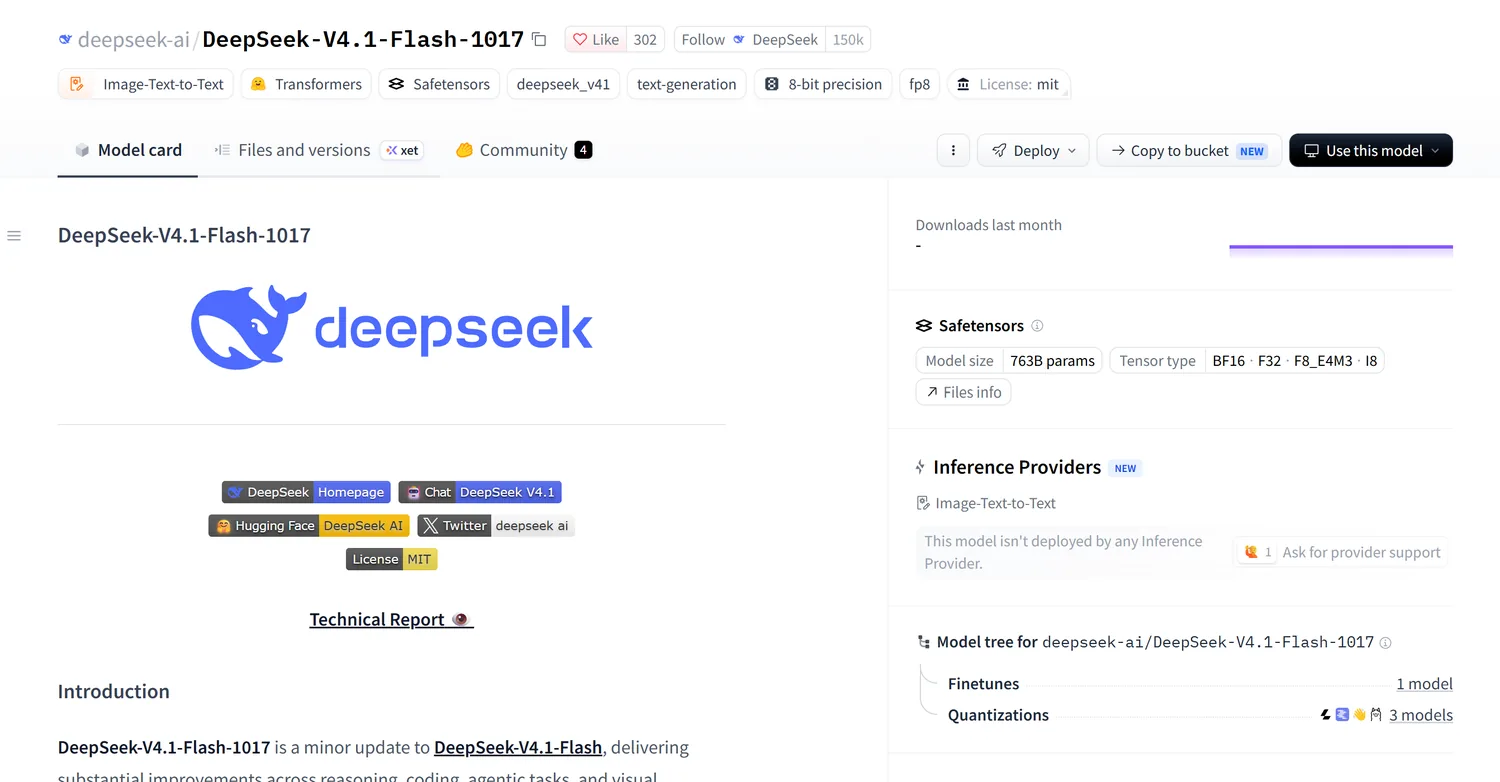
On October 17, DeepSeek updated V4.1 Flash to V4.1-Flash-1017. The official web interface, App, and API switched over simultaneously, and the model weights are now available for download on HuggingFace and ModelScope. The key facts are as follows:
- Release date: October 17
- New version: V4.1-Flash-1017; the previous version, V4.1-Flash, was released on September 10—just over a month earlier
- Availability: launched simultaneously on the official web interface, App, and API
- Weights: available for download on HuggingFace and ModelScope
- New APIs: the in-house search APIs Search (search) and Fetch (fetch) are now open to the public, both priced at 5 yuan per 1,000 calls
- Companion tool: DeepSeek Harness was updated to 0.2.1 at the same time; the official recommendation is to upgrade to 0.2.1-rc.1 or above
This update focuses on performance, task execution efficiency, and full project development capabilities. DeepSeek says that compared with the previous version, the new model improves on multiple benchmarks while shortening task runtime and output length, letting users complete tasks at lower cost and faster speed.
Pass Rate of 77%—Yet Cost Falls by 60%
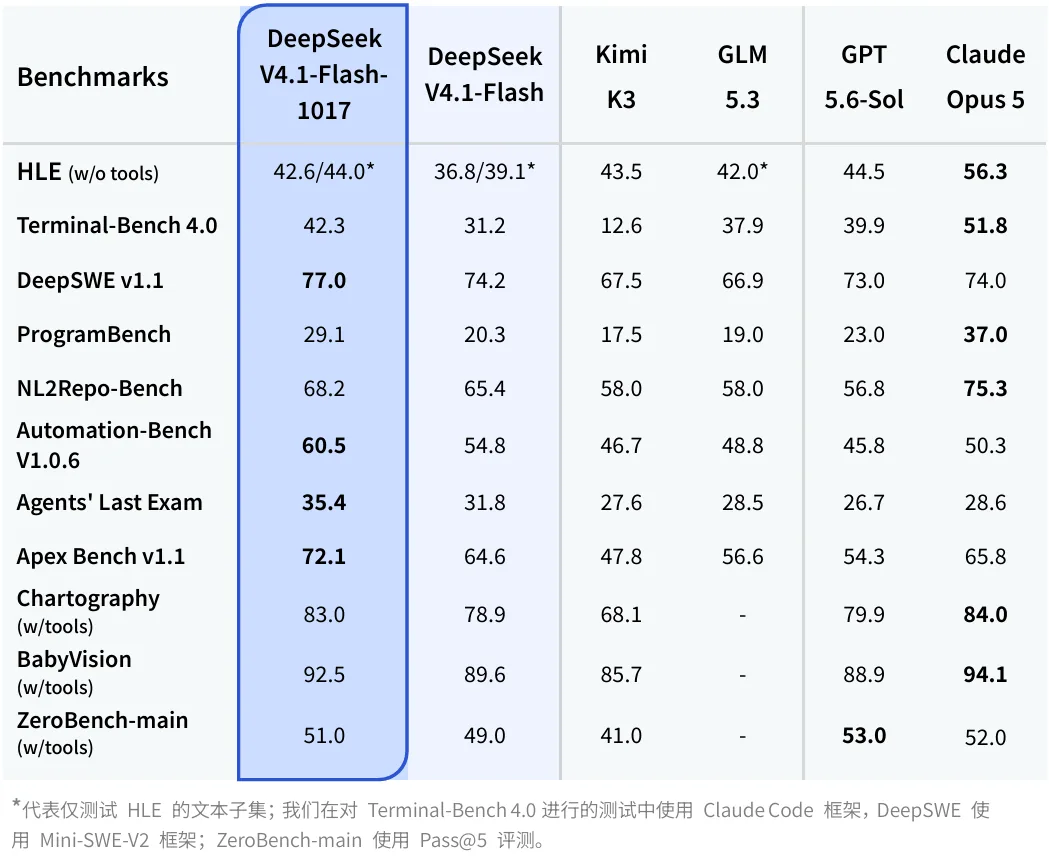
In the DeepSWE v1.1 test, the new model’s max tier achieved a 77.0% single-task pass rate, up 2.8 percentage points from the previous version, surpassing models such as GPT-6 Astra, GPT-6.1 Sol, Gemini 3.8 Flash, and Claude Opus 5. DeepSeek also says that in four tests—DeepSWE for software engineering ability, Automation-Bench for business automation, Agents Last Exam for complex task execution, and Apex Bench for professional knowledge work—the new model leads Kimi K3, GLM 5.3, GPT 5.6-Sol, and Claude Opus 5.
The most counterintuitive figure isn’t the pass rate—it’s the price: the average cost per task fell from about 3.3 yuan to about 1.3 yuan, a drop of roughly 60%. In other words, capability improved while per-task cost fell sharply. DeepSeek says the new model achieves a new “performance-cost Pareto optimum” across multiple Harness setups (scheduling frameworks for running and evaluating models), delivering better task performance at lower cost.
Another contrast in timing: just two days before the release, on October 15, DeepSeek suffered an API service outage lasting nearly 5 hours. After service was restored, the company apologized and announced a compensation plan, refunding users’ usage charges from October 8 to 14 in full as bonus credits, automatically deposited into their accounts. During the outage, some netizens speculated that a new model might be coming. Now that V4.1-Flash-1017 has officially launched, some commenters say DeepSeek has been “secretly making progress behind our backs.”
Developer feedback is also spreading. One overseas developer says the new model runs at 244 tokens per second, faster than GPT-6.1 Sol’s ultra-fast mode, while offering intelligence comparable to GPT-5.6 Sol. Others say, “This model could just be renamed DeepSeek-V4.2-Pro.”
In terms of coding ability, the new model was trained via self-feedback reinforcement learning (RL, where the model uses its own outputs to train itself), enhancing its ability to build complete projects from scratch across scenarios such as game development and 3D modeling. So-called “wish-driven” programming means users describe what they want in natural language, and the model breaks it down and completes the project with fewer prompts and fewer interaction turns. The official examples include 3D modeling of the Forbidden City and a browser-based racing game. A netizen’s “pelican riding a bicycle” made with the new model has a complete overall composition and harmonious colors, but local structures still have flaws—the boundary between the bicycle seat and the pelican’s body is unclear, and the connection between the feet and pedals is not natural enough.
Version and Price Comparison
| Item | V4.1-Flash-1017 | Previous version V4.1-Flash |
|---|---|---|
| DeepSWE v1.1 max-tier single-task pass rate | 77.0% | Up 2.8 percentage points |
| Average cost per task | About 1.3 yuan | About 3.3 yuan |
Search is another focus of this update. DeepSeek says its search has indexed hundreds of billions of web pages worldwide, handles hundreds of millions of search requests per day, supports multiple languages, and filters out SEO cheating, GEO manipulation, and low-quality AI-generated content.