
Web, App, and API all switch models together, with no change to how they are invoked
On October 17, DeepSeek updated DeepSeek V4.1 Flash to the V4.1-Flash-1017 version, and the official web, App, and API have all switched to the new model in sync. The concrete facts are as follows:
- Version: V4.1-Flash-1017, a minor version update on the V4.1 Flash model line
- Release date: October 17, 2026; takes effect simultaneously across web, App, and API
- Pricing and invocation method: unchanged; the API still accesses the latest model under the name deepseek-flash
- Weights: now available for download on HuggingFace and ModelScope, continuing under the MIT license
- Companion tooling: DeepSeek recommends upgrading DeepSeek Harness to 0.2.1-rc.1 or later for full compatibility
For developers, the most convenient part of this update is that “you don’t need to change anything”: the model identifier is unchanged, the price is unchanged, requests go out as usual, and what comes back is the new version. Putting a date (1017) in the model name is also common during rapid iteration—the endpoint name stays stable while backend weights are rolled over by date. The trade-off is that the same endpoint may be backed by different models at different times.
Performance up, time down, but one number doesn’t line up
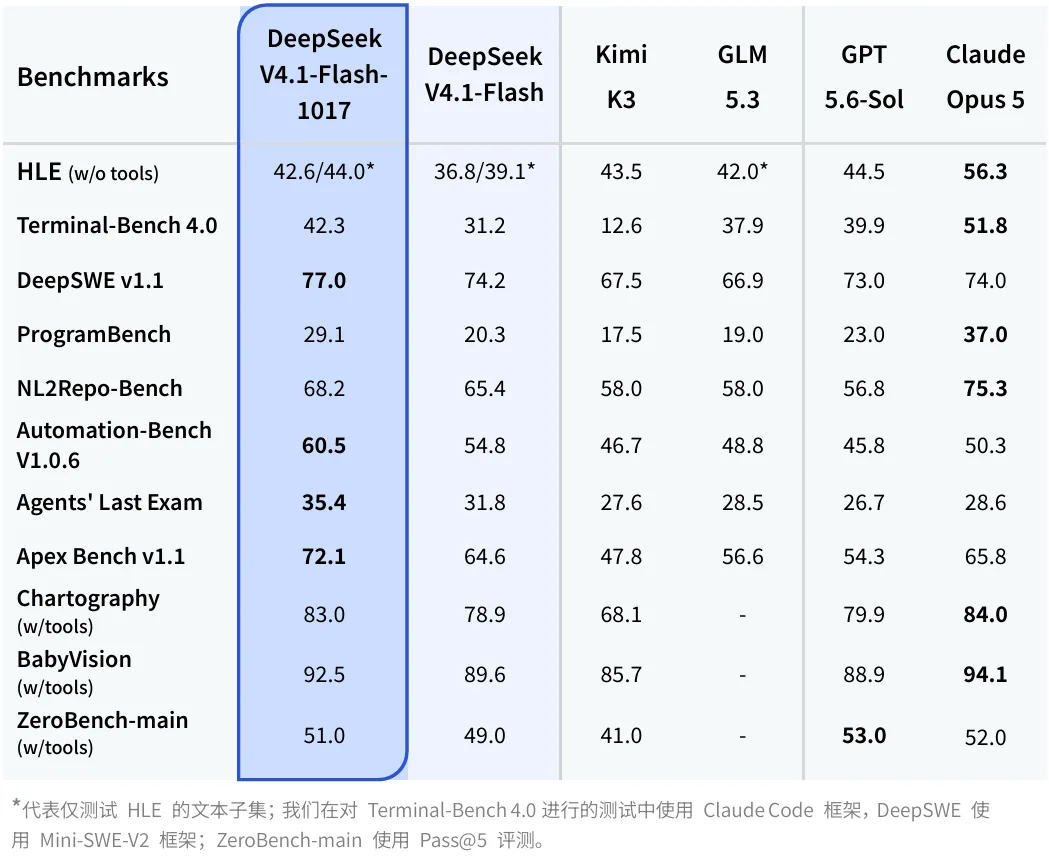
DeepSeek characterizes this update as a “Pareto improvement”: an economics term meaning making at least one party better off without making any party worse off. In this context, it means model capability improves while the overall cost per call drops. Overall cost is mainly made up of two parts—task runtime and output length—and DeepSeek says both have been reduced.
The benchmark results released with the update are as follows:
- HLE (w/o tools, i.e., without calling external tools): 42.6 (44.0)
- Terminal-Bench 4.0: 42.3
- DeepSWE v1.1: 77.0
- ProgramBench: 29.1
- NL2Repo-Bench: 68.2
- Automation-Bench v1.0.6: 60.5
- Agents’ Last Exam: 35.4
- Apex Bench v1.1: 72.1
- The three with tool calling: Chartography 83.0, BabyVision 92.5, ZeroBench-main 51.0
There is a contrast worth noting here: the HLE (no tools) row says 42.6 (44.0). The source material does not say which version the 44.0 in parentheses belongs to. If it refers to the previous V4.1 Flash, then this item did not rise in the new version, but declined—which does not fully match the official claim that “model capability across benchmarks shows a clear improvement over the previous version.” In addition, the source material provides only a single set of scores for the new version, with no complete old-version comparison, so verifying the magnitude of the improvement item by item is not possible with this material.
On the capability front, DeepSeek highlighted one change: through reinforcement learning training based on self-feedback (letting the model evaluate its own outputs and adjust its strategy accordingly, reducing reliance on human annotation), the model’s ability to “build complete projects from scratch” has been strengthened, covering scenarios such as game development and 3D modeling.
This leads to another official claim—“wish-driven” programming, meaning directly generating runnable project outputs under extremely limited prompts and reference materials. The official demo shows that, in the DeepSeek Harness environment, the new version completed a full project setup in very few interaction turns. It should be noted that this description comes from official sources, and the source material does not provide reproducible third-party evaluation details.
On compatibility, DeepSeek specifically optimized for platforms such as DeepSeek Harness, Tencent CodeBuddy, and WorkBuddy, so users of these tools can get fuller capabilities after upgrading their client versions.
Who should switch immediately, and who should wait
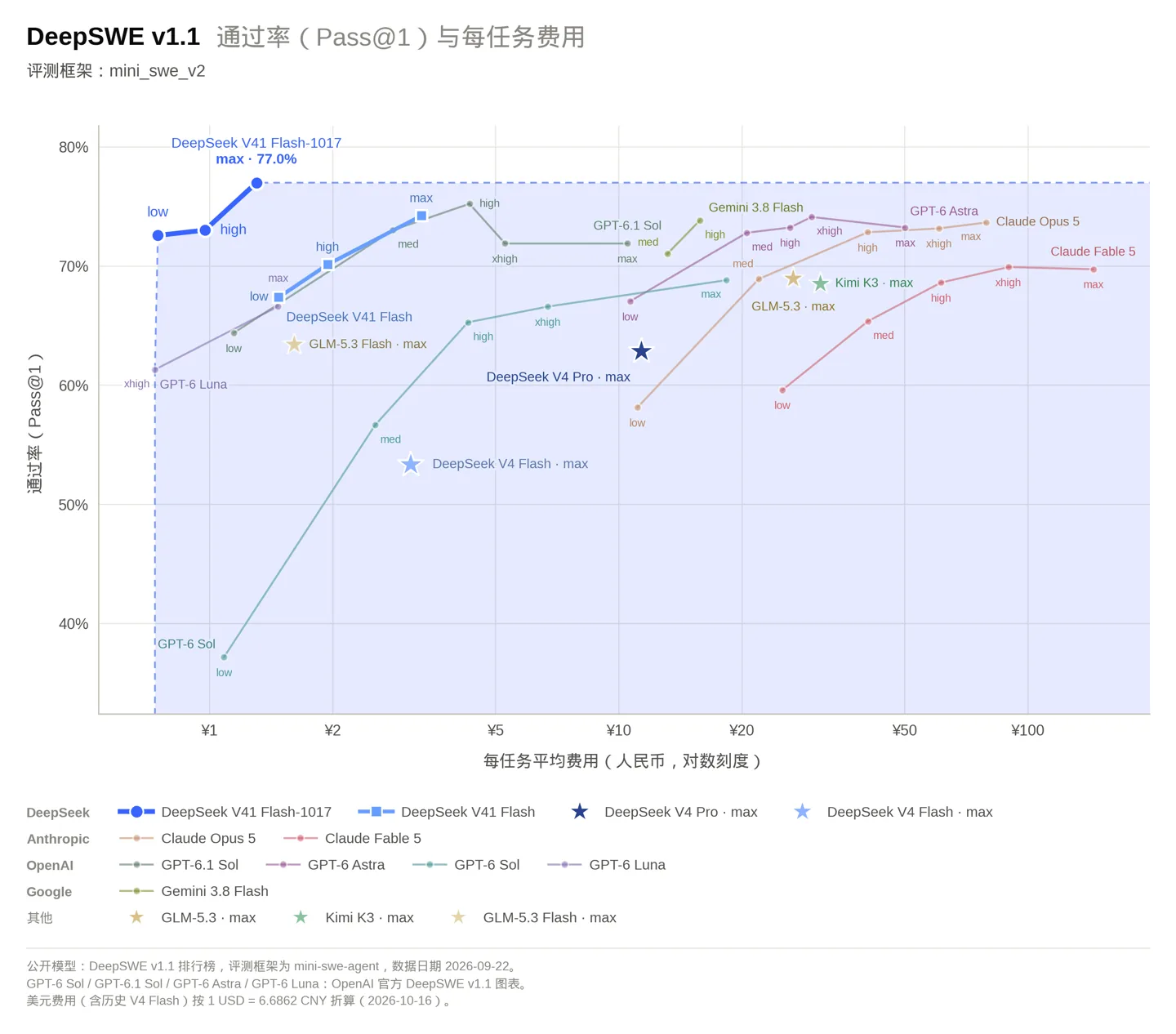
Switch immediately if: you are a developer calling deepseek-flash via the API. The model name and price are unchanged, so the switching cost is close to zero. You can first run one or two real tasks to compare whether runtime and output length actually drop. Wait if: your team has written model behavior into regression tests and needs reproducible versions. A fixed endpoint name with backend rolled over by date means the online model will keep changing. Rather than passively accepting that, it is better to first keep a baseline on your own evaluation set. Users still on an older Harness version should also upgrade to 0.2.1-rc.1 or later before evaluating the results.
Final Thoughts
Improving both performance and cost at the same time is the most tangible part of this minor update. But benchmark figures are ultimately official numbers, and the parentheses in the HLE row are a reminder that a single score set is not the same as a version comparison. Whether it is worth adjusting your workflow for it ultimately depends on how those tasks in your own business perform.