
Nearly 5-hour outage: 8:11 to 13:04

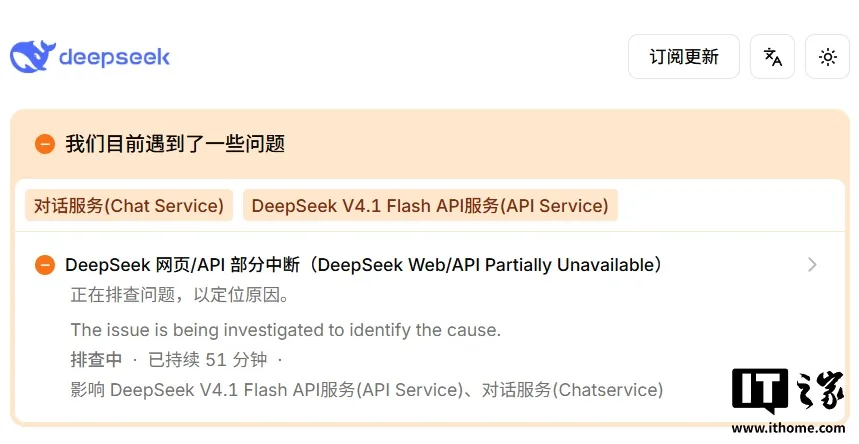
On October 15, 2026, DeepSeek’s web and API services experienced an outage, and users received a “server temporarily unavailable” message when trying to chat. That day, the DeepSeek Open Platform published a service restoration and compensation notice, confirming that service had been restored and setting out a compensation plan for API users.
The hard facts are as follows:
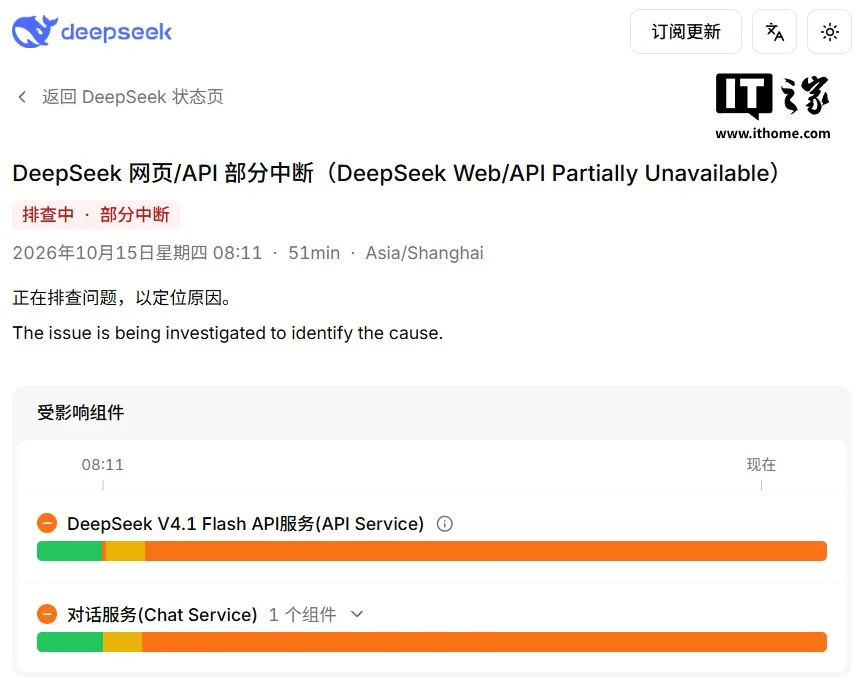
- Outage window: Beijing time, October 15, 2026, 8:11 to 13:04; officially described as “nearly 5 hours” (approximately 4 hours 53 minutes by actual duration).
- Scope of impact: web and API services. The official status page at one point showed “partial outage of web/API services”; when IT之家 reported at 9:06 that day, it noted that the outage had lasted more than 50 minutes.
- Eligible recipients: all API users, with no differentiation by plan tier or region.
- Compensation basis: based on the account’s usage charges within 7 days (the notice text reads “10.8…”, i.e., from October 8).
- Official commitment: immediately launch a comprehensive investigation and thorough overhaul focused on service stability, and comprehensively review and eliminate “single-point dependencies.”
Two terms deserve a one-sentence explanation: a “single-point dependency” is when a link in the system is supported by only one path or one component; if it fails, the entire chain goes down. “SLA” (Service Level Agreement) refers to the provider’s commitment to availability and the compensation terms for breaches. The official notice did not mention SLA compensation; the compensation was given separately in the form of an announcement.
A 5-hour outage, 7 days of usage compensated
The most noteworthy aspect of this compensation is not the amount, but the mismatch in basis: the outage lasted about 5 hours, yet the compensation covers 7 days of account usage.
Under common practice, service outage compensation usually takes two forms: one is prorating by duration, such as “outage for X hours, compensation for X hours or a multiple of that duration in credits”; the other is issuing fixed-value vouchers, decoupled from the user’s actual usage. DeepSeek instead used “7-day usage” directly as the basis, which amounts to refunding the previous week’s API spend in full. For teams with heavy usage, this is real money, not a token voucher.
It should be noted that the notice did not specify when the compensation will be credited, whether users need to apply manually, or the exact cut-off of the 7-day window—the original text is truncated at “10.8”. Users can only verify these details themselves in the Open Platform console.
| Item | Details |
|---|---|
| Outage window | 2026-10-15 8:11–13:04 (Beijing time, approx. 4 hours 53 minutes) |
| Affected services | Web, API services |
| Eligible recipients | All API users |
| Compensation basis | Account usage charges within 7 days (notice text says from 10.8) |
Advice for two types of readers
Heavy API users: reconcile your account first. Open the Open Platform console and check your usage records from October 8 to now and whether the compensation has been credited; if you ran batch jobs or stress tests this week, the compensation amount may be considerable, and it is worth confirming whether it is the full amount. Also keep the official notice and ticket records as a basis for follow-up communication.
Teams that place DeepSeek in critical paths and have hard availability requirements: consider waiting. Five hours of unavailability means a single-vendor setup ties business availability to this one provider. Until the official “eliminate single-point dependencies” overhaul has clear results—or at least until you have observed a period of stable operation—configuring a fallback route to a second provider, timeout retries, and degradation plans for critical tasks is more practical than waiting for compensation. Individual users and light callers in non-critical scenarios are barely affected; just keep using it as needed.
Final thoughts
Compensating based on 7-day usage rather than prorating by duration shows that the vendor is more willing to “give more” in exchange for users’ confidence in stability. But compensation is always after the fact; five hours of unavailability is already an incident for production systems. Whether the overhaul promise is fulfilled will depend on how often similar outages occur in the coming period.