
The Tab I Owe from Last Time
The last post, “After the Wheelchair Blew Up,” ended with three routes: the foundation, the hard core courses, and using your own machine as the battlefield. After publishing that piece, I got a question—one that I asked myself: “What about time?”
A route without time is just a wish. This post pins the time down.
First, Acknowledge Three Constraints
Before laying out the schedule, admit three things—or the schedule is just self-deception:
- I’m a night owl. My peak is 22:00–24:00, the morning is a secondary peak, and roughly 11:00–18:00 is dead time. This isn’t self-assessment; it’s what 86 days of behavioral logs tell me.
- The daily deep work ceiling is 4–5 hours. Going beyond that isn’t diligence—it’s debt tomorrow.
- The bulk of those 4–5 hours goes to the main track. The project that feeds me doesn’t yield space; tutoring sessions certainly don’t.
Conclusion: CS study gets a fixed 22:00–23:30, 5 nights a week. This time was previously spent scrolling on the phone; now it goes to building circuits. Nobody loses anything. 7.5 hours a week doesn’t sound like much—but over sixteen months that’s well over five hundred hours, enough to demolish the foundation and all three hard core courses.
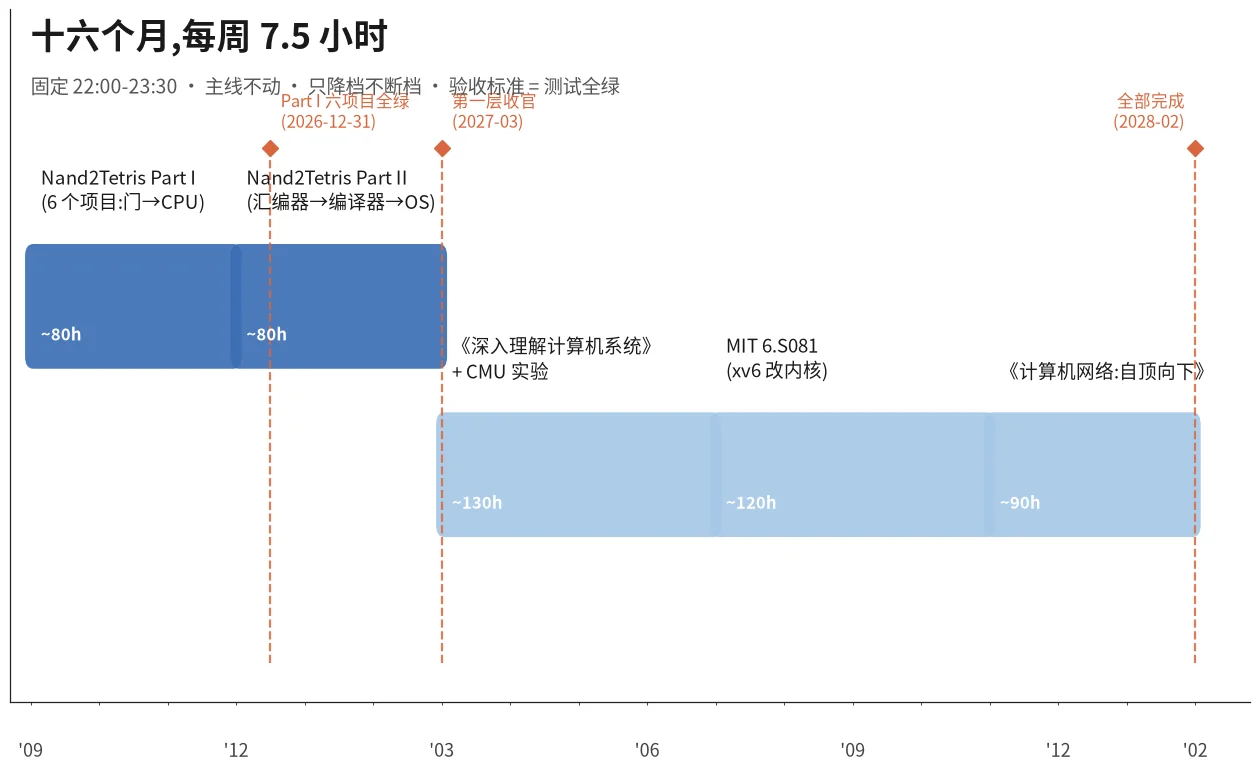
The Schedule
| Phase | Content | Window | Cumulative |
|---|---|---|---|
| Foundation · Part 1 | Nand2Tetris Part I (6 projects) | Sep 2026 → mid-Dec | ~80h |
| Foundation · Part 2 | Nand2Tetris Part II (6 projects) | mid-Dec 2026 → Mar 2027 | ~80h |
| Hard Core · One | Computer Systems: A Programmer’s Perspective + CMU labs | Mar 2027 → Jul | ~130h |
| Hard Core · Two | MIT 6.S081, modifying xv6 kernel | Jul 2027 → Nov | ~120h |
| Hard Core · Three | Computer Networking: A Top-Down Approach | Nov 2027 → Feb 2028 | ~90h |
The Next Three Months, at the Project Level
Distant phases get a line; the near ones get detail. Nand2Tetris Part I has six projects, each given a two-week buffer:
- Mid-Sep → end of Sep: Project 1, Boolean Logic. Build Not, And, Or, and Mux from NAND gates.
- October: Project 2 Arithmetic, Project 3 Sequential Logic. From adders to ALUs, from flip-flops to RAM.
- November: Project 4 Machine Language, Project 5 The Full Computer. Project 5 is the hardest gate in Part I—hand-assembling a CPU.
- First half of December: Project 6, writing your own assembler. Then leave two weeks of buffer to catch up on anything missed.
The acceptance criterion is one: all official tests turn green. Schedules measured in weeks are for robots; schedules measured in test passes are for humans.
Three Anti-Collapse Rules
The biggest enemy of self-study isn’t difficulty—it’s interruption. Here are three rules:
- Downshift, never stall. When the main track gets busy, the CS block goes from 5 nights to 2. When things settle, you pick it back up. Downshifting is changing gears; stalling is killing the engine.
- If you’re stuck for more than two hours, read the solution. Then close it and redo the project yourself. The goal is to ship the lab, not suffer.
- If you miss two weeks in a row, reschedule—don’t quit. I set this calendar; it isn’t fate.
Tonight
Start at 22:00: install the toolchain, fill in And.hdl for Project 1.
If the And gate test passes green tonight, we call it a win.
See you in sixteen months. By then, the comments on this post—if there are any—should be able to grade a piece of work that goes all the way from NAND gates to the network layer.