
Core Event
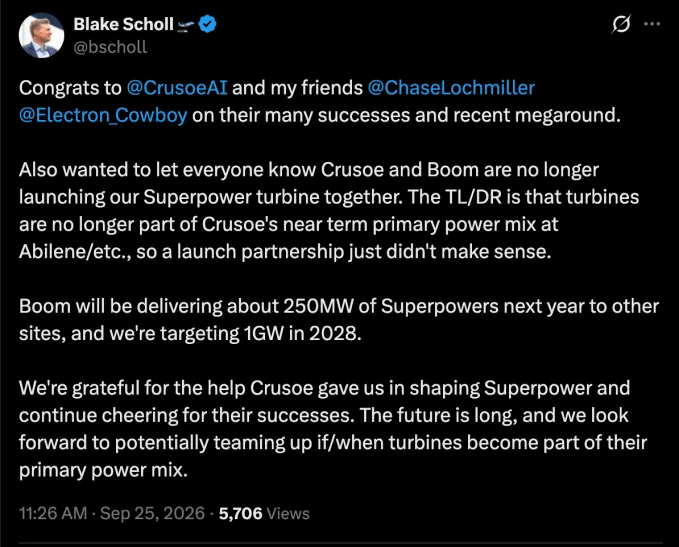
On September 25, 2026, AI data center company Crusoe confirmed the termination of its $1.25 billion turbine purchase agreement with fellow Denver-based Boom Supersonic. Boom CEO Blake Scholl announced the partnership termination on X, stating turbines are no longer part of Crusoe’s near-term primary power mix.
Key facts:
- Deal value: $1.25 billion
- Units ordered: 29 Boom Superpower turbines
- Single unit capacity: 42 megawatts (MW)
- Original delivery start: 2027
- Current status: Deal terminated; Crusoe confirmed “no longer doing business with Boom”
Background and Cancellation
Crusoe, founded in 2018 as a Bitcoin miner utilizing excess natural gas from oil fields, has evolved into one of the largest AI data center builders in the U.S., operating major campuses in Abilene, Texas that power OpenAI and Oracle workloads.
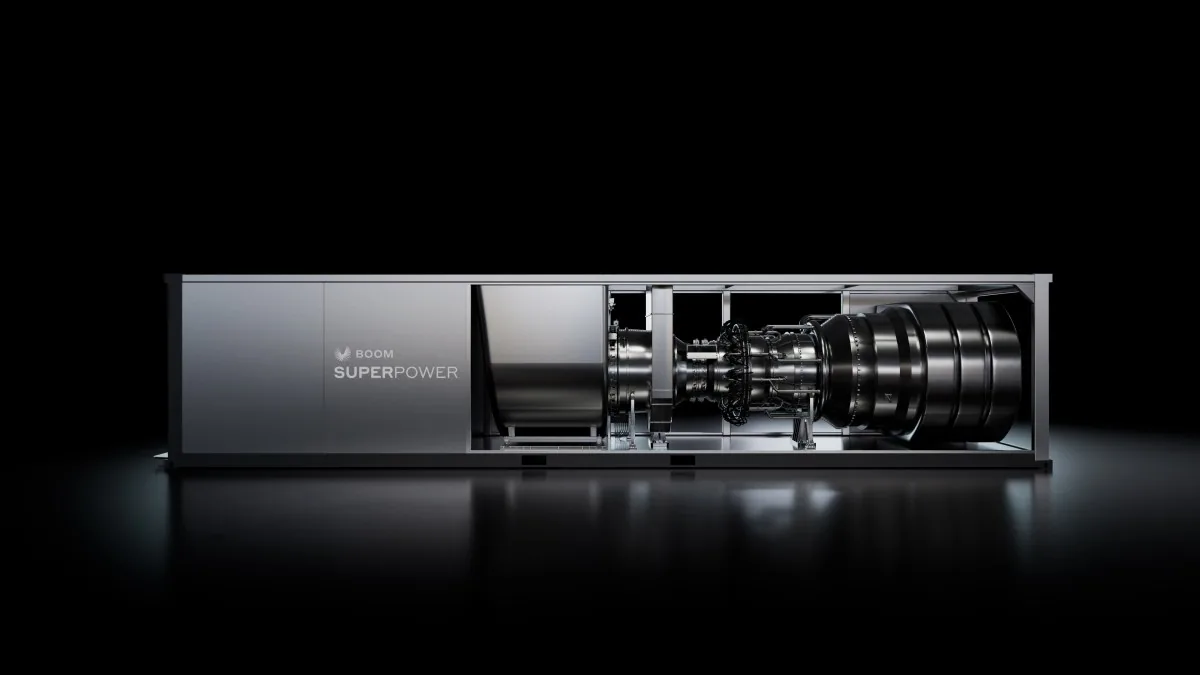
Boom Supersonic, while developing its Overture supersonic passenger jet, launched a stationary power plant business in 2025. Its Superpower turbine shares about 80% of parts with the airborne Symphony engine.
Crusoe was originally signed as the launch customer for this business. However, Scholl stated on X: “Turbines are no longer part of Crusoe’s near term primary power mix at Abilene/etc., so a launch partnership just didn’t make sense.”
Notably, Boom expects to deliver approximately 250MW of Superpower units in 2027 to other sites, with a 1GW target for 2028.
A key contextual counterpoint: Crusoe’s initially announced 1.2GW Abilene data center (for Oracle and OpenAI) is actually grid-powered, with gas turbines serving only as backup. Meanwhile, its 900MW Microsoft campus in Abilene is designed to run on onsite gas turbines—demonstrating Crusoe’s site-specific energy selection rather than one-size-fits-all deployment.
Crusoe’s flexible energy strategy

Crusoe spokesperson Andrew Schmitt told TechCrunch: “We build AI factories from the power up… as our portfolio grows, we stay flexible, choosing the energy solutions that are right for each site as its needs evolve — including turbines, along with wind, solar, batteries and the grid.”
This approach reflects a strategic pivot toward dynamic sourcing: rather than committing to a single vendor’s technology, Crusoe evaluates options per site based on actual requirements, grid access, and local energy resources.
For Boom, losing its anchor customer is a setback. The company raised $300 million last year largely to commercialize its stationary power business, with the stated goal of using these profits to fund Overture development. Overture is designed for 55 passengers with a 5,500 km range.
Energy solution comparison (based on deal terms)
| Item | Superpower turbine (Boom) | Note |
|---|---|---|
| Single unit capacity | 42 MW | Shares ~80% parts with Symphony engine |
| Planned quantity | 29 units | Total ~1218MW |
| Total contract value | $1.25 billion | No itemized pricing disclosed |
| Original delivery start | 2027 | Deal cancelled, no delivery planned |
Reader recommendations
- Suitable for: Investors and AI infrastructure developers tracking data center energy trends; monitor both Crusoe’s alternative solutions and Boom’s remaining customer progress;
- Wait and watch: Companies seeking gas turbine solutions should await actual 250MW delivery and operational data from Boom’s other sites in 2027;
- Watch closely: Crusoe’s 900MW Microsoft campus using onsite gas turbines as primary power may serve as a replicable model for similar edge data center deployments.
In closing
The AI infrastructure sector is shifting from “single large power source” to “modular energy portfolios.” Crusoe’s flexible stance reflects an industry consensus: no single optimal solution exists—only contextually optimal combinations——balancing local resource availability against technological risk exposure.