
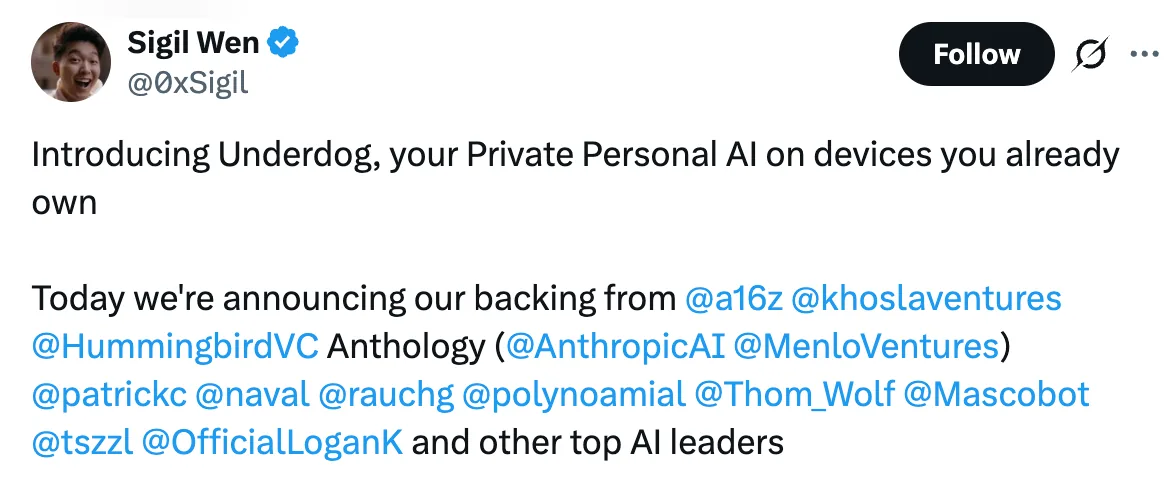
Conway Research, an eight-month-old U.S. startup, has unveiled Underdog, its first personal AI assistant, and disclosed backing from a16z and Anthology — the investment vehicle formed by Anthropic and Menlo Ventures — along with individual investors from across the AI industry.
- Announcement: product and funding revealed days ago; Zhidx reported on Oct 19.
- Availability: Underdog is invite-only and not yet publicly released. Mac and Windows betas exist; Linux, iOS and Android are planned.
- Pricing: free at first, with a promise of no ads ever. Revenue comes from a small cut of transactions completed through Stripe, similar to card interchange fees.
- Weights: the Saluki 27B model is open-sourced; the faster Woof 4B and the Husky inference engine were not described as open.
- Backers: a16z, Anthology, Stripe co-founder Patrick Collison, Vercel founder Guillermo Rauch, OpenAI researcher Noam Brown and Hugging Face co-founder Thom Wolf, among others. The amount was not disclosed.
Fully local, offline-capable

Meta’s Muse, launched Sept 8, topped the U.S. App Store free chart within 10 days, passing ChatGPT. The wave has spread to OpenAI’s Dot, Elon Musk’s Grok Bot and Manus 2.0, while ByteDance, Tencent, Ant Group and Alibaba have been reported to be building similar products. Most of them give each user a separate cloud VM so the agent can keep working in the background.
Underdog takes the other road: it runs entirely on the user’s device and works offline. Conway calls it “the most private Muse competitor to date.” It connects to mail and calendars and handles email review, scheduling, meeting notes, voice input, errands and private iMessage, with data kept local.
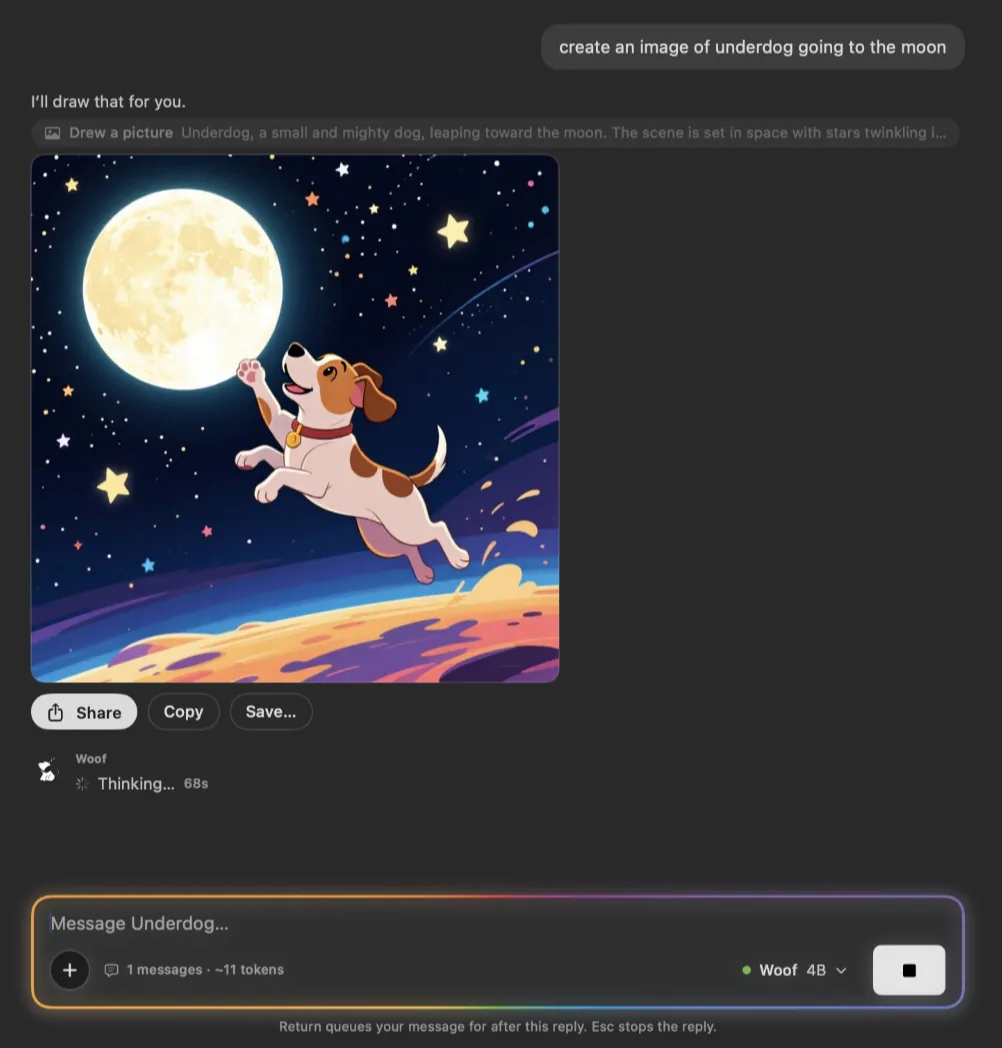
Feature updates have come quickly. On Oct 12, free local image generation and editing arrived, built on Qwen-Image Flash and Qwen-Image-2.1-Turbo, supporting natural-language prompts, reference images and local edits; a one-click meeting-notes import shipped the same day, generating summaries, decisions and action items without uploading content. On Oct 14, a device-side agent payment feature built with Stripe lets Underdog obtain a one-time Link card in the local browser and wait for user approval.
The contrast: the most privacy-focused Muse rival cannot yet match Muse or Dot on performance. On-device compute caps model size and complex-task capability. The business model also inverts the norm — most personal assistant vendors allow user data to be collected and sold to advertisers or used to train other models, while Underdog says it does neither.
Founder Sigil Wen, born in 2003, left a dual-degree program at the University of Pennsylvania and moved to Silicon Valley at 17, spending 11 months in a hacker house alongside OpenAI co-founder Andrej Karpathy, Midjourney founder David Holz and Anthropic co-founder Ben Mann. Conway’s February debut was AI Automaton, which passed 18,000 registered agents and 7,300 GitHub stars; Ethereum creator Vitalik Buterin publicly questioned the direction of “Web4.”
1/7 the weights, 96% of the performance
Underdog rests on two pieces: its models and its Husky inference engine. There are two models — the faster Woof 4B and the smarter Saluki 27B. Saluki 27B is built on Qwen3.8 27B and has been open-sourced; its weights are one-seventh the size of the full-precision version while retaining 96% of performance, and it beats Qwen on tool calling. Wen told TechCrunch it handles everyday tasks such as shopping research and math homework, and that costs are low enough to avoid a subscription.
| Item | Husky (Conway’s engine) | MLX (Apple’s open framework) |
|---|---|---|
| Test device | MacBook | MacBook |
| Woof 4B peak throughput | 730 tokens/sec with Husky Flash | Not given |
| Relative speed | 4.5x faster than MLX | Baseline |
| Response speed at equal weights | 5x improvement | Baseline |
| 16 prompt scenarios | Faster in all tests | Behind in all |
Much of that comes from scheduling. For image editing, Husky verifies eight tokens in parallel per step at 1.5x the cost of a single token; for text it pipelines work, encoding and submitting the next step while the current one runs so the GPU never waits on the host. Wen says the engine moves less data between CPU and GPU than comparable on-device engines.
Who should try it, who should wait

- Try it: Mac users who care about data staying on the machine and can accept some performance loss — especially those who do not want mail, calendars or meeting notes on a server. The invite list is the place to start.
- Wait: users who need long multi-step workflows or cross-device continuity. Linux, iOS and Android versions do not exist yet, the product is not generally available, and Conway itself says performance trails Muse and Dot.
Final word
The opening for local agents comes from the token costs and data-upload risks of always-on cloud loops. Underdog shows the route is viable, not that the experience is solved. Until compute and capability constraints ease, it reads more like a signpost than a product.