
Context7 is a retrieval-augmented generation (RAG) service that supplies live, version-accurate documentation to AI coding agents. According to its site, it has indexed the docs of more than 147,000 open-source libraries.
- What it is: vertical, coding-specific docs RAG delivered over the Model Context Protocol (MCP)
- Scale: 147,000+ libraries, from React and Next.js to Supabase and Playwright
- Setup:
npx ctx7 setup, with targeted flags such as--claude,--cursor,--opencode - Clients: Claude Code, Cursor, Codex and 20+ other tools
- Auth: OAuth device flow; also usable on remote SSH, headless servers and CI
- Pricing and licensing: not disclosed in the source material, which mentions only an enterprise tier with query storage disabled and fully private deployment
Two stages: identify the library, then search inside it
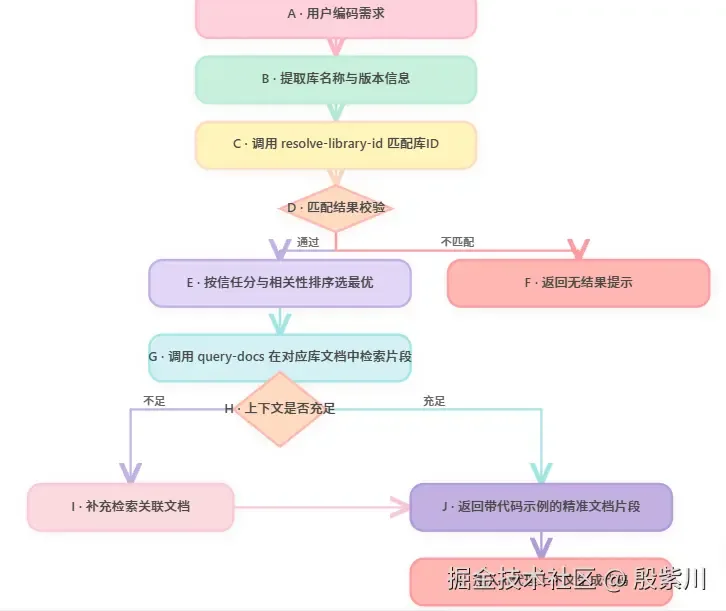
The classic failure mode of RAG in coding is cross-library contamination. Dump every doc into one vector store and a query for “useState” may return both React and Vue results, leaving the model to guess. Context7 splits the job in two.
Stage one is the MCP tool resolve-library-id. It takes a natural-language library name (“React”, “nextjs”) and returns Context7’s canonical identifier, such as /reactjs/react.dev or /vercel/next.js. It is not plain string matching: ranking weighs trust signals including repository stars, maintenance activity and domain authority, and it handles aliases — “playwright testing tool” resolves to Microsoft’s Playwright.
Stage two is query-docs. Given the library ID, it runs semantic search inside that library’s documentation and returns the most relevant passages plus code snippets rather than whole pages, keeping redundant text out of the context window. Locking the library first and searching inside it is the core difference between vertical and general-purpose RAG.
Context7 also ships a prebuilt Context7Agent that runs the whole flow automatically, keeping tool-call traces out of the core coding context and returning only a condensed answer.
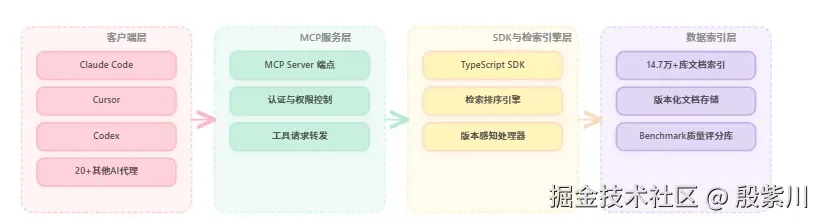
The architecture has four layers. The indexing layer handles version-aware parsing (only the latest stable release is indexed by default, older versions stay reachable, and /org/project@version targets a specific one), extracts runnable examples from Markdown, rst and ipynb files, and deduplicates with exact string matching plus cosine similarity. The retrieval layer weights trust and Benchmark scores into ranking. The MCP service layer follows the Model Context Protocol. The client layer adds a CLI for environments without MCP. Beyond automatic indexing, submissions can come from GitHub/GitLab/Bitbucket repos, official doc sites, Confluence spaces and OpenAPI specs.
The setup cost of one npx command
No vector database to deploy, no integration code to write. Running npx ctx7 setup offers two modes: an MCP server mode that registers Context7 with your AI tool so the agent can call the two core tools natively (for MCP-capable clients like Claude Code and Cursor), and a CLI + Skills mode that installs a docs skill and calls documentation over the command line for broader compatibility.
Configuration uses an OAuth device flow: a browser window opens for authorization, and an API key is generated and written into the target tool’s config file automatically. Remote SSH, headless servers and CI work the same way, as long as you can open the verification link on any device. In the author’s account the experience is nearly invisible in daily use — writing a request in Cursor such as building a Next.js App Router endpoint with JWT validation triggers a fresh docs pull, and the generated code follows the current version’s conventions.
Doc quality is publicly scored, and popular libraries miss 90
One unusual choice: Context7 turns documentation quality into a public score. Each library is tested with automatically generated developer-style questions, and the resulting accuracy figure is shown in the site’s library list; lower-scoring libraries are down-weighted at retrieval time.
| Library | Benchmark score |
|---|---|
| React | 83.6 |
| Next.js | 78.0 |
| Supabase | 74.4 |
The striking part is that even mainstream libraries maintained by Meta or Vercel land in the 70s and 80s — no sample in the published set clears 90. Live doc injection kills hard errors like deprecated APIs, but it does not guarantee a correct answer.
Trust scores combine repository signals (stars, commit activity, maintainer account age) and website signals (TLS certificate, domain weight, backlink count). Because docs come from third parties and can carry malicious prompts, Context7 runs a dual-channel detection pipeline to block injected instructions and refreshes its rules periodically. On privacy, code, conversation history and full prompts are not sent to the server — only the queried library name and question text. The enterprise tier can disable query storage or run fully privately deployed.
Who should adopt it now, and who should wait
Adopt it now if you are picking up a new version of a stack. The author reports that using Context7 for Playwright automation scripts cut debugging time by at least 60 percent, with mismatched API names and argument order as the previous main culprit. Teams maintaining older, version-pinned projects benefit too: /vercel/next.js@14.0.0 keeps you on v14 syntax instead of v15.
Wait in two cases. If the library you depend on is niche or poorly documented, retrieval gains will be limited. And direct access from mainland China may add network latency, so latency-sensitive teams should evaluate a private deployment first.
Final thoughts
Model training data will never keep pace with open-source release cycles — that is a structural weakness of every AI coding tool. Context7’s answer, vertical RAG, is not novel, but it turns “identify the library, then search” and public quality scoring into reusable infrastructure. It is a patch, not a replacement for model capability.