
Community Ports DLSS 5 Model Files into Older Games
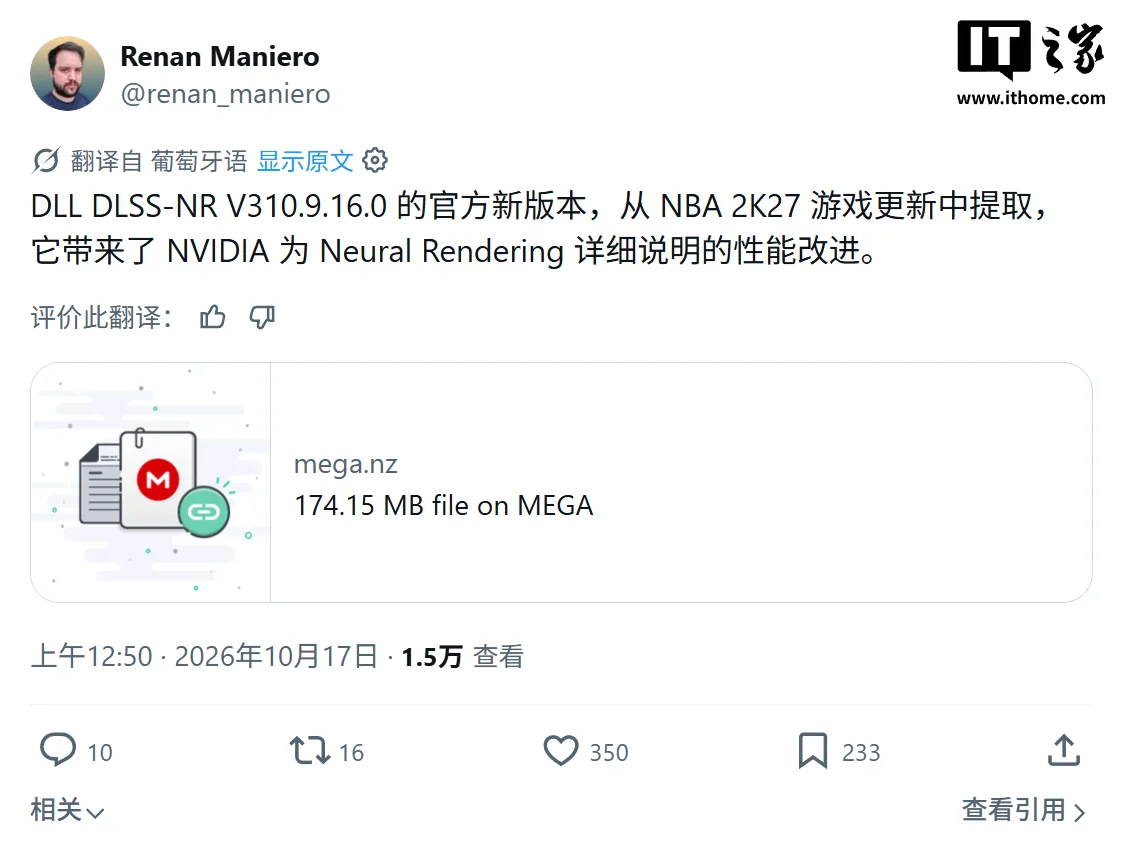
IT之家 reported on October 17 that Wccftech published a blog post that day saying a community MOD project had ported the not-yet-officially-supported DLSS 5 neural rendering model files into multiple games, and that, with no obvious drop in image quality so far, game frame rates in some scenes rose by about 30%–40% compared with the older model.
First, the hard facts:
- Time: October 17, 2026; Wccftech published the post, and community test data surfaced at the same time.
- New version: nvngx_dlssnr.dll, version 310.9.16.0; the previously circulating version was 310.8.x.
- File source: Extracted from an update for NBA 2K27, which is currently the only game with official DLSS 5 support.
- Distribution: The community experimental fork OptiScaler-DLSSNR-PreSR-Multipass, part of a third-party toolchain, not an official Nvidia channel.
- Pricing and availability: No price and no official download; users must extract the files from the game update and swap them in themselves.
- Official support list: Unchanged.
DLSS is Nvidia’s AI super-resolution technology. Put simply, it lets the GPU render at a lower resolution, then hands the image to a neural network to upscale and fill in details, thereby boosting frame rates. DLSS 5 goes further by putting the neural network into the rendering pipeline, so version differences in the model files themselves directly affect performance—this is exactly why the community dares to swap the DLL directly.
RTX 4060 Approaches 40%; RTX 4080 SUPER Goes from 108 to 150 FPS
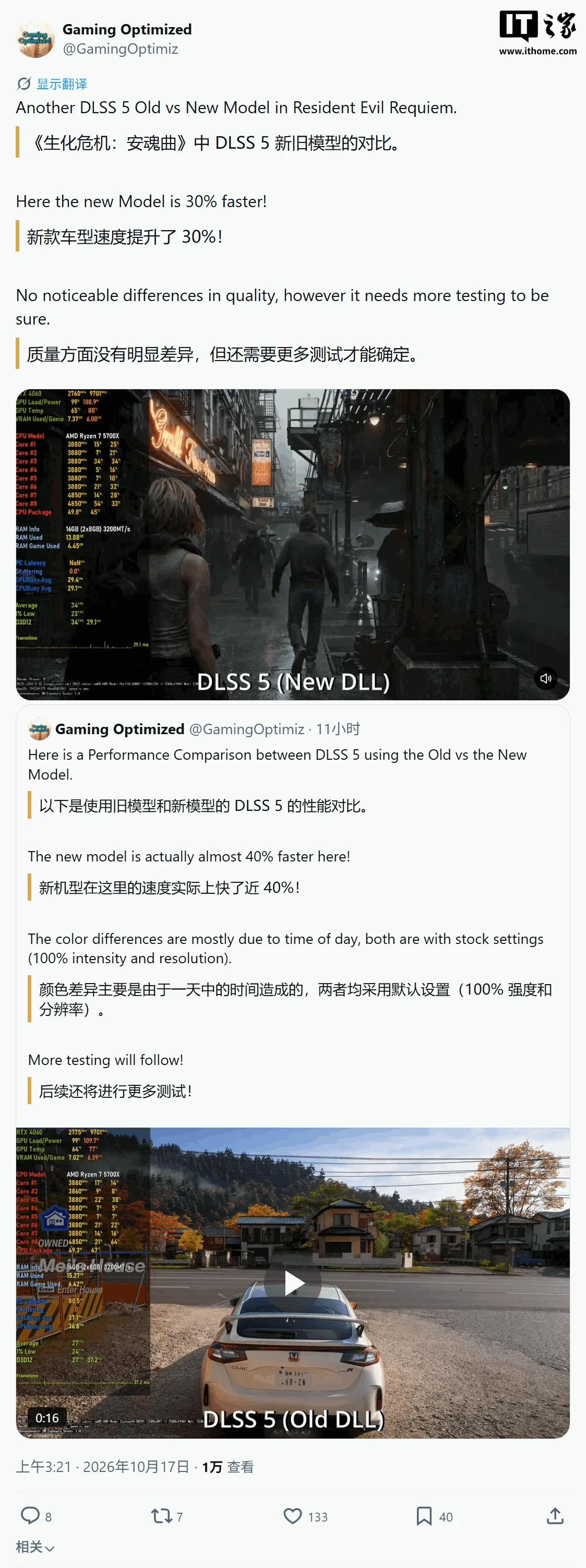
Community user Gaming Optimized compared the old and new models on an RTX 4060 with identical settings: in Forza Horizon 6, the measured performance gain was nearly 40%, and in Resident Evil: Requiem, about 30%.
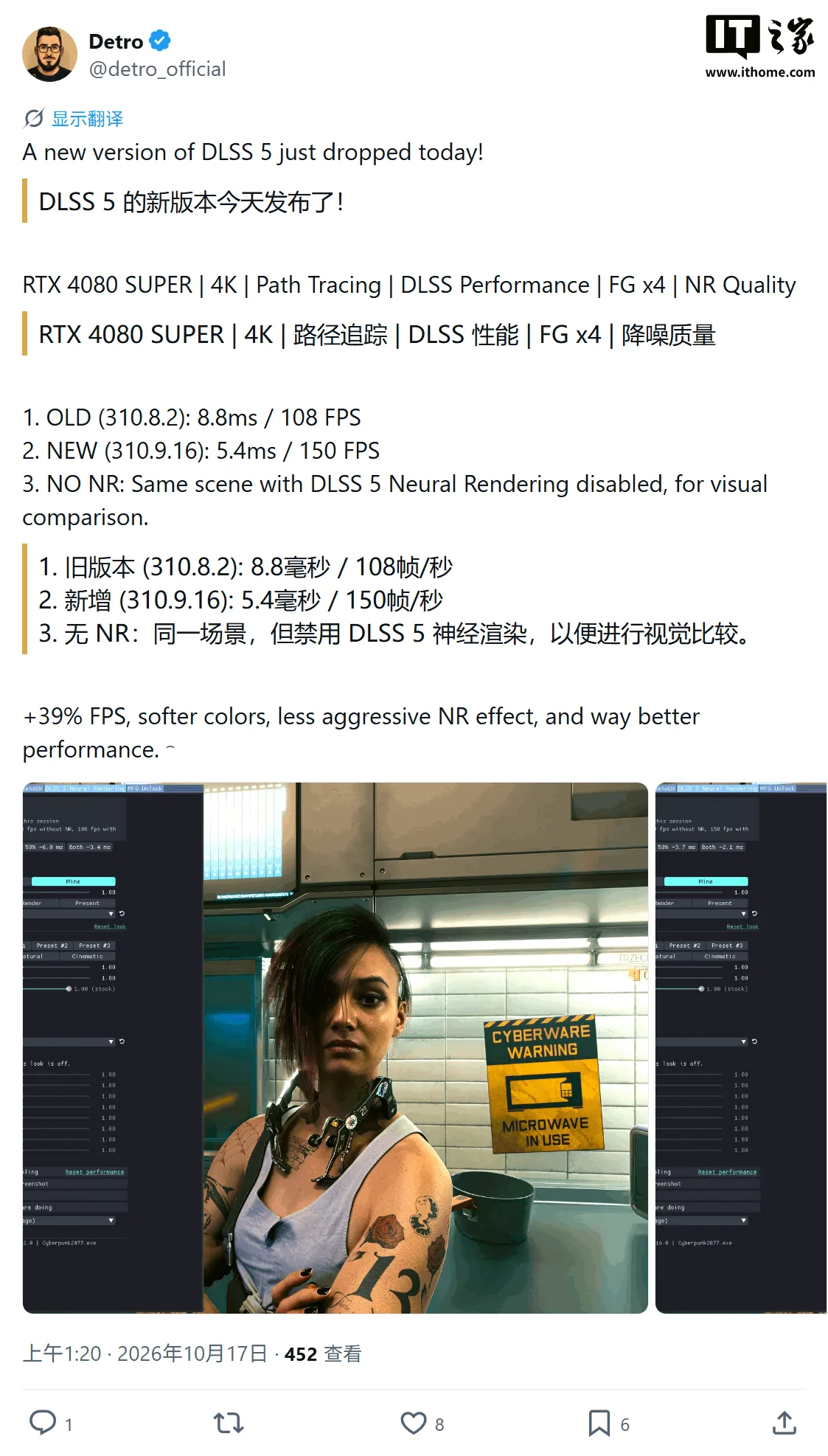
Another tester’s setup was even more extreme: an RTX 4080 SUPER at 4K, with path tracing enabled, DLSS Performance mode, and 4x MOD multi-frame generation stacked on top; the frame rate rose from 108 FPS to 150 FPS, an increase of about 39%.
| Tester | GPU | Game | Settings | Result |
|---|---|---|---|---|
| Gaming Optimized | RTX 4060 | Forza Horizon 6 | Same settings, old vs. new model | Nearly 40% improvement |
| Gaming Optimized | RTX 4060 | Resident Evil: Requiem | Same settings, old vs. new model | About 30% improvement |
| Another tester | RTX 4080 SUPER | Unnamed | 4K, path tracing, DLSS Performance mode, 4x MOD multi-frame generation | 108 FPS → 150 FPS, about 39% |
(Data in this table is from community tests reported by Wccftech and is not an official benchmark.)
The Contrast: Official Support Opens One Door; the Community Climbs Through the Window
What is really worth pondering here is not the 40% figure itself, but the context in which it appeared—officially, only NBA 2K27 explicitly supports DLSS 5, while community tests have already covered Forza Horizon 6, Resident Evil: Requiem, and other titles that have not yet been adapted, with gains ranging from 30% to 40%.
In other words, the capabilities of the model files have already run ahead of the pace at which game developers adapt them. For players, this of course looks like free performance; but the report also gives clear caveats: the above data is still early community testing, and gains may vary widely across different games, GPUs, drivers, and scenes, and there may be compatibility or image-quality issues.
The risks are not just theoretical. In the same batch of related IT之家 coverage, there was another record: an unofficial method ported DLSS 5 to the Apple M5 Pro platform; image quality did improve, but latency was as high as 240 ms. It was also a matter of “swapping files,” but the direction of the payoff was completely different.
Who Should Try It, and Who Should Wait
- People who should try it: You have an RTX 40-series GPU, happen to play one of the few games the community has already gotten working, and are willing to tinker with third-party tools like OptiScaler and accept the cost of reinstalling and rolling back. It is advisable to first record a before-and-after comparison in the same save and same scene, then check the frame rate and visuals before deciding whether to use it long term.
- People who should wait: Users who put stability first, or mainly play online games. Unofficial DLL swaps come with no official compatibility guarantee, and the report itself warns of possible compatibility and image-quality issues; until the official support list is updated, there is no harm in waiting.
Final Thoughts
This port shows that DLSS’s competitiveness is increasingly concentrated in the model files themselves, and that game developers’ pace of adoption is becoming the bottleneck. The community can squeeze out performance early, which is good for players, but it is ultimately an experimental solution, not an upgrade path to rely on long term. Once official support rolls out more broadly, that will be the point when most users should actually get involved.