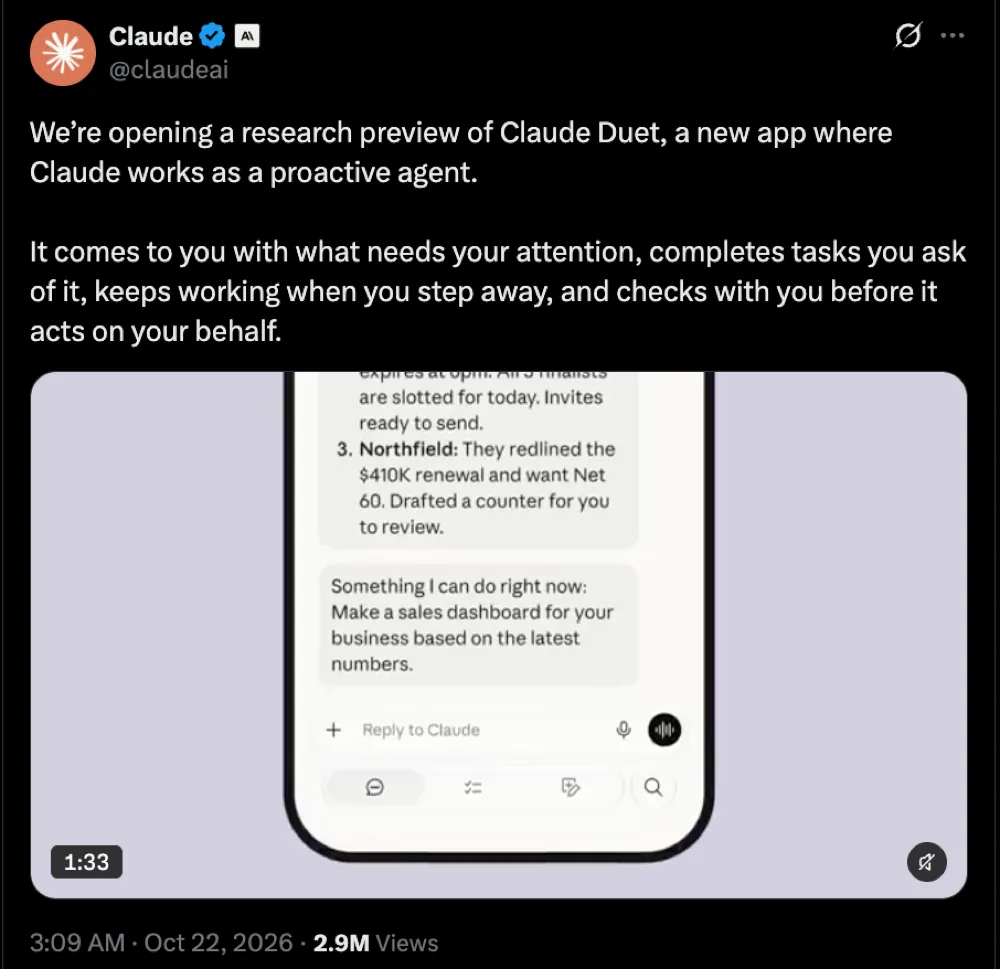
Zhidx reported on October 22 that in the early hours of today, Anthropic launched Claude Duet, a new personal AI agent app built around proactively handling work tasks. It can connect to a user’s email, calendar, bank and enterprise business systems, identify pending to-dos without an explicit instruction, and keep executing tasks.
Claude Duet is built on the Claude Opus 5.5 model and can call on more than 6,000 connectors and plugins in the Claude Marketplace to handle financial analysis, recruiting management, customer communication, payroll processing and more. Even if the user shuts down their computer or phone, Claude Duet keeps running in an independent virtual machine.
Claude Duet is available as standalone iOS, Android and web apps. The first batch is a research-preview waitlist open to Pro and Max subscribers in the United States; it is not yet broadly available.
The debut also set off discussion in the overseas AI community. Thibault Sottiaux (known online as Tibo), who leads ChatGPT and Codex at OpenAI and is jokingly called the ‘god of resets’ by developers, joked in the comments: ‘Dot, meet Duet. Duet, meet Dot. You two need to get along.’
One user wrote: ‘Duet has already won. It runs on the Opus model, and that says everything.’ He also called out to Tibo: ‘I hope you still have some tricks up your sleeve, especially on the model side.’
Another user posted the classic Spider-Man pointing meme with the caption: ‘Muse, Dots, Grok, and now Duet.’
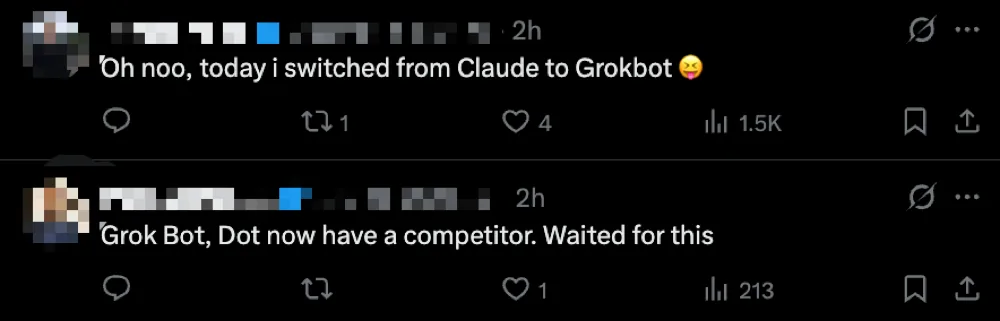
Another wrote: ‘Oh no, I just switched from Claude to Grok Bot today.’ Yet another said: ‘Grok Bot and Dot now have a competitor. I have been waiting for this for a long time.’
In September, Meta and OpenAI had already released their personal AI agents Muse and Dots. With Anthropic joining, the race around personal AI assistants has gained another participant.
- A daily proactive briefing, covering recruiting and finance
A defining feature of Claude Duet is that it can identify work that needs to be done in advance, without the user asking.
According to a demo video released by Anthropic, Claude Duet proactively sends a work briefing every morning, pulling information from the connected apps to tell the user which items matter today and which decisions need to be made soon. The video shows a day in the life of Nicole, a user who runs a coffee company. In the morning, Claude Duet sends Nicole a briefing listing three items.
Claude Duet does not just list to-dos; it also prepares the corresponding materials in advance, including a permit application, recruiting arrangements and a draft counteroffer for a contract.
Beyond the briefing, it also proactively proposes building a sales dashboard based on the company’s latest operating data. Nicole replies ‘Go for it!’ and Claude Duet says it will pull data from the point-of-sale system, the online store, the CRM, customer service, the payroll system and the bank account. The user does not have to open each platform one by one, download data and organize it; Claude Duet can call the relevant tools itself to complete the task.
Claude Duet also proactively reminds Nicole that the Chicago store will open in 26 days but the health permit has not been submitted. It has already drafted the application and prompts the user to review and pay.
In addition, Claude Duet adjusts task priorities as work progresses. For example, when the Northfield renewal does not need immediate attention, it proactively tells the user that the matter can wait until next Monday.
The recruiting scenario further shows how Claude Duet takes part in work that lasts several hours.
In the demo, Claude Duet first reports that the interview panel is interviewing three candidates and that notes will be compiled after the interviews.
It then generates a summary based on interviewer feedback, noting that Jenn is every interviewer’s top pick while reminding the user that Jenn has another job offer.
After Nicole confirms that Jenn is also her top choice, she asks Claude Duet to pull the compensation package from the HR folder and draft an offer email. Claude Duet immediately generates the email draft with Jenn’s compensation package PDF attached, and hands it to the user to confirm sending.
- More than 6,000 tools connected, work continues after the user leaves
Claude Duet inherits the memory, skills and connected apps from a user’s existing Claude account, lowering the setup cost.
For interaction, Claude Duet supports text and voice input. Users can assign tasks, check progress and add new requirements at any time within a single ongoing conversation.
Unlike traditional automation tools that require the user to keep a device online, Claude Duet has its own virtual machine and browser. After the user assigns a task, it can decide which apps to call and which actions to take, and keep running in the background. Even if the user leaves the computer or turns off the phone, the task is not interrupted. When a task is complete or needs review, Claude Duet sends a notification.
However, it cannot yet show users its browser operations as they happen.
On tool connectivity, Claude Duet can use more than 6,000 connectors and plugins in the Claude Marketplace to connect to the software services businesses use every day.
For example, it can find missed important messages in Gmail and Slack and draft replies; check unpaid invoices through QuickBooks or Stripe and prepare payment reminders; and fill in hours, bonuses and expense information in Gusto to prepare payroll.
In recruiting and sales, it can draft job postings and publish them to LinkedIn after user review; use contact records and deal history in HubSpot to write follow-up emails; prepare agreements through Docusign and send them for signature; and use Canva to turn a product launch plan into a social media marketing campaign.
For merchants running online stores, Claude Duet can also connect to Shopify to help design and manage the store. Anthropic says a more complete visual editor will come later, allowing users to preview designs before the store goes live.
For payments, Claude Duet supports buying business supplies through Link, Stripe’s digital wallet. After the user confirms the item, Link requests payment authorization again and completes the purchase with a virtual card, avoiding giving the merchant the real card number.
It also supports online checkout through Shopify’s Shop Pay. In the future, Anthropic plans to let Claude Duet use login credentials stored in 1Password to access websites, with user authorization.
- Payments and emails require approval, and background checks consume quota
Because Claude Duet needs to connect to email, banking and other business apps, Anthropic specifically emphasized security in its product introduction.
First, on account credentials, Claude Duet follows the design of Claude Managed Agents and does not directly touch the user’s passwords or login tokens.
Second, Claude Duet can read information, draft documents and prepare actions on its own, but when it comes to sending messages externally, making payments, signing documents or deleting content, it must first show the user the action it is about to take and wait for confirmation.
Some actions will not be executed even with user approval, such as securities trading or transfers of funds between accounts.
To address sensitive data leaks, Anthropic also equipped Claude Duet with new dedicated classifiers and a safety system prompt that check message content and block sensitive information from leaving.
For the most sensitive categories, such as credit card numbers and government-issued identification numbers, the system refuses sharing requests. For other sensitive information such as health and personal finances, transmission is allowed only when the user explicitly instructs it.
Anthropic says Claude Duet’s security infrastructure has undergone penetration testing by internal red teams and external security firms, and is covered by a public bug bounty program.
As for proactive notifications, Claude Duet does not continuously monitor all connected accounts.
It currently checks connected apps every few hours, mainly because constant checking would drain a user’s plan quota faster. Users can also set which notifications they want and how often. Both Claude Duet’s proactivity and its background execution carry usage costs.
Claude Duet currently shares usage quota with the main Claude product under Pro and Max plans. Periodic background checks consume quota, while complex tasks such as building financial models or presentations require more rounds of model inference and cost more.
Anthropic also explicitly acknowledges that Claude Duet is still at an early stage and may misunderstand conversations or misjudge how urgent a matter is.
Because the product is currently designed mainly around work scenarios, its ability to handle personal life tasks such as booking tickets is still immature.
This preview is open only to Pro and Max users in the United States via a waitlist; users must wait for an official email before gaining access. Claude Duet is currently offered as a standalone app and has not yet been integrated into the main Claude app.
Conclusion: competition in personal AI agents keeps heating up
With Claude Duet, the personal AI agent track has another new product.
On September 8, Meta launched Muse, a personal AI agent developed by its Superintelligence Labs; on September 30, OpenAI launched Dots, an always-on personal agent; on October 21, Anthropic officially unveiled Claude Duet.
All of these products treat proactive service as a key direction, hoping AI can use the user’s existing information and tools to find matters that need handling in advance and execute actions once authorized.
As Meta, OpenAI and Anthropic enter one after another, competition in personal AI agents is extending to app connectivity, continuous execution, proactive judgment and management of operational permissions. Who can make AI genuinely and reliably handle daily affairs remains to be seen.