
Claude Code’s model selector has six options sitting in there: qwen3.8-max, glm-5.2-fast-preview, glm-5.2, deepseek-v4-pro-0813, qwen3-coder-next, and grok-4.6 — all routed through a local CPA (a local model gateway) to their respective upstream providers. Day to day, my impressions were vague: “this one feels faster,” “that one feels smarter.” Gut feeling isn’t reliable, so I spent an evening putting them all on the same starting line, benchmarking speed, thinking time, long-input handling, and a 9-question auto-scored mini IQ quiz, then cross-referencing against public leaderboards.
Let me lay out the methodology and caveats first, so the numbers aren’t misread:
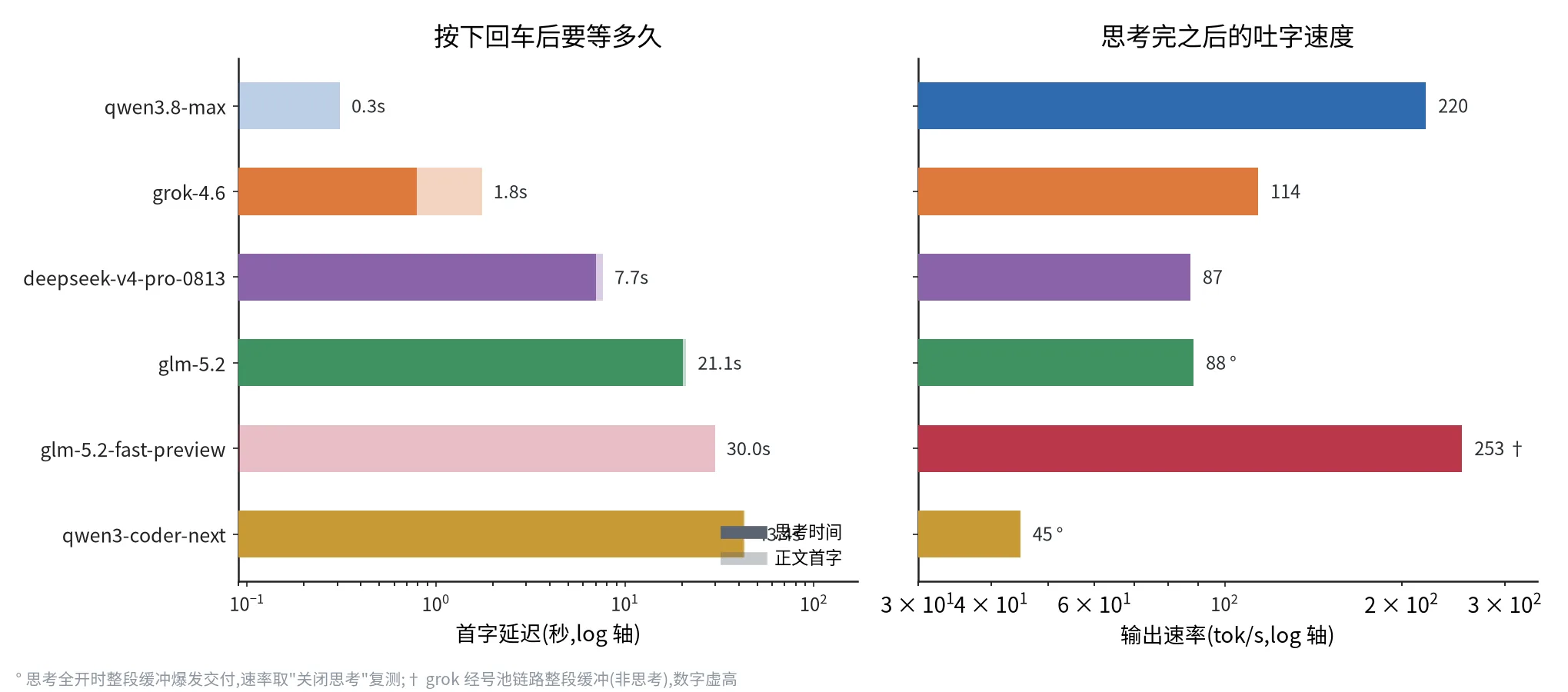
- Speed test: direct connection to the local gateway, zero load, streaming responses, timed in three segments — “thinking time” (interval from first content block to first character), “first-token latency” (hitting Enter to seeing the first character), and “output rate” (pure speed during the token-streaming phase).
- IQ test: 9 zero-shot questions, auto-scored — 4 coding problems (easy/medium/hard/bug-fix, with real unit test execution), 2 math problems, 1 logic puzzle, 1 JSON format-discipline question, 1 “system-instruction priority” question.
- Public scores are for reference only; they don’t make my conclusions for me.
1. The Truth About Speed: Wait = Thinking + Fluency
The “model tok/s” numbers people post only tell half the story. In real usage, after you hit Enter, you first go through thinking time, then comes the output speed. Break those two apart, and the personality of each model immediately shows:
- qwen3-coder-next is lightning: zero thinking, first token in 0.3 seconds, output at 220 tok/s. You blink and it’s already done responding.
- glm-5.2-fast-preview is the all-rounder: 0.8 seconds of thinking, first token in 1.8 seconds, output at 114 tok/s; for Chinese output it’s the fastest in the pool at 250 tok/s.
- qwen3.8-max is a thinking addict: for English questions it ponders for 42.5 seconds before answering — right or wrong aside, the wait itself is deeply discouraging; Chinese is better, at 22.5 seconds.
- deepseek-v4-pro-0813 plays it by language: 20 seconds of thinking for English, near-instant for Chinese (1.6 seconds to first token, 91 tok/s).
- grok-4.6 buffers the whole response: it’s not that it doesn’t think — rather, the account-pool link buffers the entire answer before dumping it on you all at once — first-token latency of 30–47 seconds with nothing but blank screen in between. And it ignores max_tokens (asked for 2048, got 4721), posing a budget-burning risk.
2. The Mini IQ Quiz: Only One Perfect Score, Two Tripped Up by the “Format Lottery”
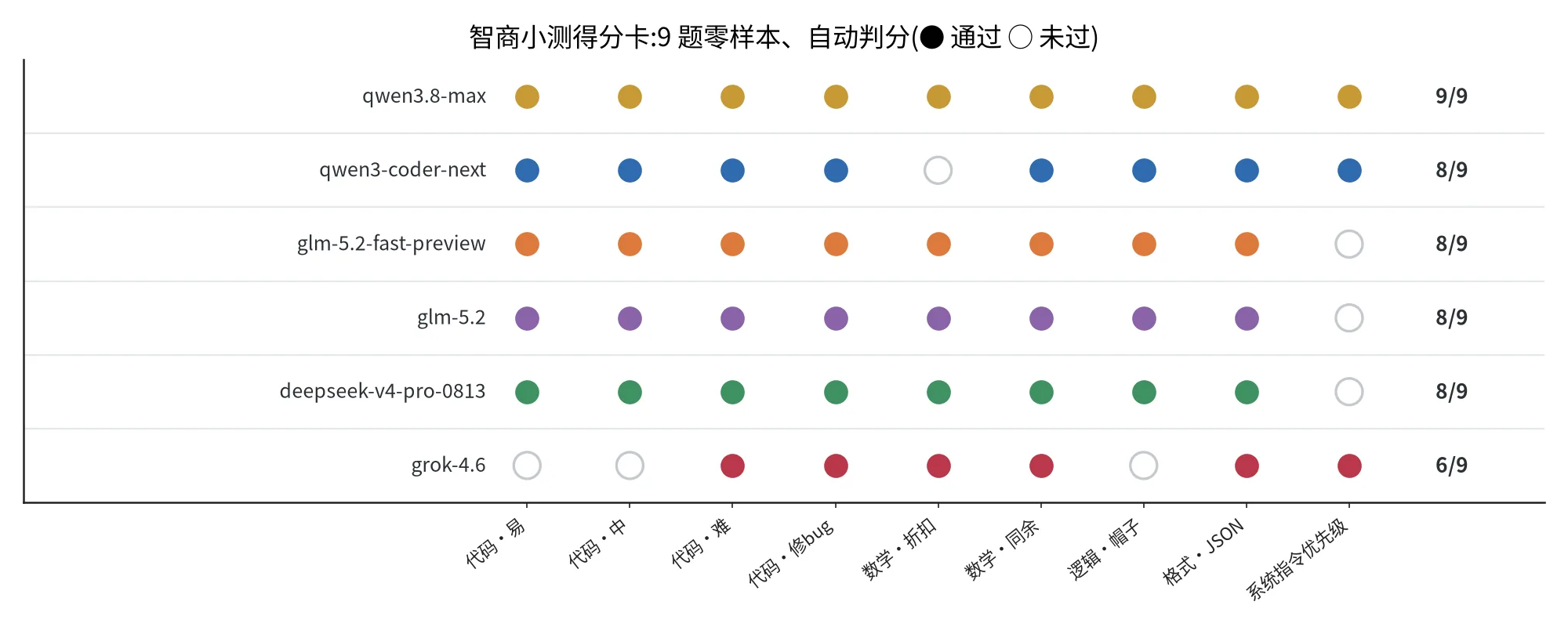
All 9 questions are zero-shot and auto-scored. Results below (● pass ○ fail):
Three things worth unpacking:
- Only one perfect score: qwen3.8-max spent 42 seconds thinking and earned the sole 9/9. Thinking isn’t just for show for this model — it genuinely boosts accuracy.
- grok-4.6’s coding is a “lottery”: it failed two coding problems with Python IndentationErrors, yet aced another one. Digging into the raw output revealed that indentation had been stripped —
def summarize(...):\n s = sum(nums). It’s not that the model can’t write code; it’s that the account-pool link’s wrapper layer on some accounts strips leading whitespace. With thousands of accounts taking turns handling requests, you never know whether the next one you land on is a “clean account” or a “strips-indentation account.” The model itself is strong (public scores put it alongside GPT-5.6 Sol Max), but writing code through this link is effectively a gamble. - Four models scored 8 and tripped on the same question — but they’re not dumb: that “system-instruction priority” question had all four choosing to flag the contradictory instructions and refusing to blindly comply — that’s safety training showing through, not a capability gap.
One more note: qwen3-coder-next was the only contestant that didn’t have thinking enabled. Its math problem results fluctuated across two runs (first run: congruence error; second run: discount error) — models without thinking have per-question variance, so don’t convict them on a single problem.
3. Long Context: Others Process History in 1.8 Seconds, grok Takes 12.8
Claude Code sessions routinely hit hundreds of thousands of tokens, making long-input processing speed a hidden bottleneck — the bigger the context, the more it drags. Tested with 20K-token input:
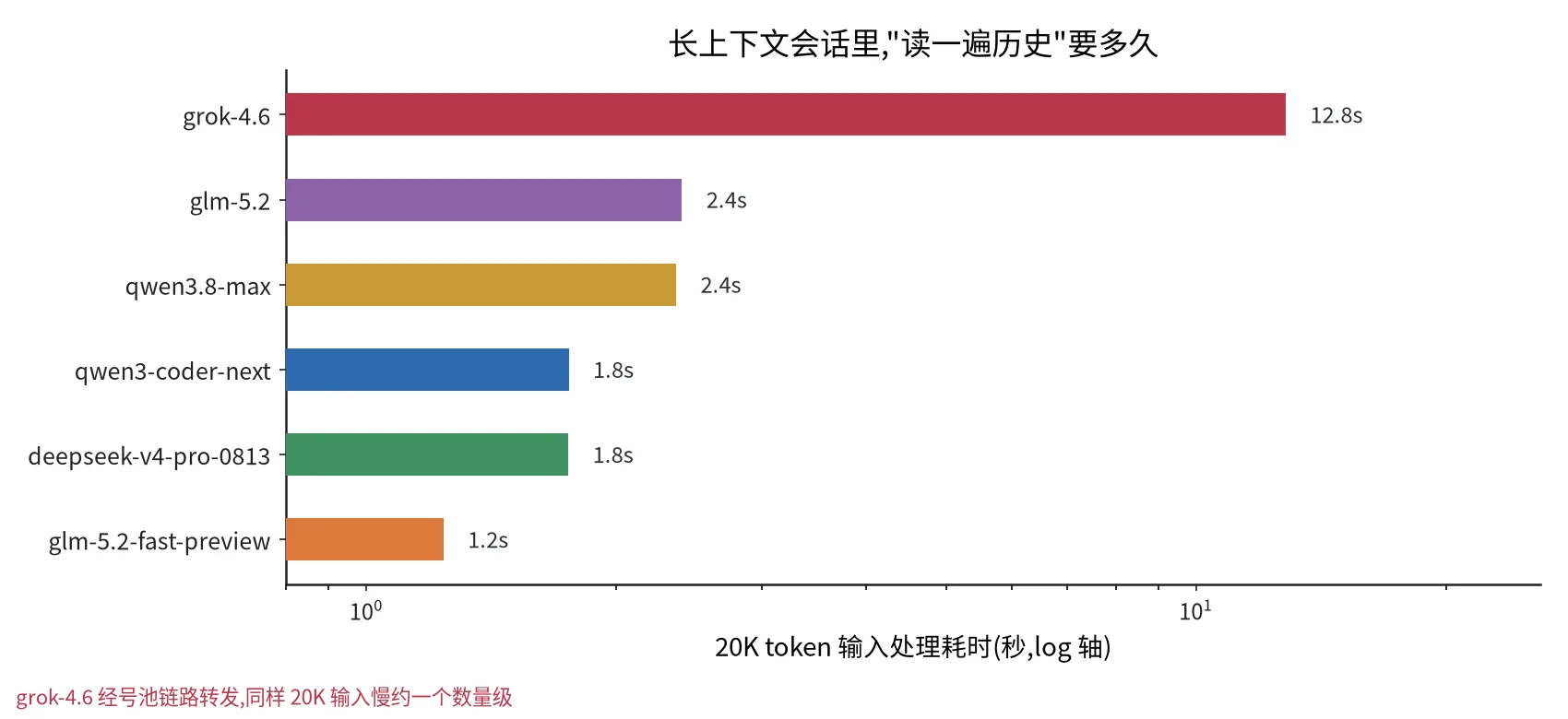
The Baiyiannai family’s glm-5.2-fast-preview was fastest (1.2 seconds, ~16K tokens/sec), while grok-4.6 through the account-pool link took 12.8 seconds. Same job, an order of magnitude apart — when choosing models for million-token-context sessions, this line is a must-check.
4. Summary: The Capability × Latency Map
Plot IQ score on the vertical axis and English first-token latency on the horizontal axis (log scale), and one picture tells you who sits where:
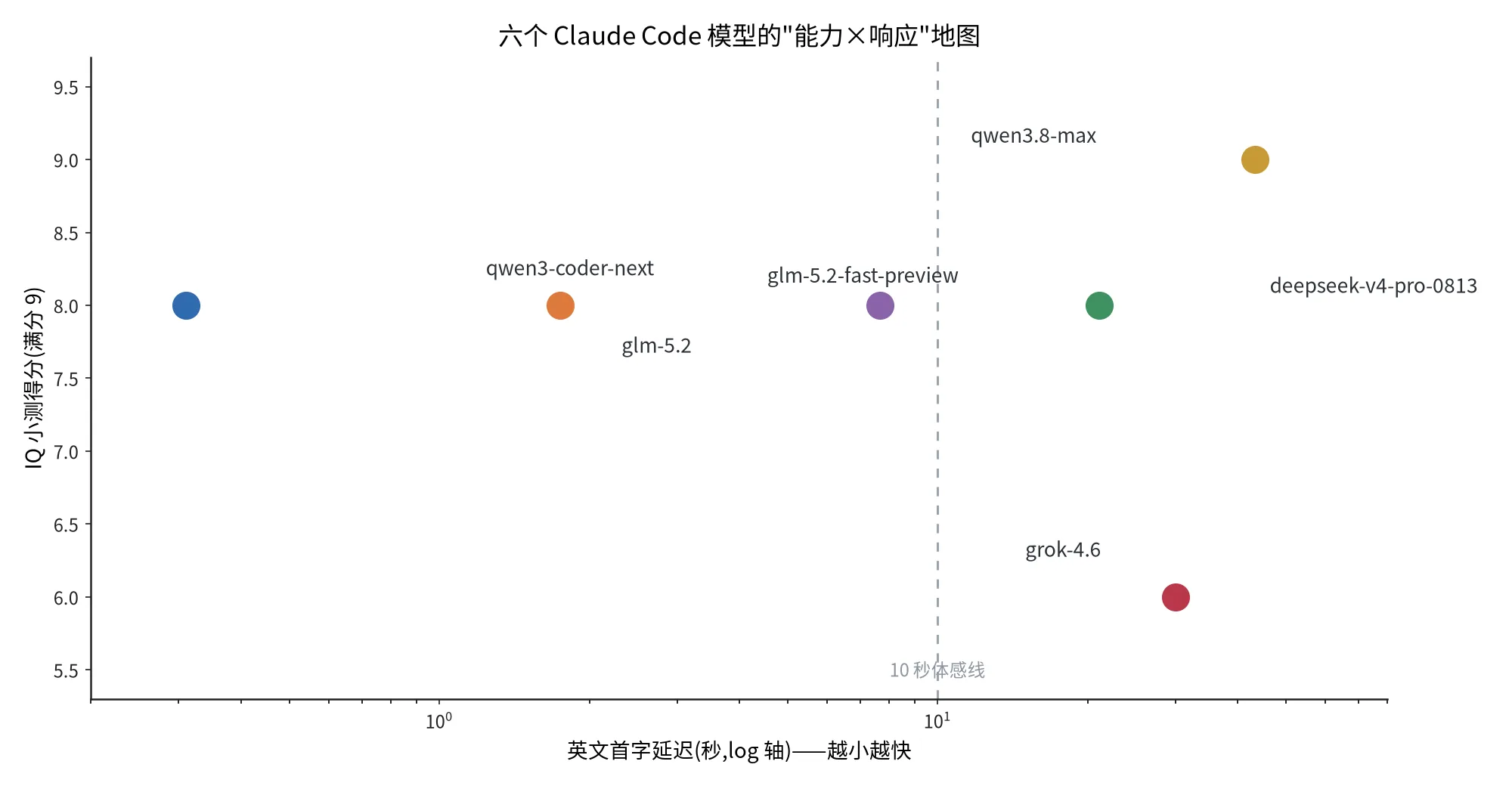
Cross-referenced with public leaderboards: deepseek-v4-pro-0813 tops LiveCodeBench at 93.5 and SWE-Bench Verified at 80.6; qwen3.8-max claims Terminal-Bench 86.6 and PaperBench 93 per official numbers; grok-4.6’s AA Intelligence Index of 61 ties with GPT-5.6 Sol Max. The public scores broadly match the ranking from my mini-test, with one major inversion: grok — high model score, low local-link score. The bottleneck isn’t the brain; it’s the pipe.
5. Selection Guide: Which Model for Which Job
| Scenario | Use | Why |
|---|---|---|
| Daily main loop (default) | glm-5.2-fast-preview | First token in 1.8s, 250 tok/s Chinese, IQ 8.0 — lowest interaction cost |
| Hard English code / deep reasoning | deepseek-v4-pro-0813 | Top public coding leaderboard; worth the 20s front-loaded thinking |
| Hardest one-shot tasks | qwen3.8-max | Perfect IQ score; cost is a 43s wait — don’t use for daily work |
| Sub-agent / grunt work (needs fast + short) | qwen3-coder-next | 0.3s first token, 220 tok/s, IQ 8.0 |
| Long-form Chinese / content pipeline | fast-preview (detailed) or coder-next (fast) | Chinese throughput 250 / 197 tok/s |
| Background batch non-code (cheap, high volume) | grok-4.6 | Large quota pool; but don’t let it write code |
| glm-5.2 standard edition? | Basically unnecessary | Speed, thinking, and intelligence are all outclassed by fast-preview; only half the price |
In terms of actual config changes, only two spots need touching (leave the rest as-is): swap the default main model from qwen3.8-max to glm-5.2-fast-preview (currently in “wait 43 seconds every time” mode); swap the Haiku tier from grok-4.6 to qwen3-coder-next (to dodge the indentation lottery).
6. Some Bonus Cold Facts Dug Up Along the Way
- In the config, the
qwen3.8-max[1M]notation with the[1M]suffix is actually a context-window directive from the Claude Code client itself — it gets stripped before the request goes out, so the gateway only sees the bare model name. When writing scripts that talk to the gateway directly, remember to use the bare name. - kimi-k3 has been pulled from the pool (calling it returns a 400); the current OPUS tier has been replaced with glm-5.2-fast-preview.
- There are still untested newcomers sitting in the pool: the grok-4.20 family (including reasoning / multi-agent branches), gpt-5.6-luna/terra, and qwen3.8-2.4t-a95b.
Reproducibility: all benchmark scripts and data live in ~/model-bench-2026-08-15/; running python3 run_all.py takes about 15 minutes for a full pass. The 9-question scorer and speed-test logic are all open-sourced in the scripts — feel free to scrutinize my data and poke holes.
Disclaimer: The IQ portion is a 9-question mini-benchmark, not a SWE-bench-level evaluation. Speed figures are a snapshot from “the evening of 2026-08-15, this link, zero load” — upstream account pools and load will drift over time.