
A post dated 2026-10-25 and published by Juejin analyzed the author’s local Claude Code usage over the previous seven days. The article says all dollar amounts are converted at Anthropic’s published API list prices; how subscription-plan quotas are measured is not public. The local data reflects one person’s usage.
The article’s context was that starting October 21, users on X said Claude Code usage was being consumed ‘five times faster.’ Claude Code lead Boris Cherny first replied on October 22 that ‘we have no changes on our side,’ and later the same day said the team was investigating. As of publication, no official cause had been announced; the article does not speculate about that episode and instead analyzes where usage goes under normal conditions.
Cost breakdown
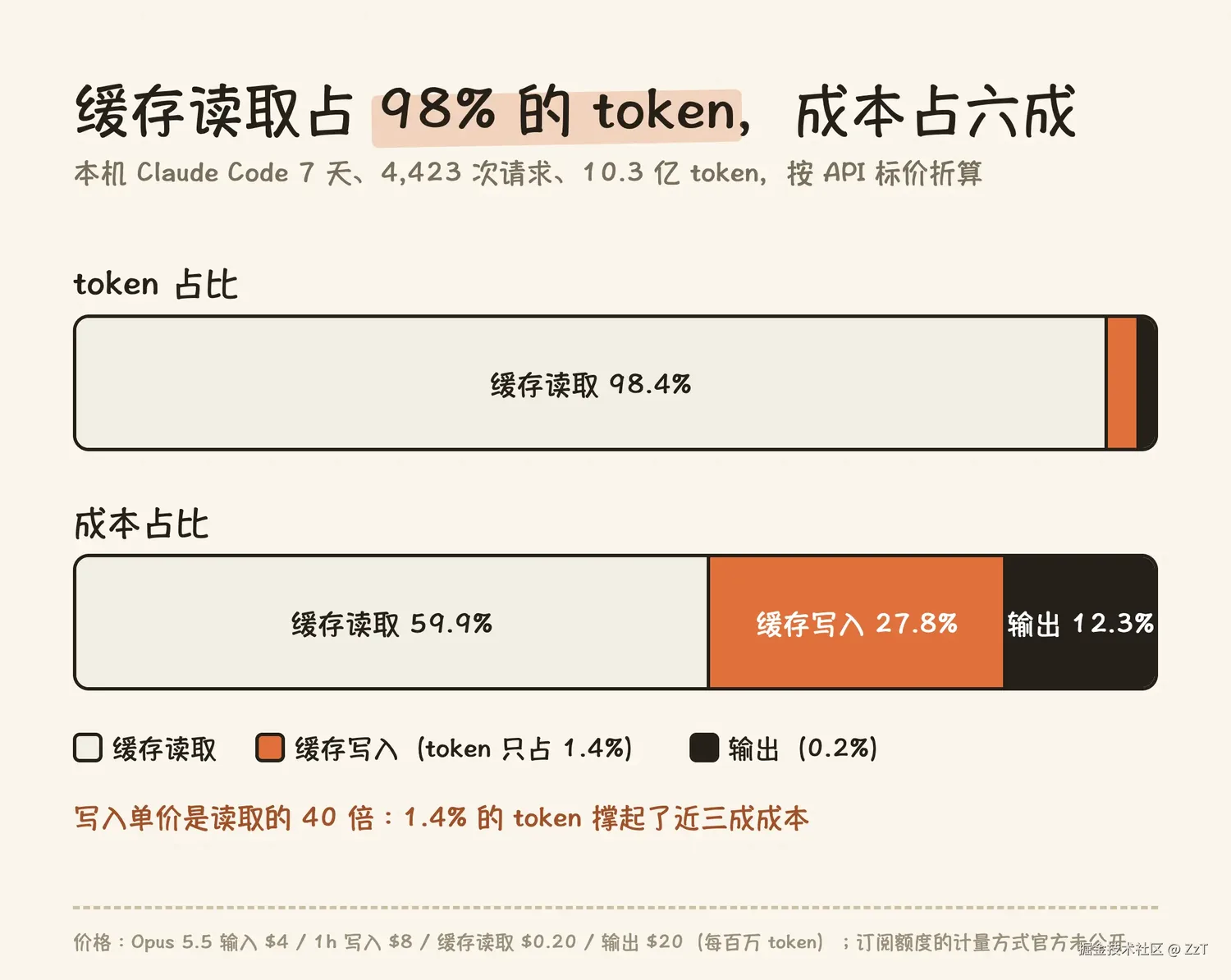
- Seven days had 4,423 API requests and 1.03 billion tokens, about $335 at API list prices.
- Cache reads were 98.4% of tokens and 59.9% of cost; cache writes were 1.4% of tokens and 27.8% of cost; model output was 0.2% of tokens and 12.3% of cost. About 60% of cost went to rereading the conversation, while output was about 12%.
- The average request carried 233,000 tokens of context and returned 469 output tokens; the cache hit rate was 98.6%.
- The article says the 30-day data had the same structure: cache reads were 98.0% of tokens and 53.1% of cost, while cache writes were 33.7% of cost.
The article says Claude Code sends the full conversation with every request, together with the system prompt, tool definitions, and files that have been read.
Context and cache expiry
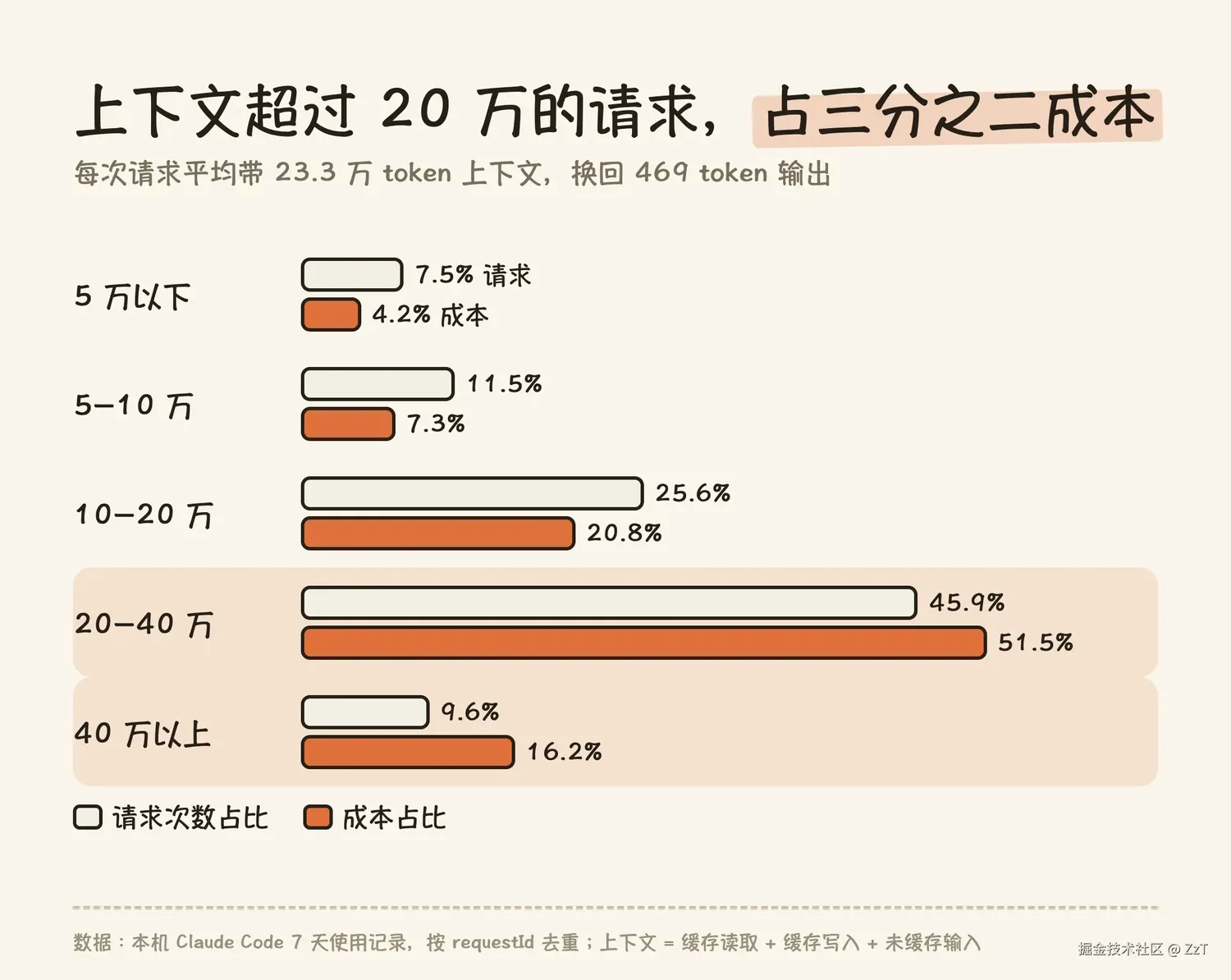
- Over seven days, the median context per request was 227,000 tokens, and the 90th percentile was 394,000. Requests over 200,000 tokens were 55.5% of requests and 67.7% of cost; requests under 100,000 were 19% of requests and 11.5% of cost.
- Opus 5.5 has a 1 million token context window. Claude Code auto-compacts when context approaches the limit, but before that is triggered, a session can remain in the 200,000 to 300,000 token range for a long time.
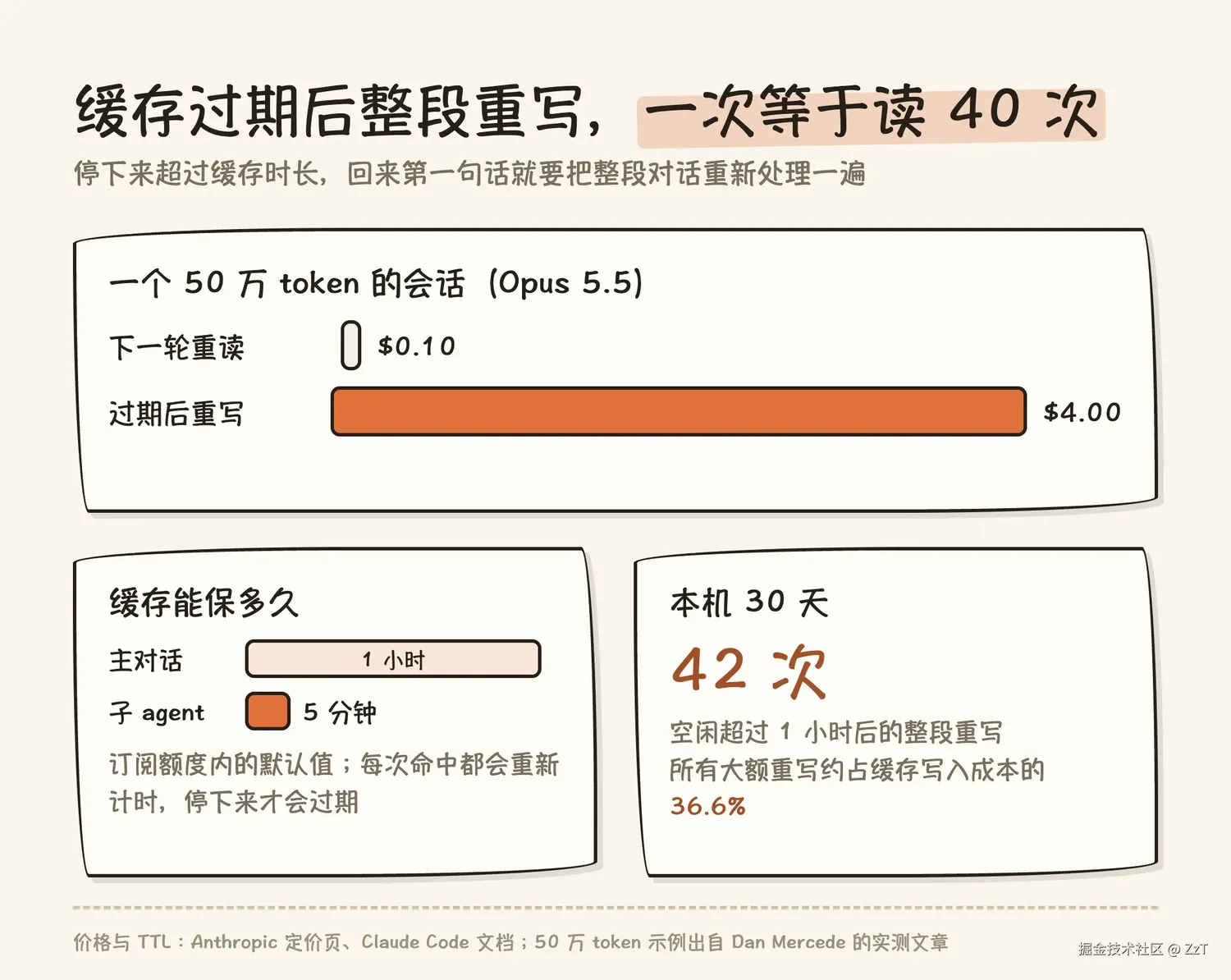
- The article cites Claude Code documentation: within subscription quota, the main conversation uses a 1-hour cache by default, while subagents and compaction use 5 minutes by default. Each cache hit refreshes the timer.
- Opus 5.5 cache reads cost $0.20 per million tokens, versus $4 per million tokens for normal input; 1-hour cache writes cost $8 per million tokens, 40 times cache reads.
- In seven days, there were 15 full rewrites of more than 100,000 tokens; all occurred after idle time and accounted for 18% of cache-write cost. Over 30 days there were 55, of which 42 occurred after more than 1 hour idle, totaling about $138 and 36.6% of cache-write cost.
- Subagent requests were 15.9% of all tokens but 44.8% of cache writes.
User reports of wakeups with the lid closed
The article cites anthropics/claude-code issue #102597: one user closed a laptop for 6.5 hours, the system woke about every 15 minutes, and Claude Code sent 81 requests and completed 29, including 15 full rewrites of 400,000 to 580,000 token contexts, totaling about 7.1 million tokens, while overnight output was about 7,000 tokens; weekly quota rose from 20% to 56%. Issue #103064 reported a 2.2-hour lid-closed period in which weekly quota rose from about 9% to 19%. The article says these issues were open with no official reply, and the cause was users’ inference from external observation.
Token-saving tests and recommendations
The article cites item-by-item tests in the claudiu project: truncating each tool output to 4,000 tokens saved at most 4.2%, and truncating to 2,000 saved at most 9.2%; deduplicating repeated file reads saved at most 2.1%; reordering tool definitions had no room because cache misses were only 1.7% of total cost; adding a code-indexing tool in three rounds of 56 A/B tests produced costs from flat to up to 12% higher, and the issue was closed as ’not planned.’
The article’s recommendations include:
- Use
/clearwhen changing topics instead of continuing in a long session; the article cites official documentation that/clearcosts nothing. - Finish up before a long absence and start a new session on return; running
/compactin the old session also reprocesses the full history. Claude Code 2.1.290 and later offers theidleCompactionsetting to compact while idle. - For subagents that will be followed up repeatedly, consider extending their cache time;
subagentPromptCacheTtlrequires version 2.1.242 or later. - Starting with 2.1.251,
/usageshows a ‘Prompt cache (main)’ line for the main conversation, showing hit and write ratios, but it does not include subagents. - To analyze your own data, run the same statistics on session records under
~/.claude/projects; one streaming response appears as multiple lines, so records must be deduplicated byrequestId.
The article concludes that Claude Code usage is driven less by how many questions are asked and more by how long a session runs and how long it sits idle. Controlling context length and avoiding restarts of large sessions after idle time are more effective than techniques that compress one type of tool output.