
A New Track Explodes: Decision Models — Timeline and Key Facts
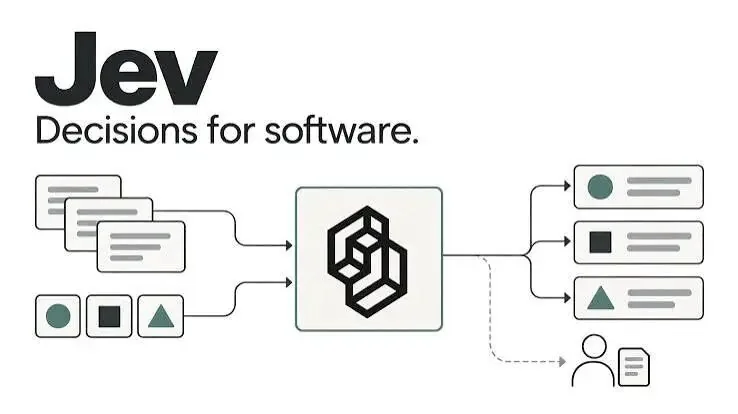
Decision models based on the softmax mechanism are moving from concept to industrial practice. These models specialize in high-frequency, lightweight judgment tasks rather than long-form text generation. The core characteristic is answering only preset multiple-choice, yes/no, or scoring questions and returning structured results, thereby decoupling judgment from generation and reducing both cost and latency.
- Jev by TypeSafe AI: Released September 15, closed-source hosted, priced at $0.042 per million input tokens, output free; it doesn’t write a single word — it only makes judgments
- OpenAI Decisions API: Announced at Developer Day on September 29, based on their own small models
- Cloudflare Clef: Open-sourced on October 1, post-trained on Qwen
- Amazon Strands Decider: Released in early October, also built on Qwen
- Shanghai AI Lab Intern-Decision: Open-sourced in three sizes — 0.8B, 2B, and 4B — with a focus on multimodal capabilities, inference speed 2–3× faster than Jev
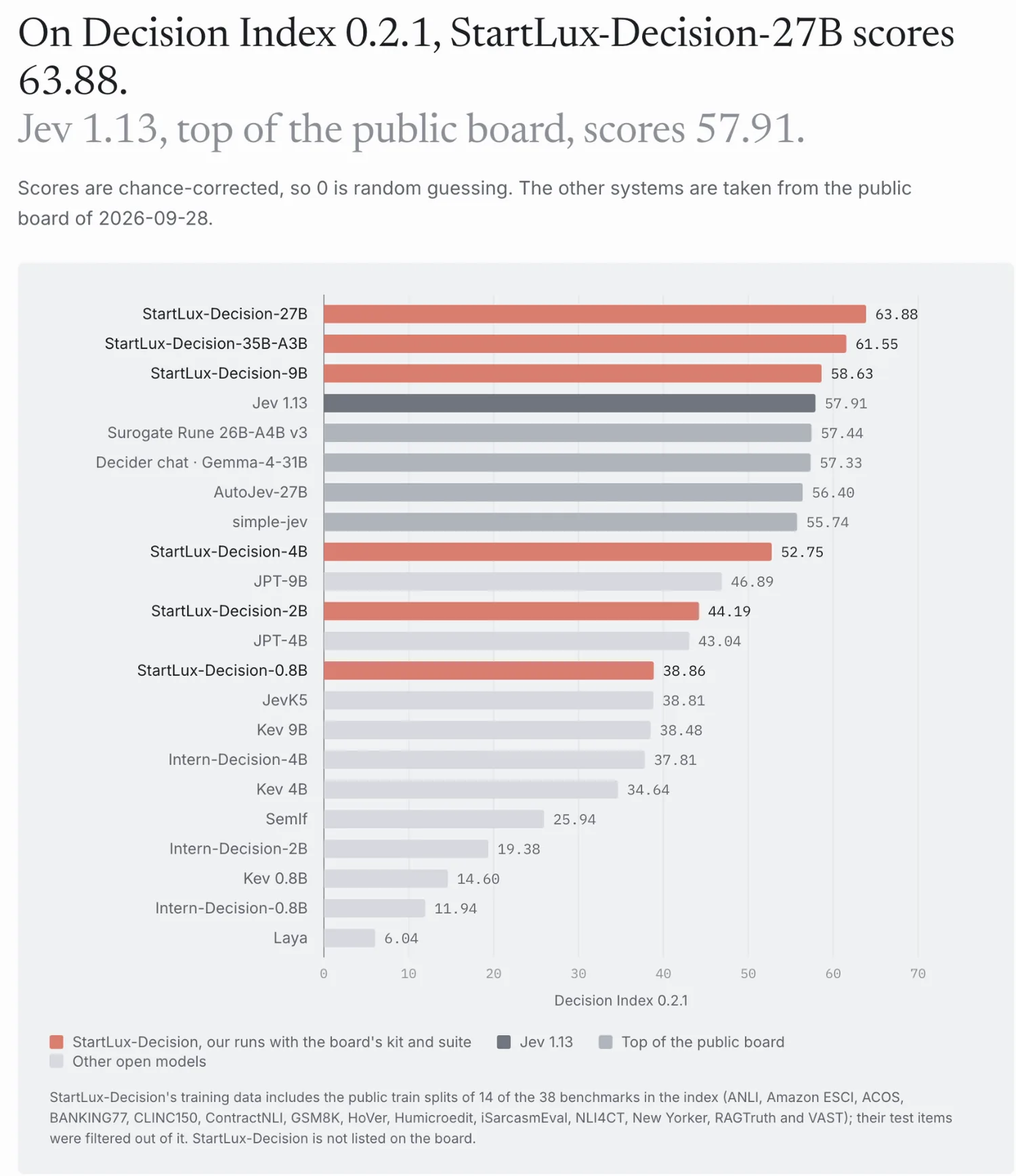
- StartLux-Decision: Released September 30, open-sourced multiple model sizes including 0.8B, 1.3B, 7B, and 27B plus quantized files, supporting local deployment; claims the 27B version scores 63.88 on Decision Index 0.2.1, surpassing Jev 1.13’s 57.91 (leading in 31 of 38 tests)
China’s Collective Move: The Open-Source and Localization Logic
The moat for decision models is still shallow — the time window is extremely narrow. Jev is named after “System One” (borrowed from Kahneman’s Thinking, Fast and Slow, referring to the intuitive system), aiming to serve as the high-frequency judgment layer within Agent architectures. Market response was swift: within 24 hours of Vercel integration, 13% of paid users began using it — double the adoption rate of any previous model launch.
However, Jev’s closed-source and cloud-only constraints create an obvious gap: developers handling sensitive data or lacking cross-border API access struggle to deploy it. Chinese teams have almost simultaneously chosen the open-source + localization route:
- StartLux 27B quantized to Q4 is approximately 2.71GB, with decision consistency still reaching 98.3% compared to the original weights
- Intern-Decision supports image and UI understanding, making it suitable for decision scenarios requiring visual input
- Cloudflare, Amazon, and APUS solutions are all built on Qwen — Chinese open-source models have become the universal backbone for global decision models
A telling contrast: StartLux claims its 27B model outperforms Jev in decision-making capability, yet its debut demo was a chess match (winning 35 of 36 games). However, the original article explicitly notes: “Chess was never meant to be the main battleground for decision models — it’s more of an attention-grabbing demo.” Decision models focus on micro-judgments like “which agent should this ticket be assigned to” or “should this command be approved,” not complex strategic gameplay.
Product Parameter Comparison
| Product | Publisher | Weights Open | Model Size | Pricing/Deployment | Highlights |
|---|---|---|---|---|---|
| Jev | TypeSafe AI | No | Undisclosed | $0.042/M input tokens, output free | Closed-source SaaS, cloud-only API |
| Decisions API | OpenAI | No | Undisclosed | Hosted API | Based on proprietary small models |
| Clef | Cloudflare | Yes | Based on Qwen | Open source | Post-trained on Qwen |
| Strands Decider | Amazon | No | Undisclosed | Hosted API | Qwen-based |
| Intern-Decision | Shanghai AI Lab | Yes | 0.8B, 2B, 4B | Open source + local deployment | Multimodal, inference 2–3× faster than Jev |
| StartLux-Decision | StartLux | Yes | 0.8B, 1.3B, 7B, 27B, etc. | Open source + local deployment | Decision Index 63.88 vs Jev 57.91 |
Adoption Advice: Who Should Hop On Now, Who Should Wait
- Suitable for immediate testing: Agent engineering teams that need to handle high-frequency micro-decisions. If data compliance requirements are light and no local deployment is needed, start with Jev’s low-latency, low-cost API; if deploying on an intranet or handling sensitive data (finance, government, healthcare), the open-source solutions from StartLux and Intern-Decision are a better fit
- Better to wait: Small-to-mid teams expecting “a universal Agent framework that works out of the box.” The author cautions: long-task stability, exception recovery, and context management are far harder than getting the model to run; a decision model is only one link in a local AI system — the overall experience depends on upper-layer integration capabilities
Final Thoughts
Jev itself is not a technological singularity — rather, it validates market acceptance of “intelligence layering.” When the cost of judgment approaches zero, the center of value inevitably shifts from the model layer to the product and system layers. Whoever can deliver end-to-end reliable experiences through compositional capabilities will win the next phase.