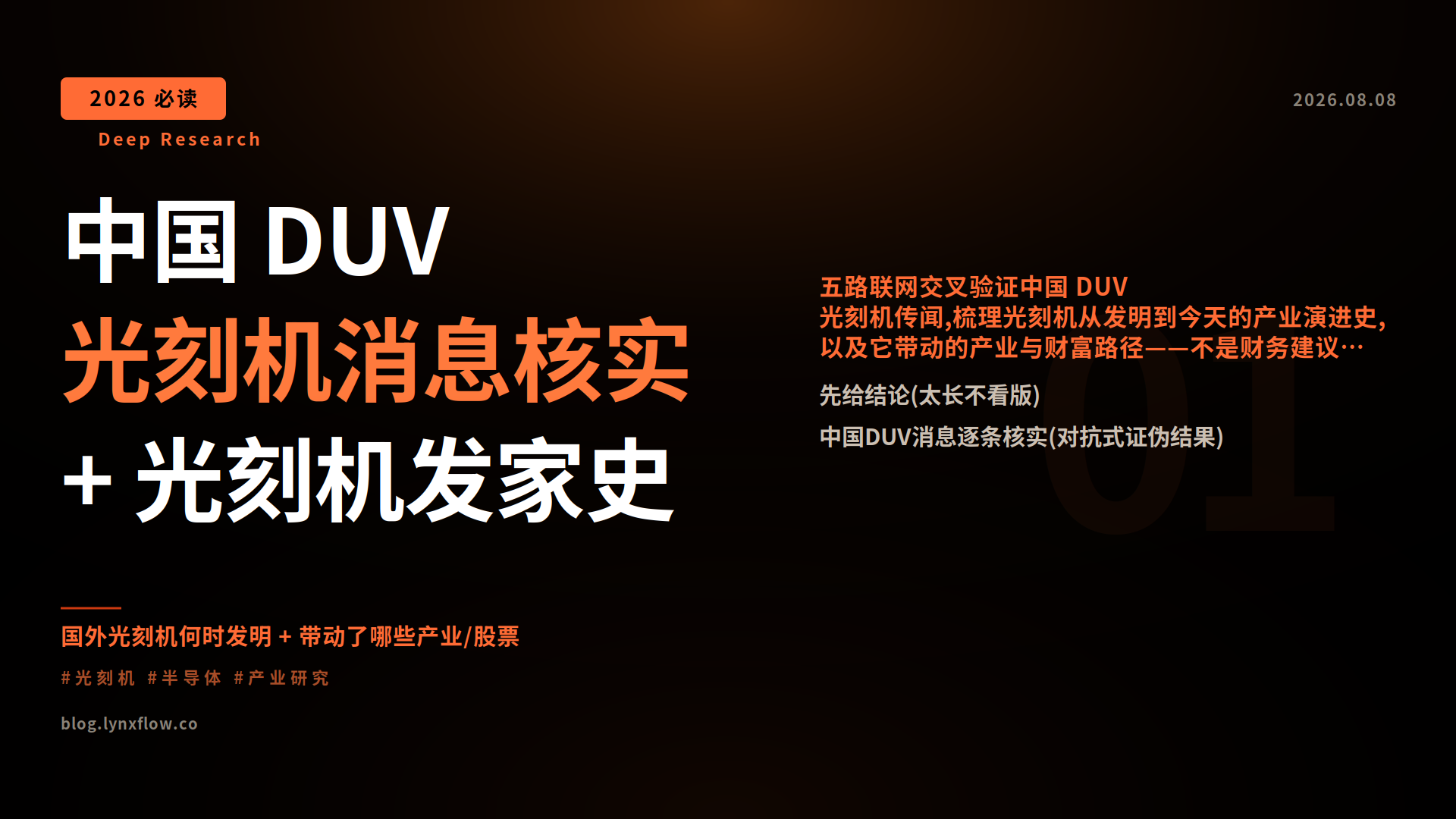
Generated on 2026-07-28 | Method: 5-path networked research (Tavily+Grok cross-validation) + 10-claim adversarial falsification + integrated planning (16 agents / 433K tokens / 1421 tool uses) This is not financial advice, for informational reference only.
I. Bottom Line First (TL;DR)
China DUV news: partially true, but the most headline-grabbing details don’t hold up. China is developing domestic immersion DUV, SMIC is indeed testing domestic DUV, and Shanghai Yuliangsheng is a real company (registered in 2022) — these are true. But “Yuliangsheng is the integrator,” “deliveries to Hua Hong/Changxin,” and “ASML恰好 fell 2.1%” — none are independently confirmed or have conflicting data. The 5 units/2026 and 20 units/2027 figures originate from a single The Information report, echoed by TechPowerUp, but lack independent follow-up from Reuters/Bloomberg or other major international financial media.
“Foreign tycoons/families who became obscenely wealthy from inventing the lithography machine” — this premise is itself a misconception that must be corrected. ASML was a joint venture spun off from Philips in 1984; there is no single founder-billionaire. The individuals most closely tied to lithography and their net worth: former CEO Peter Wennink (
€100M), former CTO Martin van den Brink (€5.94M annual salary) — neither appears on the Forbes billionaires list. The truly “national/institutional-scale” wealth belongs to the Dutch treasury, institutional shareholders (BlackRock holds 8.4%), and the Carl Zeiss Foundation (which holds Zeiss, a technology partner, not ASML shares). Arthur del Prado (~$930M) is the founder of ASM International; his wealth comes from the parent company ASM, not ASML. There is no “lone inventor strikes it rich” story — only a wealth mechanism of “systemic monopoly + long-term institutional/executive equity holdings.”The right leverage for class mobility is your core profession, not betting on a single news headline. Referencing real foreign paths: wealth comes from ① early equity in monopoly deep-tech companies (employees/executives holding long-term); ② early supply-chain positioning (TSMC/Intel/Samsung injected $6B into ASML in 2012 for priority supply); ③ national-level long-term strategic stakes. For you (not a semiconductor engineer, but skilled in data + content/automation), what’s transferable is: use your data/content/automation capabilities to serve the “domestic substitution” ecosystem (supply chain databases, equipment vendor monitoring SaaS, vertical media), and treat investing as a disciplined secondary allocation — not going all-in on an unverified news item.
II. Claim-by-Claim Verification of the China DUV News (Adversarial Falsification Results)
The workflow applied a “default skepticism, best-effort falsification” approach to each key claim (multi-source cross-check):
| Claim | Verification Result | Key Points |
|---|---|---|
| Shanghai Yuliangsheng Technology Co., Ltd. is a real company | ✅ True | Registered July 2022, registered capital ¥100M, unified social credit code 91310115MABWJMB0XK (Tianyancha/Qichacha) |
| Yuliangsheng is the “integrator of multiple teams” | ❌ Falsified | Chinese financial media (Securities Times/21st Century Business Herald/East Money) all used “rumored/reportedly” language; no authoritative source confirms it as the integrator |
| ~5 units this year, ~20 by 2027 | ✅ Single-source true | TechPowerUp (2026-07-27) cited The Information’s original report: “five systems this year, ~20 by 2027.” Only one international source; no independent follow-up from Reuters/Bloomberg |
| Delivered to SMIC | 🟡 Partially confirmed | Multiple sources confirm SMIC is testing domestic DUV (testing Yuliangsheng immersion DUV since Sept 2025; SMEE SSA800 28nm delivered to SMIC in May 2025). But “testing/delivery” ≠ “in mass production” |
| Delivered to Hua Hong Semiconductor and Changxin Memory | ❌ Falsified | No public disclosure of Hua Hong/Changxin procuring domestic DUV; only SMIC is confirmed |
| ASML stock fell ~2.1% in Amsterdam | ⚠️ Unverifiable | Conflicting data: some say it fell 2.1% on July 24/26, others say 5.80% on July 27, 3.76% on July 20. The precise “2.1% drop” cannot be confirmed; July did see pressure from export control concerns |
| China is developing domestic DUV (broader sense) | ✅ True | SMEE SSA 800 is in mass production, targeting 50 units/year; but domestic content <30%, core components still depend on overseas supply |
In one sentence: the big picture (China pushing hard on DUV) is true; but the most “impactful” details in The Information’s report (who integrates, who receives deliveries, how much the stock dropped) are precisely the ones that don’t hold up.
III. When Was Foreign Lithography Invented + Which Industries/Stocks Did It Drive
Invention and Evolution Timeline
- 1960s: Contact/proximity lithography (mask directly touching/near the wafer)
- 1980s: i-line (365nm mercury lamp) and DUV emerge; Nikon/Canon dominate the market
- 1984: ASML founded as a JV between Philips and ASM International (first CEOs: Gjalt Smit/Wim Troost); Philips fully spun off and IPO’d in 1988
- 1993: ASML launches the PAS 5500 stepper, laying the foundation
- 1997: ASML introduces TWINSCAN dual stage (revolutionary, boosts throughput)
- 2000: ASML acquires Silicon Valley Group (SVG) for $1.6B
- 2003: Immersion 193nm (water between lens and wafer to boost NA) validated (in collaboration with TSMC); 2004 first Proteus system — this is where ASML overtook Nikon/Canon
- 2013: ASML acquires Cymer for €1.4B (EUV laser source)
- 2016: ASML increases stake in Zeiss SMT to 24.9% for €1B (optical systems)
- 2017: First EUV production system NXE:3400B delivered (TSMC/Samsung/SK Hynix)
- 2024: High-NA EUV EXT:5200 shipped
Key correction (verified): Nikon was actually the first to launch a mass-produced immersion lithography system (2006), but exited the advanced lithography market in 2012; Canon pursued nanoimprint lithography (NIL) but never reached mass production due to engineering challenges. ASML won through “deep co-development with TSMC/Intel/Samsung forming an R&D-validation-improvement loop” + exponential investment in EUV (the three major customers injected $6B into ASML in 2012).
Industries and Stock Growth Driven (Order of Magnitude)
Lithography advances drove four waves of industrial revolution: PC → Internet → Smartphone → AI/HPC. Related stock long-term returns (order of magnitude; some figures verified with discrepancies, treat as “rough magnitudes”):
- ASML: ~€680.5B market cap in 2026, Europe’s largest tech company; returns since IPO/over ~20 years in the tens-of-multiples range (exact figures vary widely by source and time window)
- Semiconductor ETFs SOXX/SMH: ~300%–3500% over 10-20 years (huge variance depending on start/end dates)
- TSMC: ~300x over ~28 years
- NVIDIA: market cap from hundreds of billions to ~$5 trillion magnitude
- Applied Materials (AMAT): ~4772% over 20 years (~50x; the workflow’s original figure of 5015% was verified as 4772% per Finance Charts)
- Tokyo Electron: significant appreciation over 20 years; 2026 stock price hit ¥81,260 all-time high
Note: These are “company/industry-level” wealth expansions, not “lone inventor strikes it rich.”
IV. Which Foreign Tycoons/Families Became “Obscenely Wealthy” from Lithography? (An Honest Correction)
Conclusion: None. This is the misconception most in need of correction in the entire research:
- ASML has no single founder-billionaire. It was a joint venture spun off from Philips and ASM International in 1984, not founded by an individual inventor.
- The individuals most closely tied to lithography never reached “obscenely wealthy” levels:
- Former CEO Peter Wennink (2013-2024): Dutch media Quote estimated his net wealth at ~€100M at departure (growing as ASML stock rose from €50-60 to €800+). Extremely wealthy, but far from nation-level.
- Former CTO Martin van den Brink (1984-2024, known as “Mr. ASML,” central figure in EUV): 2023 total compensation ~€5.94M (ASML 2024 remuneration report); not on the Bloomberg/Forbes billionaires list.
- Arthur del Prado: Founder of ASM International (1964/1968), net wealth ~$930M in 2017, once listed on Forbes — but his wealth came from the parent company ASM International, not ASML (he was merely a shareholder representative at ASML).
- The real “national/institutional-scale” wealth:
- ASML’s largest shareholders are institutions: BlackRock ~8.4%, Fisher 1.12%, Capital World 1.08%, etc. — no single controlling family.
- Carl Zeiss Foundation: holds Zeiss (ASML’s optical technology partner), does not hold ASML shares; it is one of Europe’s oldest and largest foundations, with wealth derived from Zeiss, not ASML equity.
- Dutch treasury/pensions: benefit indirectly through ASML’s tax revenue, dividends, and employment — ASML is the Netherlands’ largest company by market cap. This “national-level” dividend is institutional/universal, not belonging to any one individual.
- The real wealth mechanism (this is what you should learn):
- Monopoly premium (sole EUV supplier, $120M+ per system) → high margins
- Executive/early employee long-term equity holdings (Wennink’s holdings appreciated ~16x from 2013-2024)
- Deep customer binding + national strategy (TSMC/Intel/Samsung injected $6B in 2012 for priority supply + technology assurance)
- Institutional/foundation-style long-term holding (the BlackRock and Carl Zeiss Foundation models)
In one sentence: Lithography made the Netherlands and institutions rich; it made executives comfortably wealthy; but it did not create an individual who is “obscenely rich.” Treating “lone inventor strikes it rich” as a path template starts from a false premise.
VI. Legal and Risk Framework (China Context)
What Chinese Citizens Can Legally Do
- A-shares: SMIC (688981/0981HK), Hua Hong Semiconductor (688347/1347HK), AMEC (688012), NAURA (002371), Piotech (688072), Hwatsing (688172) — domestic semiconductor equipment/manufacturing mainline.
- Hong Kong Stock Connect: Meeting the HKD 500K threshold (raised in 2026) allows purchasing Hong Kong semiconductor stocks.
- QDII funds: Compliant channel for indirect exposure to overseas semiconductors (including ASML/NVIDIA).
Restricted / Gray Area
- QDII quotas are tight but still operational; the Stock Connect’s HKD 500K threshold imposes capital requirements on ordinary investors.
- Mainland residents directly opening US brokerage accounts to buy ASML ADRs: gray channels have been shut down post-2026; compliance risk exists.
Prohibited / High Risk
- Insider trading: explicitly prohibited by securities law; new short-term trading regulations took effect in April 2026.
- Single-news-driven short-term speculation: The CSRC’s 2026 system work conference explicitly stated it would “strictly investigate excessive hype and market manipulation”; Securities Law Article 55’s market manipulation criteria (using concentrated capital advantages for continuous trading, etc.); single-day price moves exceeding 10% trigger abnormal trading monitoring. Chasing unverified news = legal + market dual risk.
- The US Entity List has expanded to 140 Chinese semiconductor companies; SMIC and others are subject to export controls — this affects their business and stock prices and must be factored into risk assessment.
VII. Honest Warnings (Must Read)
- This is not financial advice, for informational reference only; I am not licensed, and you should not place trades based on it.
- Unverified news should not be the basis for investment decisions — the most impactful details of this DUV news (who integrates, who receives deliveries, how much the stock dropped) happen to be the least substantiated.
- Semiconductor stocks are highly volatile; single-news-driven rallies often retrace; by the time news breaks, prices have often already priced in expectations.
- Domestic DUV localization rate is <30%, with core components still dependent on overseas supply — “domestic substitution” is a long-cycle, slow-moving variable, not a short-term catalyst.
- Class mobility relies on the leverage of your core profession (data/content/service monetization), not betting on a single news headline. Real foreign paths also prove: wealth comes from systemic monopoly + long-term holding + ecosystem positioning, not news speculation.
- Your greatest leverage is data analysis + content/automation capabilities + domestic substitution long cycle = supply chain data/media/SaaS — this is the path within your reach, and the one where foreign paths are transferable.
Appendix: Key Sources
- ASML official site/Wikipedia (founding 1984/Philips spin-off/TWINSCAN/immersion/EUV)
- ASML 2024 remuneration report (Martin van den Brink 2023: €5,939,000)
- Tianyancha/Qichacha (Shanghai Yuliangsheng 2022 registration/registered capital ¥100M/credit code 91310115MABWJMB0XK)
- TechPowerUp 2026-07-27 (citing The Information: 5 units this year/~20 by 2027)
- Finance Charts (AMAT 4772% over 20 years)
- CSRC 2026 system work conference / Securities Law Article 55 (market manipulation criteria)
- Full research journal:
/home/li/.claude/projects/-home-li/45c2411a-348a-4359-a791-f5329d20c6d8/subagents/workflows/wf_e965d728-2d2/journal.jsonl