
Comparing image-to-3D results

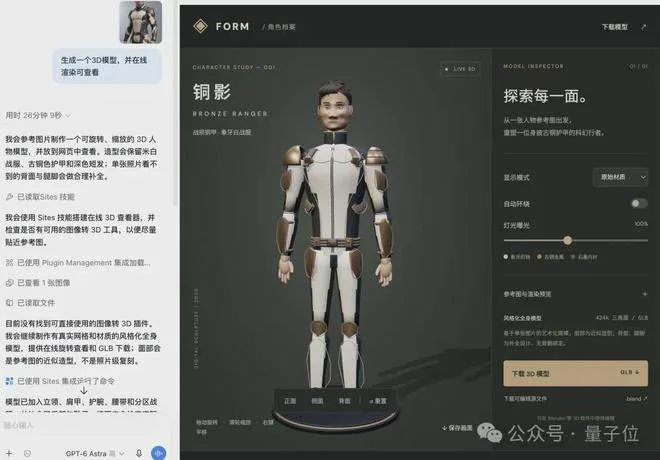
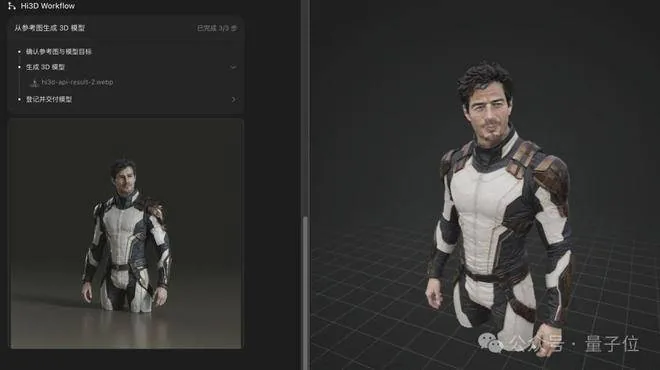
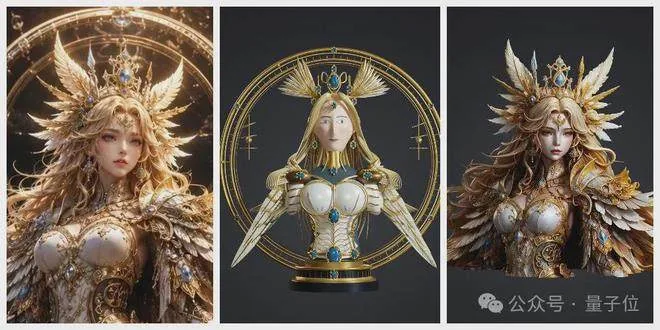
In several tests shown by QbitAI, an input portrait is rendered by, from left to right, the original image, GPT-6 Astra’s output and Hi3D Agent’s output. The article says Astra produced a recognizable basic form, while Hi3D Agent and the V3.0 model behind it came closer to the reference in silhouette, volume relationships and local detail.
Hi3D Agent is Hi3D’s AI assistant for 3D creators, and the model behind it, Hi3D V3.0, is described by the team as the industry’s first commercially available 2048³ ultra-high-precision self-developed Chinese AI 3D model. The article frames this as a division of labor: large language models interpret creative intent and organize tasks, while dedicated 3D models generate the geometry.
What is actually open source: V1.0
The release covers V1.0 model code — a high-resolution geometry refinement model built on Sparc3D, and one of the earlier, production-validated versions in the Hi3D series. The code is on GitHub and Hugging Face; the official project page offers downloads, and a Hugging Face Space offers free trials.
Architecture and benchmark numbers
Sparc3D was published in 2025 at NeurIPS 2025, proposing a high-resolution 3D modeling framework focused on representing and reconstructing complex geometry. Hi3D V1.0 keeps that core architecture and scales training from the paper’s 500,000 assets to about 2 million curated 3D assets, roughly four times more.
Generation works coarse-to-fine: an upstream model produces a coarse mesh for overall shape and major parts, then V1.0 refines sparsely around the surface using both the image and the coarse mesh, stepping through 1024³ and 1536³ levels. 1536³ is the resolution of the extracted geometry mesh — the finer the steps, the better small bumps and gaps can be expressed.
According to its technical report, V1.0 scores 0.75 on multi-view fidelity and 0.841 on detail richness, ranking first among the methods compared in the report, with a 90% slicing success rate. Slicing is the prep step that turns a 3D model into layer-by-layer printer instructions; actual printing still depends on wall thickness, supports and materials.
Models, agent and interfaces
Beyond the open model, Hi3D can be called through MCP: developers can invoke it from MCP-compatible agents or tools to submit generation jobs, check progress and retrieve results. Hi3D Agent serves creators directly — users describe needs in natural language and keep adjusting shape, local structure, geometry, texture and mesh on an existing model, then move toward part splitting, coloring and print prep, or download the result for Blender or a game engine.
Per the article, researchers can use V1.0 as a base for technical validation and model research, developers can plug the geometry refinement into their own workflows, and enterprises can explore private deployment and internal integration subject to the officially published licensing and deployment terms.