China Telecom Open-Sources a 29B Intent Model That Fills in the Parameters

On October 19, the XingChen AGI Lab under China Telecom’s AI subsidiary open-sourced Xing4.0-29B-Intent, extending intent understanding from “figuring out what the user wants” to “filling in the structured parameters at the same time.”
- Release date: October 19, 2026
- Version: Xing4.0-29B-Intent, 29B parameters, fine-tuned on the XingChen 29B base
- Price: free and open source, code under Apache 2.0
- Availability: live at launch on GitHub (TeleChat-USP repo), Hugging Face, ModelScope and Modelers
- Weights open?: yes. Model weights, 2.753 million SFT samples, an inference SDK and an official image are all released
The launch lands amid the buzz around Jev. TypeSafe AI’s “System 1 model” offers three decision primitives: Noul for yes/no boolean judgments returning a probability between 0 and 1, Choice for picking one of several mutually exclusive options, and Score for rating on an ordered scale. They run in parallel with latency as low as 70 milliseconds, inside a 70–500 ms band.
Its insight was that high-frequency, low-latency work like intent recognition does not need a trillion-parameter model to “think hard.” But primitive outputs are bounded by candidate options and cannot cover open-ended parameter extraction. Tell a system to set the east showroom lights to 80% at 4000K, the west side to 30% at 2700K, and leave the entrance lights alone, and recognizing “adjust lighting” is only step one. Objects, values, attribute mappings and the “do not touch” boundary all remain.
Xing4.0-29B-Intent merges both jobs into one model and returns a unified category+args hierarchical JSON: category holds the intent, args hold the parameters, doing multiple-choice and fill-in-the-blank in one pass. (For general readers: zero-shot means recognizing new categories without examples; a schema constraint means outputs must match a predefined field structure, which curbs format drift.)
| Dimension | Jev (TypeSafe AI) | Xing4.0-29B-Intent |
|---|---|---|
| Positioning | Noul/Choice/Score primitives for predefined decisions | Intent classification plus parameter extraction in one JSON |
| End-to-end latency | 70–500 ms | under 150 ms |
| Zero-shot Micro-F1 | 12.62 points lower | 70.27 |
| Strict exact-match score | 21–48 | 61 |
| Openness | not mentioned in source | weights, 2.753M samples, SDK, image, Apache 2.0 |
Zero-shot lead of 12.62 points, wider gap on exact match
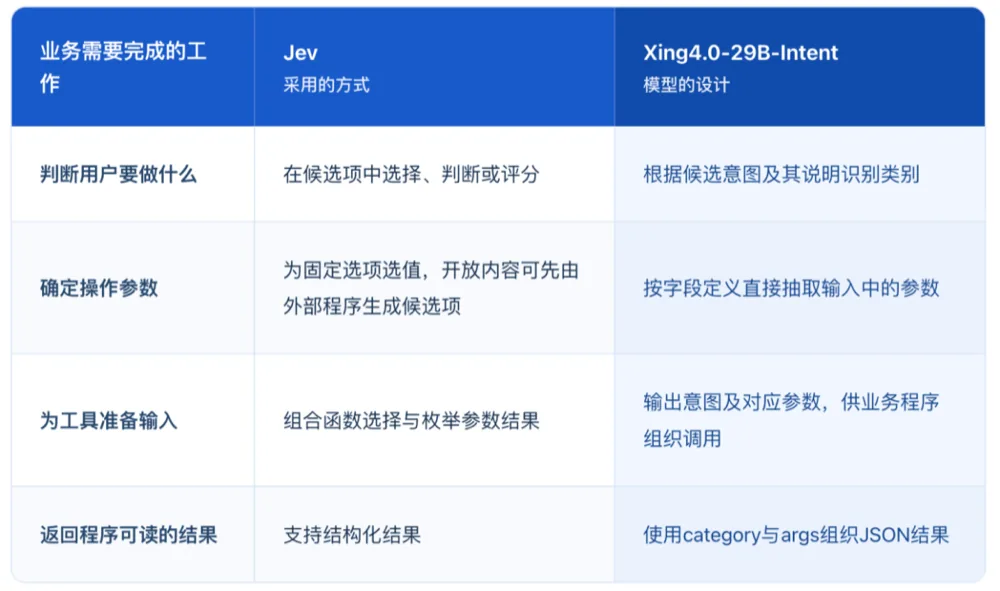
Zero-shot cold start targets the costliest part of deployment: every new business scenario usually means re-collecting intent categories, labeling data, sometimes retraining. A model that can identify new categories and extract parameters with few examples cuts integration work.
On the zero-shot cold-start benchmark, Xing4.0-29B-Intent reaches a Micro-F1 of 70.27, 12.62 percentage points above Jev’s best configuration and ahead of GPT-4.1.
The sharper contrast is on the strict exact-match metric: Xing4.0-29B-Intent scores 61, while Jev’s two configurations land between 21 and 48. The gap there matters more than the Micro-F1 margin, because a partially correct parse still needs human or rule-based cleanup before a business system can act on it. Part of the difference is task design: Jev optimizes fast decisions inside predefined options, while Xing4.0 must handle entities, attributes and parameters inside the input text.
On a unified leaderboard covering 48 public datasets, Xing4.0-29B-Intent posts an Overall score of 58, nine points above runner-up Gemini-3.6-Flash, leading across entity recognition, relation extraction, event extraction and intent understanding. The backbone is a framework called USP (Unified Schema-driven Semantic Parsing), which folds all four task types into one output structure so model output and downstream interfaces need less format reconciliation.
On data, the team says its 2.753 million SFT samples were rebuilt from 61 public datasets, spanning 19 domains and 52 languages, making it the largest open intent-understanding corpus of its kind; related work on terminal-interaction data has been accepted to EMNLP 2026.
11 real-world tests: solid binding, weak on negations
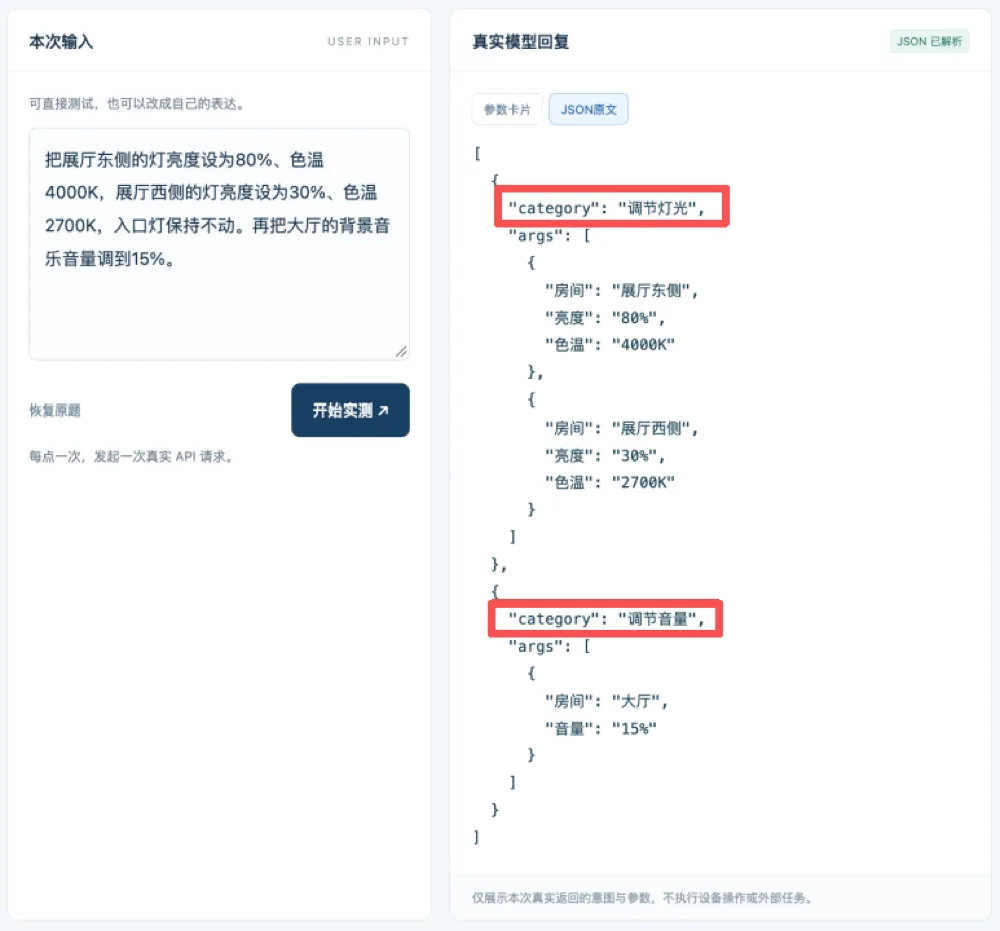
Zhidx ran 11 tests through the API across smart spaces, smart cockpits, enterprise workflows, office collaboration and personal agents.
Multi-object parameter binding held up. In one lighting-and-audio instruction, the model returned two intents, attached two parameter objects to lighting, and correctly excluded the entrance lights marked as untouched. In enterprise scenarios, tickets for two stores, reimbursements for two people and the owners and budgets of two projects stayed separate. In an office test, when meeting time, place and attendees were changed mid-conversation, the previously agreed 30-minute duration was preserved.
The miss came on physical-device negations. In the cockpit test, “do not open the rear windows” was parsed as closing the windows at 0% opening; if a rear window was already partly open, executing that parameter would change its state. The lesson: for real hardware, a correct parameter is not the same as a safe action, and a business-rule layer is still needed. On the plus side, in the personal-agent test the model kept “cancel tomorrow’s meeting” inside a memo as recorded text rather than executing it.
Who should try it now, and who should wait
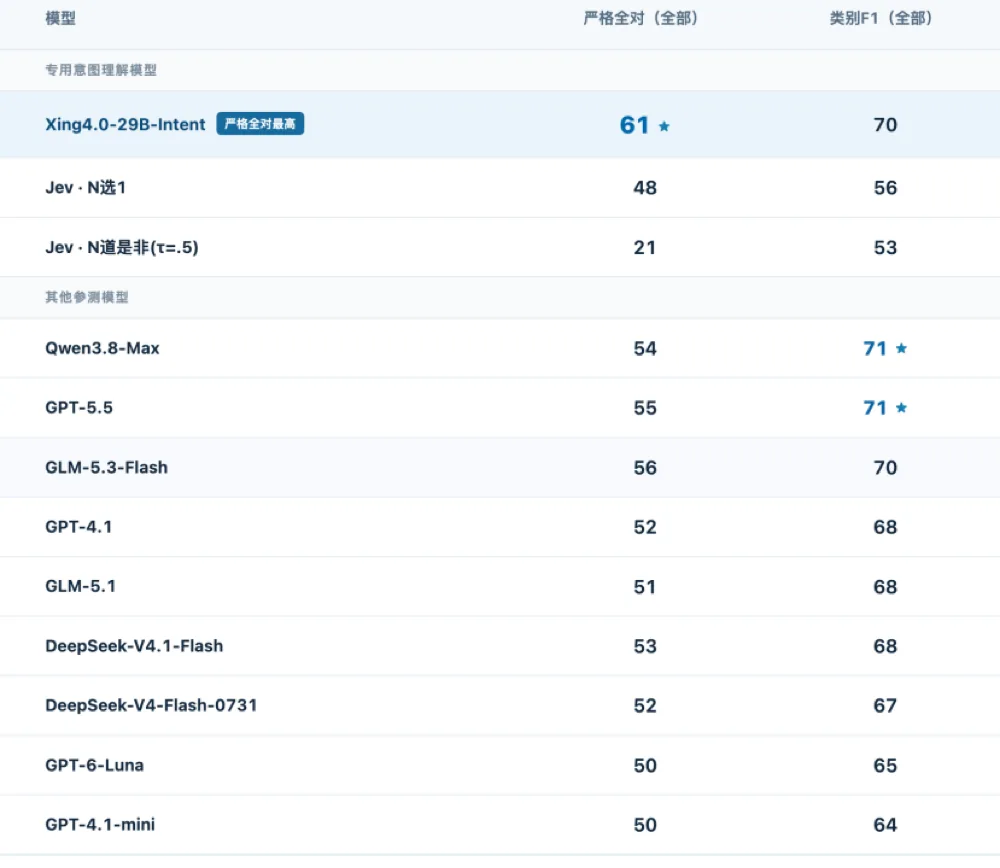
- Try now: teams building phone voice assistants, smart-home hubs, cockpits, customer service and office systems. These scenarios share fixed fields, high-frequency commands and latency sensitivity, and with weights, corpus and SDK open, a small-sample pilot on your own data is cheap.
- Wait: teams that need zero human fallback end to end, or that directly drive physical devices. A 29B model is not cheap to deploy, the negation miss shows control commands still need rule checks, and its sub-150 ms latency is slower than Jev’s 70 ms floor, so latency-critical products should benchmark first.
Final thoughts
Jev’s rise and Xing4.0’s release point the same way: hand high-frequency, well-defined work to specialized models and leave general models’ compute for harder reasoning. As specialized models move from judging intent to filling in parameters, agent competition is shifting from what can be demoed to whether the underlying semantic interface is stable enough. The unglamorous parameter-alignment layer may be what actually sets deployment speed.