
Overview
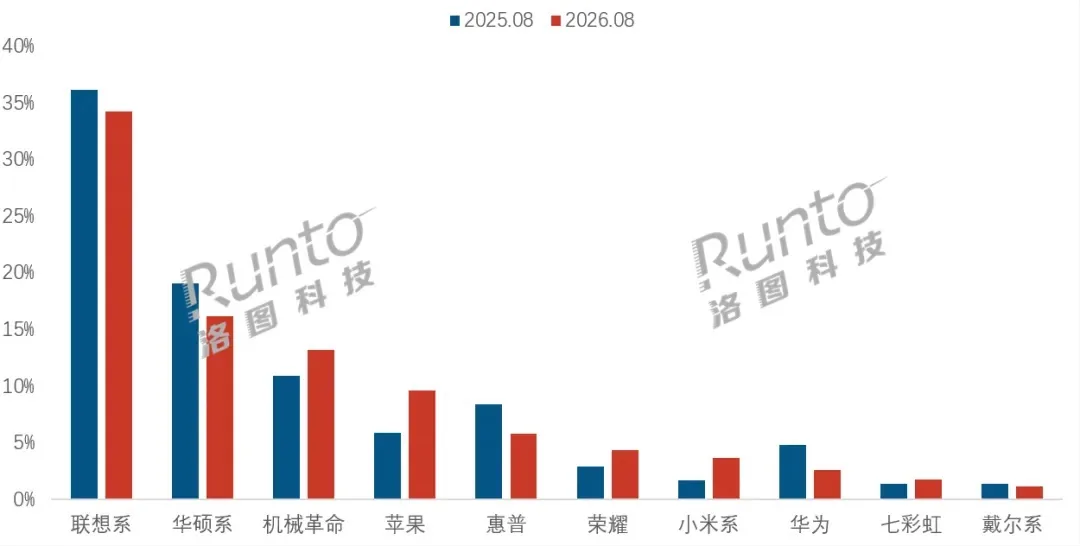
RotoTech released its report on September 27, 2026, revealing the online laptop market performance in China for August 2026 (excluding enterprise official platforms). Sales reached 1.223 million units, down 20.8% year-over-year; revenue stood at RMB 9.64 billion, down 11.1%; however, the average selling price soared to RMB 7,885, up 12.3% year-over-year, reflecting a typical pattern of declining volume but rising prices.
Market Structure: High-End Resilience vs. Mid-End Squeeze
Price bracket distribution shows a pronounced structural split. The RMB 4,000–5,999 segment, propelled by Apple’s entry-level models, captured 28.7% share—up 8.7 percentage points year-on-year—overtaking the 6,000–7,999 yuan segment as the second-largest sub-market. This outcome presents a notable anomaly: despite overall sales declining sharply, Apple’s entry-point models supported relatively stable share in the mid-tier segment.
The premium RMB 10,000+ segment delivered the strongest growth, with share rising to 23.7%, a 11.6-percentage-point year-on-year increase. AI flagship laptops and professional creation notebooks formed the core of this growth, signaling strong consumer resilience among performance-oriented buyers.
Starkly contrasting, the RMB 6,000–7,999 segment dropped to 17.0% share, down 10.6 percentage points year-on-year. This mid-to-high-end transitional “sweet spot” now faces pressure from both above and below—squeezed by Apple’s upward price creep and emerging AI-powered competitors.
Entry-level models under RMB 4,000 continue to contract, with notably reduced product variety. Some brands have paused subordinate product lines entirely. RotoTech attributes this to prolonged consumer memory chip shortages, forecasting the tight supply-demand imbalance to persist at least until 2027. Rising component costs naturally erode margins for low-spec laptops, necessitating reduced supply.
Key Metrics Summary
| Price Bracket | August 2026 Share (YoY Δ) | Primary Driver |
|---|---|---|
| RMB 4,000–5,999 | 28.7% (+8.7pp) | Apple entry models |
| RMB 6,000–7,999 | 17.0% (-10.6pp) | Intensified competition |
| RMB 10,000+ | 23.7% (+11.6pp) | AI flagships & professional creators |
Purchase Recommendations
- Upgrade seekers: If AI capabilities (e.g., on-device large language models, smart video editing) or pro-creative workflows (4K video, 3D rendering) matter, premium RMB 10,000+ laptops offer improving value; autumn’s launch cycle presents favorable timing.
- Students and office users: The RMB 4,000–5,999 segment now features more options, with Apple entry models and high-value Windows alternatives forming dual tracks; prioritize post-Back-to-School promotions ending this month.
- Wait and observe: Entry-level laptops under RMB 4,000 face scarce supply and aging configurations; adding RMB 1,000–1,500 to budget secures longer product lifecycles.
In Closing
As memory costs remain elevated, manufacturers are optimizing their product portfolio via tiered configuration strategies, moving toward a new equilibrium of “high-spec premium, refined mid-tier, and entry-level.” Should AI chip capacity fail to scale as expected this quarter, the premium segment’s pricing resilience may prove unsustainable.