
Chery Puts a Domain Model on Stage

On the morning of Oct 20, at its 2026 Global Innovation Conference, Chery introduced CheryMind, a domain-specific foundation model that the company positions as built for physical AI.
Two quick definitions: a domain-specific foundation model is trained on top of a general base model using an industry’s own data to serve that industry’s tasks; physical AI refers to models that understand and act on real-world equipment such as cars and robots.
The hard facts announced on stage:
- Unveiled: Oct 20, 2026, at Chery’s Global Innovation Conference
- What it is: a domain-specific foundation model, positioned for “physical AI”
- Usage: 60,000+ employees use it every day
- Reach: 200+ business scenarios, 400+ enterprise systems connected
- Data: 700TB of enterprise knowledge, 200PB of engineering data
- Not disclosed: parameter count, version, pricing, whether weights are open, external availability
The source material for this story is thin, so the points above are the whole of the factual record.
Employee Count First, Parameters Never
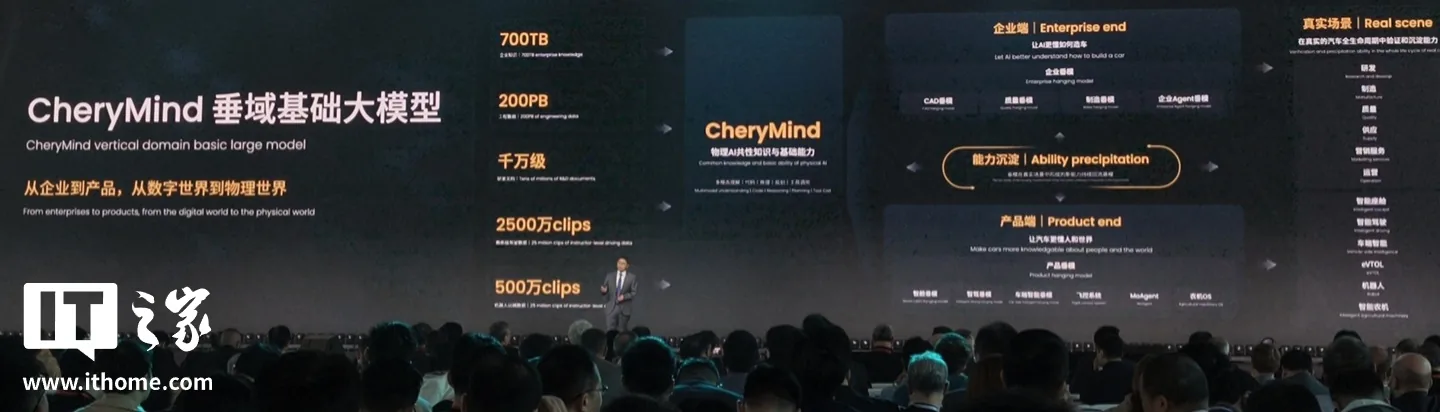
Most foundation-model launches open with parameter counts, benchmark scores and open-source licenses. Chery’s message contains none of those, offering instead “60,000+ employees using it daily,” “200+ business scenarios” and “400+ enterprise systems connected.” The company made internal adoption, not model size, its headline metric — for a carmaker, that reads more like a progress report on a system already in production than a launch of something still to be validated. In industry terms, connecting 400+ enterprise systems usually means wiring the model into ERP, MES, OA, R&D and supply-chain workflows rather than leaving it in a chat box.
The data gap is the most striking number. 700TB of enterprise knowledge and 200PB of engineering data are not on the same scale: at 1PB = 1024TB, 200PB is roughly 205,000TB, about 290 times the knowledge figure. In other words, engineering data is the real body of training material here, and the knowledge base is a small slice of it. That fits the “physical AI” framing — geometry, operating conditions, simulation and sensor data rather than document Q&A.
The model was not the only item on the agenda. Material on the same page notes Chery’s Ziwei chip made its debut with three series and five package types, with 8-inch wafers already in mass production; chairman Yin Tongyue described Chery as “an AI technology company wearing a carmaker’s vest” and said companies that dare not rebuild themselves with AI will be eliminated; a pre-conference notice also mentioned a humanoid robot named “Mobao.” Taken together, CheryMind looks like the software layer inside a broader AI narrative.
Who Should Watch, Who Should Wait

- Worth watching: people running automaker AI platforms, enterprise knowledge bases or engineering-data governance. CheryMind discloses an operating set of metrics — scenarios, systems, data volume — that domain-model vendors rarely put forward, making it a useful yardstick for internal projects.
- Better to wait: developers and outside enterprises hoping to call the model. There is no public information on APIs, pricing, open weights or availability, so for now it looks like an internal productivity tool rather than a purchasable product. Teams that want to build with physical AI should wait for an access point or technical detail.
Final Word
The real signal in CheryMind is not parameter count but the claim that 60,000 employees use it daily — it moves the yardstick for large models from leaderboards back to the production line. Whether a domain model holds up depends on whether scenarios and systems are genuinely connected. Whether it deserves the label “physical AI” will have to wait until Chery publishes the model’s capability limits and data sources.