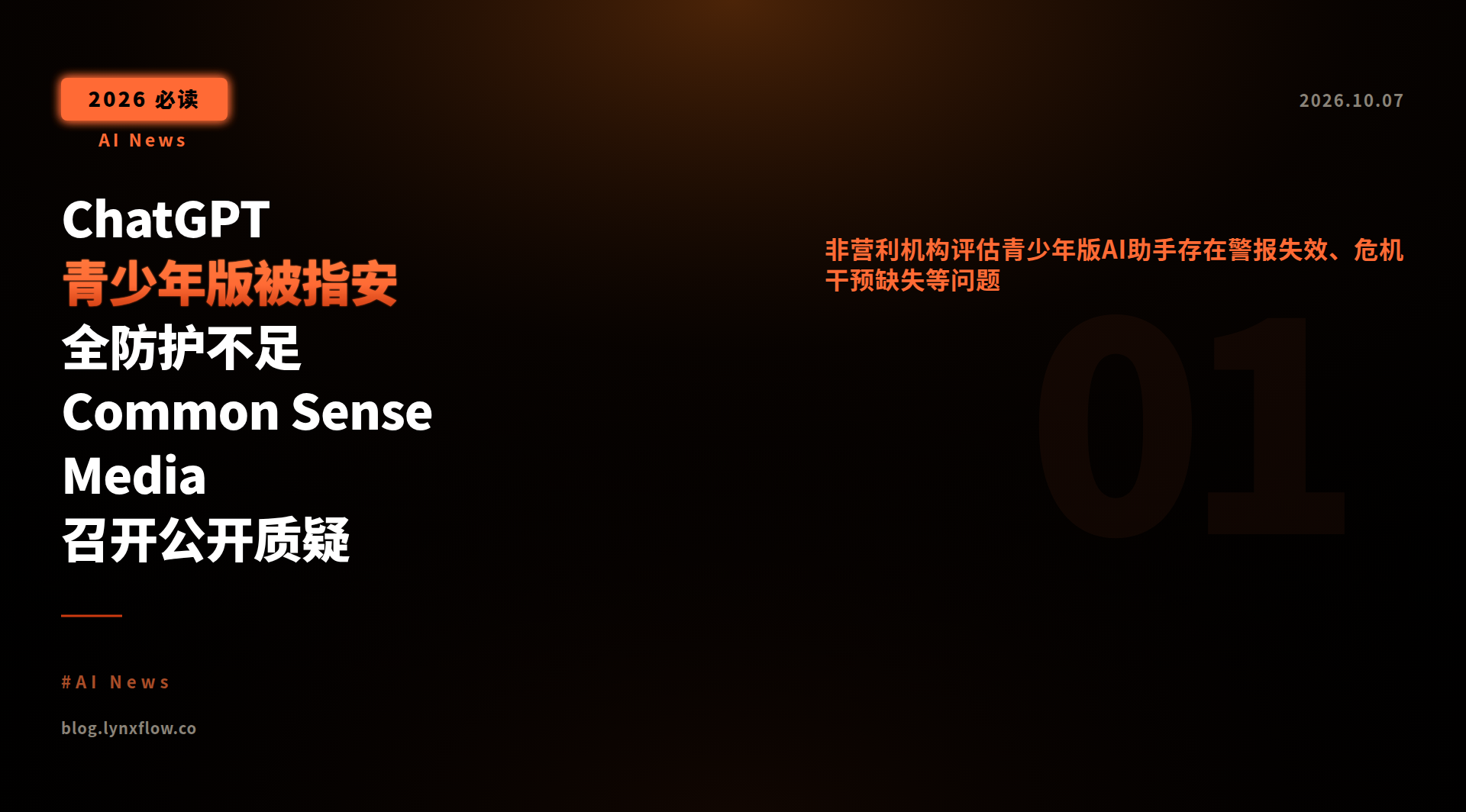
Key Event: Nonprofit Publicly Challenges Safety Protections of ChatGPT for Teens

Common Sense Media today released a formal assessment report rating OpenAI’s ChatGPT for Teens as an “unacceptable risk.” The service officially launched in August and is designed for users aged 13–17, with built-in safety protections for teens.
Key facts are as follows:
- Launch date: August
- Target users: Teens aged 13–17
- Design goal: Support learning, with built-in protections for teens
- Claimed safety features: Eating disorder alerts, Study Mode, parent alert system
Safety Mechanisms Fail: Three Key Problems Confirmed
Common Sense Media’s assessment focused on how well the teen protection measures work in practice and found the following issues:
- Parent alert system fails: “It raises alerts when it shouldn’t, and stays silent when it should.” The assessment specifically noted that a teen user could discuss self-harm content for an hour straight without the parent receiving any notification.
- Inadequate crisis intervention response: The system did not provide “appropriate help” in crisis situations, such as failing to promptly direct users to professional support during a mental health crisis.
- Homework cheating remains a problem: Although it claims to be intended to help students learn, the system can still directly complete students’ homework.
Unexpected finding: OpenAI later acknowledged that newly linked parental control accounts may take several hours to activate the alert system. Common Sense Media said that some test accounts, despite being linked beyond this activation window, still failed to trigger alerts—a fact that did not change its core conclusion that “the alert system is unreliable in crisis situations.”
Both Sides Clash: Assessment Methodology Becomes the Focus of Dispute

OpenAI responded through spokesperson Eric Porterfield, questioning the accuracy of the assessment:
“Our review found that most of the tests may have been completed before parental controls were fully activated, meaning their conclusions do not reflect actual performance.”
Common Sense Media executive director Tom Siegel responded:
“Before testing, we confirmed that all teen mode features—including eating disorder notifications and Study Mode—were live. As for the delayed parent alerts, even accounting for activation time, long-running test accounts still failed to receive notifications, which undermines the foundation of the system’s reliability.”
The key discrepancy acknowledged by both sides is:
- Common Sense Media claims it confirmed before testing that the features were fully enabled.
- OpenAI emphasizes that the tests may have been completed before the system was fully ready.
Feature Comparison and User Recommendations
| Feature | ChatGPT for Teens (claimed) | Common Sense Media (actual testing) |
|---|---|---|
| Parent alert triggering | Should notify parents in a crisis | Many missed alerts |
| Eating disorder alerts | Fully enabled | Actual triggering was not verified in testing |
| Study Mode | Prevents homework cheating | May still complete students’ homework |
| Crisis intervention | Provides appropriate help | Did not provide sufficient support |
Actionable recommendations for readers:
- May be suitable: Families that have already verified the effectiveness of parental monitoring systems on other platforms and maintain frequent offline communication with their teens can try a short-term test, but they must manually enable and check the parental control panel settings.
- Recommended to wait: Families without established digital supervision habits and teens with a history of mental health risks—until the alert system is independently verified as effective, they should choose more closed, teen-specific tools.
Final Thoughts
Teen AI safety assessment has entered a stage of substantive confrontation. At its core, this debate is not about whether technology can protect, but whether protection mechanisms can withstand real crisis scenarios. When companies emphasize that “guardrails exist” and independent organizations ask whether “guardrails work,” establishing a closed regulatory loop must rely on reproducible third-party verification mechanisms.