
The AI Course That Went Viral Overnight
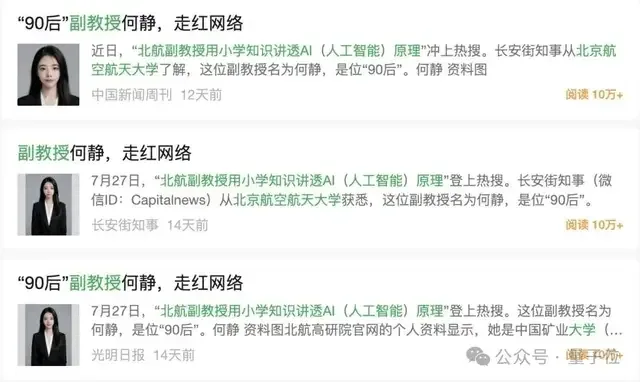
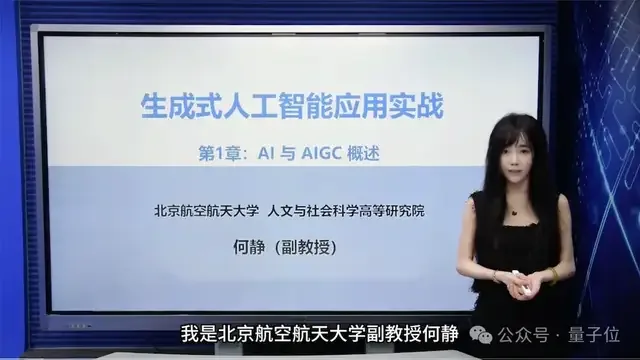
He Jing, a 35-year-old associate professor at Beihang University, went viral on Bilibili for explaining AI applications in accessible terms — a moment that also thrust a university educator into the intersection of public scrutiny, science communication, and academic evaluation. Her videos cover generative AI principles, AIGC applications, Agent development, AI integration with CAD, AI-generated PPTs, and OpenClaw deployment. She often likens generative AI to a “kitchen,” with different large language models as chefs specializing in different cuisines — a metaphor netizens praised as “so simple even a three-year-old could understand.”
The real explosion of attention came in October 2025, when a recorded lecture was reposted on short-video platforms, racking up over 2 million views. He Jing noted that her previous highest-performing video had topped out at just over a million views, signaling that her reach had clearly exceeded the classroom. She subsequently opened a Bilibili account and organized what had been scattered software demos and classroom content into AI tutorials aimed at the general public.
Controversy Shifts from Course to Credentials
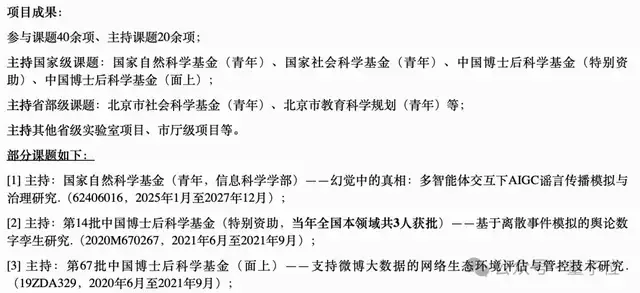
With fame came skepticism. Discourse quickly pivoted from teaching quality to her appearance, educational background, and research output. Public records show that He Jing earned her undergraduate degree from Sichuan Agricultural University, her PhD from China University of Mining and Technology (Beijing) in geoinformatics engineering, and completed postdoctoral research in journalism and communication at Tsinghua University. Beihang University’s official profile lists over 40 publications and more than 20主持ed research projects.
Key controversies surrounding her center on:
- Career trajectory: Critics label her path as “four major pivots.” She responds that her pre-PhD studies were largely foundational, and the true跨界 occurred when she moved from geoinformatics engineering into journalism and communication.
- Project and publication volume: Some question how a young associate professor can carry so many projects. He Jing argues that public-opinion research tied to AI is highly time-sensitive — research subjects can rapidly lose relevance as the technology evolves, and certain fields demand faster engagement with real-world developments.
- Academic evaluation criteria: She emphasizes that the older “standard path” of evaluating talent is insufficient; research directions that align scarce expertise with real-world needs matter just as much.
Here, “public opinion” (舆情) refers to the formation, diffusion, and evolution of public sentiment on digital platforms — a process that typically calls for analysis spanning data science, communication studies, and governance perspectives.
Rewriting AI Communication Through a Lens of Media Studies
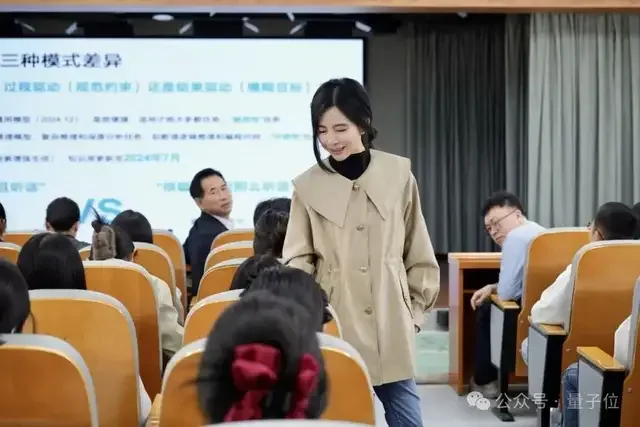
He Jing attributes her approach to science communication to her interdisciplinary background. She says that her STEM training taught her how to analyze the world, while journalism and communication taught her how to converse with an audience: the first question in any lecture isn’t “what do I want to say,” but “what do my listeners need — and what can they actually understand?” This is precisely why she insists on low-barrier explanations of AI.
She recalls being frustrated in 2016 when she first encountered AI content that was so technically dense she couldn’t grasp the key ideas — until she stumbled upon a well-made explainer video that finally made it click. That experience shapes her approach today: she imagines her audience as the person she once was — unfamiliar with AI, even intimidated by it.
Beyond Bilibili, she has also used AI tools to address online rumors. In response to baseless claims circulating on the internet, she produced an AIGC short film titled Rumors Come True, writing absurd rumors directly into the script. AIGC — “AI-Generated Content” — refers to text, images, audio, or video produced by AI models. She believes that in an algorithm-driven media environment, corrections rarely outpace more sensational rumors, and AI has given everyday creators a new means of expression.
AI Tools Meet Content Operations
He Jing doesn’t just talk about AI — she puts it to work in her own content operations. She revealed that a portion of routine comments and direct messages are already handled by AI agents; OpenClaw helps her reply to some of the content. She also checks in periodically to step in personally when a question requires a human touch. An AI agent can be understood as a software proxy capable of autonomously executing multi-step tasks according to instructions.
On the tools front, she mentioned testing various options, including Claude Code and Codex — the latter of which she previously used to reply to comments during Bilibili livestreams. These practices demonstrate that her AI education goes well beyond conceptual lectures; it’s woven into real workflows, platform interaction, and content production.
Looking at her publicly shared video topics, AI for research, AI for the office, and AI for creativity stand out as the scenarios where everyday users feel demand most acutely: some want AI to assist with literature and information management, others are interested in productivity tools like PPT and document workflows, and still others are using AI for video and design production. For science communicators, the real challenge isn’t merely introducing tools — it’s situating them within concrete tasks so that non-technical audiences know when to reach for them, how to get started, and how to troubleshoot when things go wrong.
The Next Stop for AI Literacy
He Jing’s rise is more than a personal story — it reflects a new set of needs as AI enters the mass-learning phase: users don’t lack concepts; they lack approaches that are actionable, transferable, and clearly explained.
From an industry perspective, AI education is shifting from expert-driven narratives to scenario-driven ones. Whoever can translate complex models into workflows that ordinary people can understand and operate is best positioned to capture attention and earn trust. The He Jing case also serves as a reminder for universities and platforms: AI science communication brings influence, but it also amplifies personal controversy. What will truly matter going forward isn’t just making AI sound exciting — it’s helping more people integrate AI stably and cost-effectively into their learning, research, and work.