
Core Announcement: Booster K1 Explorer Edition Now on Sale
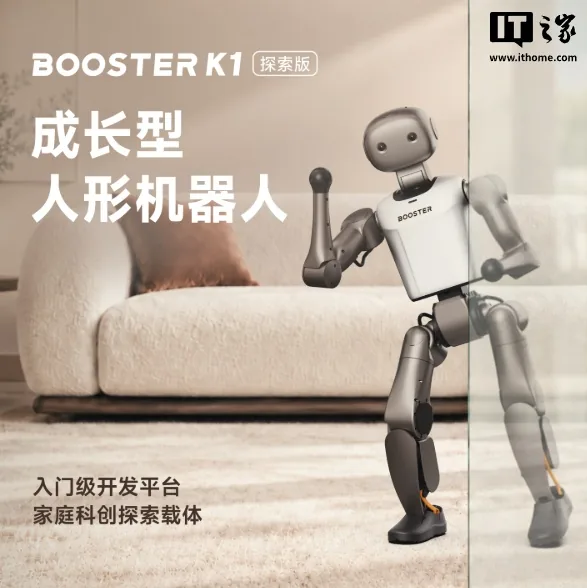
Suqian Evolution officially launched its Booster K1 Explorer Edition humanoid robot on September 18, 2026, marking the product’s market entry. Key factual highlights:
- Release date: September 18, 2026
- Product variant: Booster K1 Explorer Edition
- Jingdong retail price: ¥38,999
- Product positioning: Entry-level ready-to-use unit for embodied AI development
- Physical specs: ~95 cm height, ~19.5 kg weight
- Degrees of freedom: 22 joints
- AI model: Doubao LLM (pre-installed)
- Development support: Open API, OTA update capability
Technical Details: Specifications and Interaction Capabilities
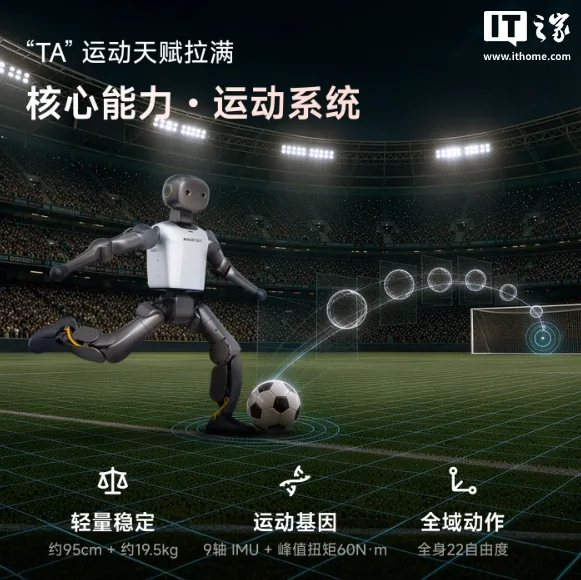
The Booster K1 Explorer Edition emphasizes developer-friendliness and extensibility. Its hardware includes a stereo depth camera, ring-shaped 3-microphone array with speakers—an integrated system for AI physical-world interaction.
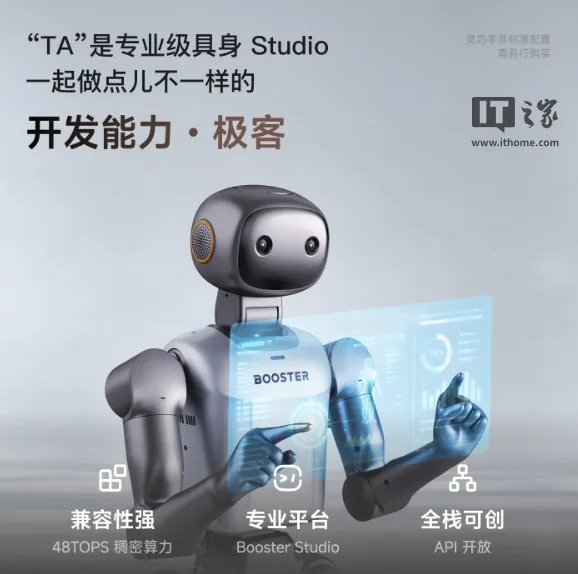
The unit is claimed to deliver 48 TOPS dense compute performance. Dense compute refers to peak inference performance when all model parameters participate in computation simultaneously—a harder metric than sparse or quantized alternatives.
A notable design choice stands out: the combination of 48 TOPS dense compute and a ¥38,999 price point is uncommon in the consumer humanoid robot segment. Many competitors at similar price brackets reduce costs by deploying lower-spec chips or enabling only quantized/lightweight model execution. The Booster K1 preserves full dense-model inference, enabling robust local AI experimentation.
Developers can customize the robot via its open API, building domain-specific applications on top of the provided SDK. OTA remote updates ensure software capabilities remain upgradable over time, reducing long-term maintenance overhead.
Specification Comparison

| Feature | Booster K1 Explorer Edition |
|---|---|
| Height | ~95 cm |
| Weight | ~19.5 kg |
| Degrees of Freedom | 22 |
| Compute | 48 TOPS (dense) |
| AI Model | Doubao LLM (built-in) |
| Sensing | Stereo depth camera, ring 3-mic array + speaker |
| Dev Support | Open API, OTA updates |
Who Should Buy?
Three user segments find the most alignment with this product:
- Universities and research labs: The 22-DoF platform supports classroom demos and algorithm prototyping;
- AI developers and startup teams: 48 TOPS local compute accommodates lightweight model deployment and rapid iteration;
- Robotics enthusiasts and makers: The all-in-one design avoids the need to develop motors, control stacks, or perception systems from scratch.
Enterprises or commercial operators are advised to wait for subsequent enterprise or industry-specific variants, particularly pending clearer information on after-sales support and integration tools. Home users should carefully evaluate whether the 19.5 kg weight meets household safety requirements, especially in environments with children or pets.
Final Thoughts
The Booster K1 Explorer Edition’s pricing and feature set reflect 2026’s emerging trend in Chinese humanoid robot development: achieving lower barriers through integrated hardware design and pre-bundled LLMs. If this approach gains traction across the industry, it may accelerate the transition of embodied intelligence from academic labs into reproducible real-world development workflows.