
On August 19, a question topped Zhihu’s hot list: “Have major internet companies started regretting their AI bets?”
One highly upvoted answer nailed it: Regret? Maybe not. But it hurts—yes, it does.
Tencent’s Q2 free cash flow turned negative for the first time—minus 13.8 billion yuan. Alibaba reported a full-year 2026 fiscal free cash outflow of 46.6 billion yuan. Baidu’s AI revenue now accounts for 50% of its total, yet its stock price has dropped 13%.
The numbers certainly look rough on paper. But I think the word “regret” misses the point. These companies have long since passed the “whether or not to pursue AI” stage. The real question on everyone’s mind is: can they survive as they are in three to five years if they don’t?
In this post, I’ll break down the numbers from the latest financial reports, trace where the money is actually going, and explain why no one can afford to hit the brakes.
1. Let’s Lay Out the Ledger
First, here’s a look at the latest AI-related capital expenditure and cash flow figures from a few major Chinese tech companies:
| Company | Latest CapEx | YoY | Free Cash Flow | Notes |
|---|---|---|---|---|
| Tencent (2026 Q2) | 52.78B CNY | +176% | -13.8B CNY (excl. compute prepayments: +37.6B CNY) | First negative in nearly 20 years; H1 cumulative: 84.72B CNY |
| Alibaba (FY2026) | 126.06B CNY | +46.63% | Net outflow of 46.609B CNY | Previous fiscal year saw a net inflow of 73.87B CNY; cash reserves: 520.8B CNY |
| Baidu (2026 Q2) | 11.4B CNY | +199.7% | Net outflow of 7.95B CNY | AI revenue accounts for 50%; stock down 13% |
| ByteDance (2026, supply chain estimates) | Up to ~$70B | — | Not disclosed | ~25B CNY in 2025 → could reach $100B by 2027 |
Data sources: Tencent, Alibaba, and Baidu earnings reports and conference calls; Shenzhen Business Daily, Blue Whale News, and Changjiang Securities research.
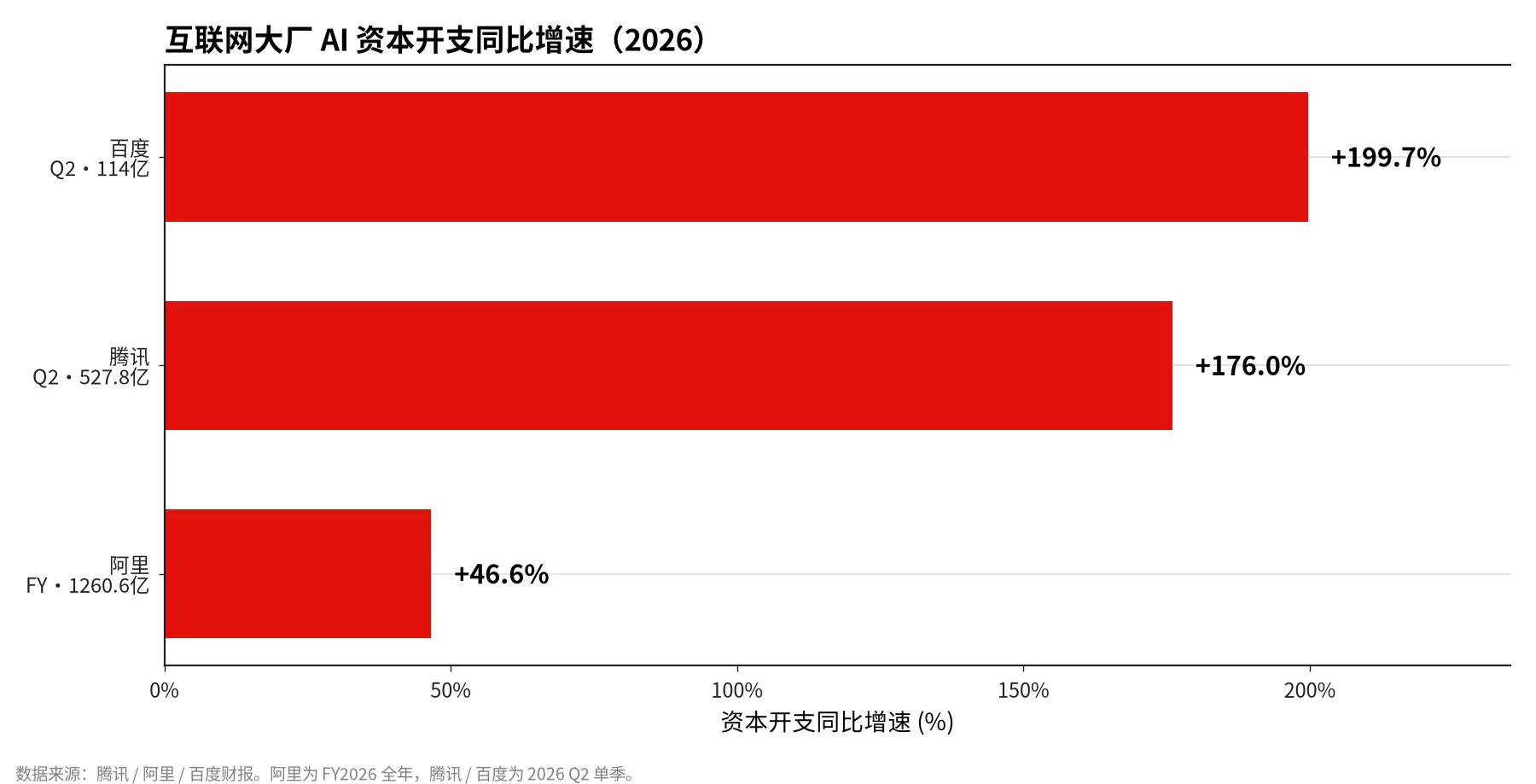
One detail is worth singling out: Tencent’s headline free cash flow of minus 13.8 billion yuan looks alarming, but strip out “compute procurement prepayments” and it’s actually +37.6 billion yuan. On the balance sheet, non-current prepayments surged from 24.5 billion yuan at the start of the year to 91.2 billion yuan—that’s the compute prepayment story laid bare. In other words, the money hasn’t disappeared; it’s been front-loaded into compute commitments.
Tencent’s net cash position plummeted from 146.86 billion yuan at the end of Q1 to 58.2 billion yuan, which looks like “running out of money” at a glance. But total cash reserves still stand at 511.1 billion yuan, and the new borrowing comes at low rates of 0.75%–3.5% in RMB. This is deliberate leverage to secure compute capacity, not a broken capital chain.
2. Who’s Getting the Money—The Value Chain Is Shifting Upward
The world’s top nine cloud providers will burn through roughly $830 billion in a single year (up 79% YoY), with 40%–50% of that increase driven purely by chip price inflation. The five North American hyperscalers are projected to spend $785 billion on CapEx in 2026. The CapEx-to-operating-cash-flow ratio has already skyrocketed from 46% in 2024 to well over 110%—meaning the entire industry is seeing free cash flow turn negative.
So where’s the money going? NVIDIA, TSMC, optical module makers, data center operators, power infrastructure, and top-tier AI researchers—these are all the more certain “shovel-sellers” in the gold rush. AI scientists command salaries of 130,000 yuan per month; one company reportedly offered a chief scientist a package worth 124 million yuan. ByteDance has been rumored to be spending nearly 100 million to recruit talent. Money is flowing upstream along the value chain.
What’s even more sobering is the “burn money, see no return” problem. Meituan CEO Wang Puzhong put it bluntly: many companies are investing heavily in AI and ending up with nothing but noise. Token consumption has skyrocketed, but the logical link between investment and user experience improvements hasn’t yet been established.
But the statement “all the money is being captured by semiconductor and model companies” is only half true. Alibaba’s Cloud Intelligence Group revenue in Q4 of fiscal 2026 reached 41.626 billion yuan, up 38% year over year, with AI-related product revenue of 8.971 billion yuan—marking 11 consecutive quarters of triple-digit growth. Cloud and model services are genuinely generating revenue.
3. The Most Unique Variable: DeepSeek
There’s a variable in China that doesn’t exist in the U.S.—DeepSeek trained competitive models with relatively modest resources, sending a clear signal across the industry: spending more doesn’t automatically mean better results.
This signal is already shaking the “burn cash = build a moat” narrative. In late July, DeepSeek slashed the input cache hit price across its entire V4 series API to one-tenth of the launch price, with V4-Pro dropping from 1 yuan per million tokens to just 0.1 yuan. Shortly after, OpenAI cut its entry-level Luna price by 80% on July 30. The big tech companies have shifted from “mindlessly burning cash” to “calculating the cost per token.”
This raises a genuine question: if you can achieve 90% of the results by spending one-tenth the money, what exactly are these companies buying when they pour hundreds of billions into training their own foundation models—capability, or just a seat at the table?
4. Valuation Restructuring: From Light-Asset Platforms to Heavy-Asset Compute Factories
This is the real essence of the “AI capital game.” Internet giants are being forced to transform from “light-asset platforms” into “heavy-asset compute factories,” and their valuation logic is shifting from “steady returns on existing assets” to “growth premium on incremental bets.”
Here’s a sharp angle to consider: AI is not a savior for big tech—it’s a catalyst for valuation restructuring. Giants are trapped in an “impossible trinity”: they can’t simultaneously maintain high PE valuations, stable cash flow returns, and breakthroughs in AGI technology.
Look at Zhipu as a reference point: a company with 2025 revenue of 724 million yuan, a net loss of 4.718 billion yuan, and R&D spending of 3.18 billion yuan (4.4× its revenue) briefly touched a market cap of 1 trillion HKD. Why? Because of its scarce identity as the “first large model company.” But the moment Kimi K3 was released and that scarcity evaporated, 300 billion HKD in market value vanished in two trading days. When the scarcity premium fades, the market cap finds its true level on its own.
5. So—Do They Regret It?
No. What these companies are buying with their AI bets isn’t current revenue. It’s three things:
- Defense: If you don’t invest and your competitor does, in three years their search, recommendation, and ad efficiency could be 20% better than yours—and your market share will slowly get eaten away.
- A ticket to the cloud business: Enterprise customers now ask about AI capability as their first question when evaluating cloud providers. No AI answer means no new orders.
- A lifeline for the next decade: Skip AI, and the real question becomes whether you can survive as a company in three to five years.
The actual winners at this stage are the “shovel sellers” and “mine rights owners”—compute providers, semiconductor firms, and model companies. What the big tech companies are betting on is whether they can evolve from “shovel buyers” into “those who actually strike gold.” Until they do, the pain is just tuition they can’t avoid paying.
References
- Big Tech’s All-In Bet on AI (Shenzhen Business Daily, Tencent Earnings Breakdown)
- Tencent’s 84.7 Billion in CapEx: Opportunities and Hidden Risks (Blue Whale News)
- China’s AI Compute Chain: Model Progress × CSP CapEx Acceleration (Changjiang Securities Research)
- Have Major Internet Companies Started Regretting Their AI Bets? (Zhihu · Xiaohézi: Defense/Efficiency/Cloud)
- Have Major Internet Companies Started Regretting Their AI Bets? (Zhihu · Chen Mo: Financial Report Analysis)
- Just How Cash-Strapped Is Zhipu? (Zhihu · Kuaima Finance Media)
- Is Zhipu’s Trillion-HKD Market Cap a Scarcity Mirage? (Zhihu · Bowang Finance)
- What OpenAI’s Price Cuts Reveal About China’s AI Investment Strategy: Efficiency First (Xueqiu)