
Quick Overview
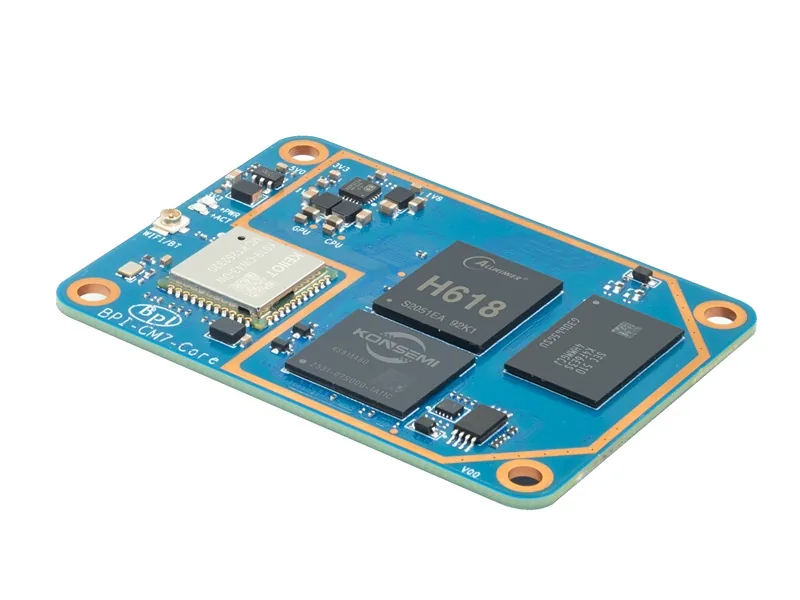
Banana Pi officially launched the BPI-CM7 System-on-Module (SOM) in late September 2026, with IT之家 reporting it on October 5. The product targets compact embedded projects requiring balanced compute capability.
- Processor: Allwinner H618 SoC featuring quad-core Arm Cortex-A53 + Arm Mali-G31 GPU
- Memory & Storage: 2GB onboard LPDDR4 RAM, 32GB eMMC flash
- Wireless: Kertong K019 module based on Infineon CYW43455, supporting Wi-Fi 5 (1×1) + Bluetooth 5.1
- Persistence: 256-byte EEPROM
- Dimensions: 55mm × 40mm
- I/O Expansion: Via two 100-Pin connectors: HDMI, 100Mbps Ethernet, 1×USB 2.0 OTG, 3×USB 2.0 Host, microSD slot
- Availability: Launch date and pricing not disclosed in current报道
Technical Details
The CM7 uses the Allwinner H618 SoC, built around a quad-core Arm Cortex-A53 cluster running up to 1.8GHz (industry-wide spec, not directly cited). The Mali-G31 GPU provides basic 3D acceleration. LPDDR4 RAM offers lower power consumption and higher bandwidth than LPDDR3, while the 32GB eMMC suffices for lightweight OS deployments and app storage.
A notable trade-off: the module ships with 1×1 single-stream Wi-Fi 5 (802.11ac). Compared to common 2×2 dual-stream configurations in the same price range, this halves the theoretical peak throughput, though it reduces power draw and RF complexity—suitable for edge nodes where bandwidth demands are modest.
At 55mm × 40mm, the CM7 matches the Raspberry Pi Compute Module form factor. Two 100-Pin connectors (0.5mm pitch) expose extensive I/O:
- HDMI output (up to 1080p @ 60Hz per industry standards)
- 100Mbps Ethernet (non-Gigabit)
- 1×USB 2.0 OTG (for device mode or firmware flashing)
- 3×USB 2.0 Host (may require external hub for multiple peripherals)
- microSD slot (emergency boot or backup)
- 256B EEPROM (for MAC address or custom configuration storage)
Parameter Comparison
No direct comparison data was provided for other models; clarifications only:
| Feature | BPI-CM7 | Notes |
|---|---|---|
| CPU | 4×Cortex-A53 | 64-bit Armv8 architecture |
| GPU | Mali-G31 | Entry-level GPU, OpenGL ES 3.2 support |
| RAM | 2GB LPDDR4 | Non-upgradable, onboard |
| Storage | 32GB eMMC | Fixed, non-removable |
| Wireless | Wi-Fi 5 1×1 + BT 5.1 | 2.4/5 GHz dual-band; not Wi-Fi 6 |
| Size | 55×40mm | Standard Compute Module dimensions |
| Ethernet | 100Mbps | Not Gigabit-capable |
Who Should Consider It
- Recommended for: Embedded beginners, educational kits, lightweight IoT gateways (e.g., home sensor aggregator),边缘 computing use cases needing HDMI output and multiple USB ports.
- Best to wait: If your project requires Gigabit Ethernet, high Wi-Fi throughput (e.g., video streaming), intensive graphics (Mali-G31 only handles basic UIs), or user-accessible memory/storage upgrades—the fixed config and百兆 physical layer are limiting factors.
Final Thoughts
The CM7 continues Banana Pi’s tradition of offering ‘high-value’ open-hardware modules. As edge computing trending toward miniaturization, the compact SOM form factor with full I/O access lowers the hardware barrier for customization—though users must weigh the cost savings against connectivity limitations.