
Lynx from Sequoia|Deep Dive into i-have-adhd on GitHub: Making AI Stop Beating Around the Bush
GitHub’s trending list today featured not only flashy 3D engines and automated deployment tools, but also an unassuming project that hits squarely at developers’ pain points—i-have-adhd. It takes an “attention-deficit-friendly” design philosophy and transforms AI assistants’ enthusiastic yet verbose replies into clear, actionable checklists. While AI assistants are getting increasingly good at waffling, this project goes the opposite direction: it doesn’t teach you how to phrase things, it teaches AI to shut up and get to work.
Core Features: Compressing AI “Fluff” into Action Checklists
This project is essentially a Claude Code plugin, but it改造s not the AI model itself—it改造s the AI’s “output mode.” Imagine you ask a coding assistant how to fix a bug. A typical response might look like:
“Your auth flow is a bit complex—middleware, token verification, and cookie handling all need a look. I checked the verifyToken function in src/auth.ts, and around lines 42 to 58 it’s using an outdated API… hope this helps!”
But with i-have-adhd enabled, the same question gets answered like this:
Run
npm install jsonwebtoken@latest, then editsrc/auth.ts:42.
- Open src/auth.ts
- Replace verifyToken (lines 42–58) with the code below
- Run
npm test -- auth.spec.tsNext step: if any tests fail, paste the first line of the error message
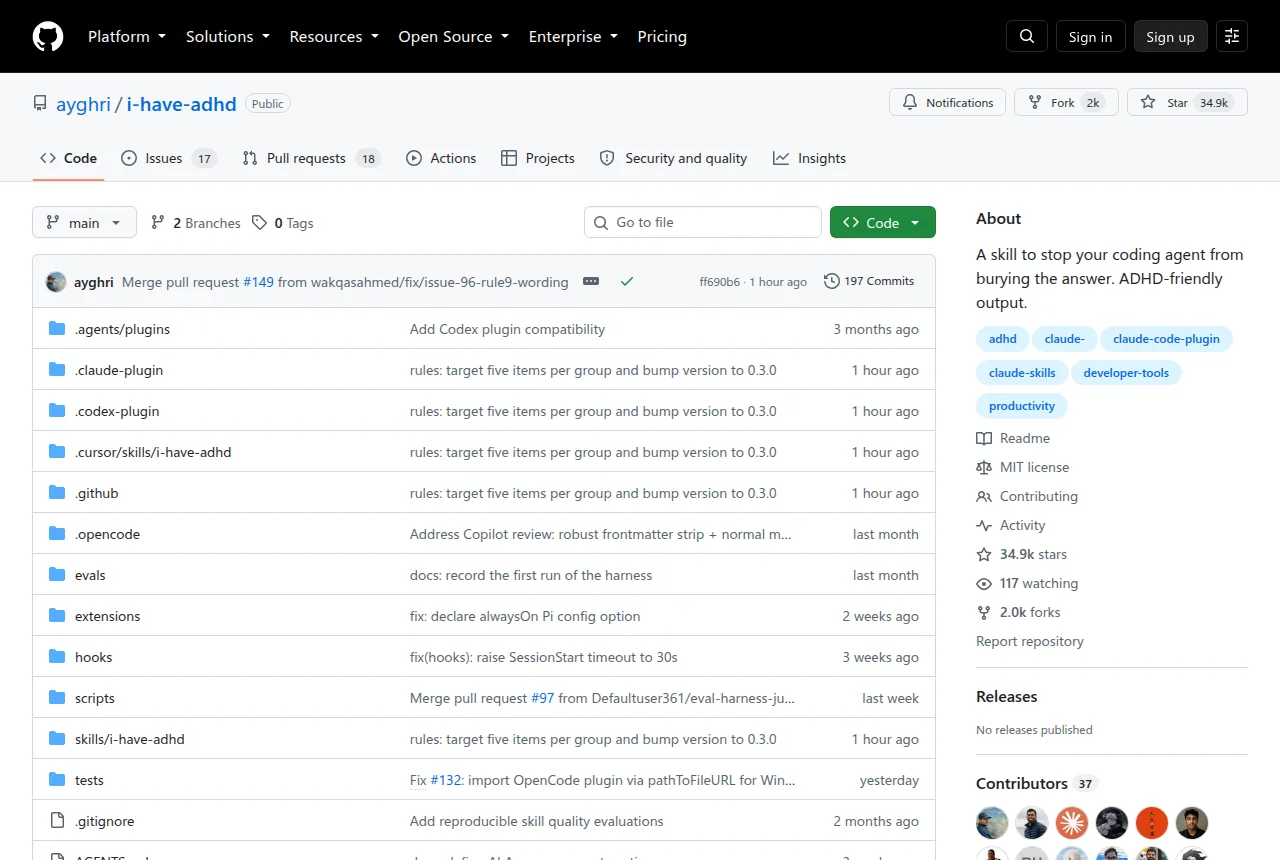
It doesn’t cut information—it reconstructs the delivery. Numbered lists replace “first, second, finally,” and clear actions replace vague suggestions. Among the 10 rules, the core is the three-part structure: “lead with the next action, follow with steps, close with what’s next.” Every turn ends with an executable exit.
Getting Started: Three Steps to Install This “AI Switch”
The installation is straightforward. Run this in your CLI:
| |
After restarting Claude Code, the /i-have-adhd command kicks in automatically. When filing issues, the system defaults to concise mode.
Want to tune it to your own style? Fork the repo and edit skills/i-have-adhd/SKILL.md. The 10 rules are written in plain natural language:
- Always start with the next actionable step
- Number every multi-step task
- Leave a concrete next step at the end of each turn
- Estimate time in minutes, not “a bit”
- State errors directly—skip the comfort padding
- Cap lists at five items per group
Technical Highlights: Rules Over Retraining
The cleverest part of this project is that it doesn’t touch model weights—it only changes the output instruction templates. Technically, it’s a textbook example of “engineered prompt engineering”: translating cognitive-behavioral techniques from clinical psychology into output constraints for large language models.
Some might worry it’s too rigid, but the project deliberately preserves flexibility. Rule #9, for instance, emphasizes that you “mustn’t omit relevant items when grouping,” meaning semantic categorization happens before list compression. Rule #7 requires “making wins visible,” quantifying progress feedback into explicit markers. These aren’t simple string replacements—they’re dynamically structured outputs based on the task chain.
Another technical choice is the “low-key tone.” There’s no API-doc-style technical anxiety in the project—just a pragmatic extraction of time estimation and task-decomposition methods from The Adult ADHD Toolbox, rewritten in the voice of instructions to an LLM rather than a self-management guide for humans. This explains why it says “no ADHD diagnosis required”—it’s really solving a shared dilemma we all face in the age of information overload.
Who It’s For / Comparison with Similar Projects
- For: Engineers who call AI heavily to write code, Tech Leads who need to break down tasks for their teams, anyone whose focus gets scattered by long-winded replies
- Not for: Users who prefer exploratory conversations (it will actively prune tangential topics), or non-technical decision-makers who only need conceptual answers
Most similar projects focus on “enhancing AI capabilities” (multi-turn memory, code execution, etc.), while this one focuses on “reducing AI noise.” If AI assistants were like human assistants, other projects make them smarter—i-have-adhd makes them more tactful, knowing what to say and what to leave out.
- Focus preservation: Cuts visual noise by 70% per interaction
- Task conversion: Straight-to-steps delivery boosts executability
- Customization freedom: Rule files can be forked and modified
Final Thoughts
When AI gets good at giving speeches, i-have-adhd is a reminder: good communication is first about getting the message across. Technology’s value isn’t about how flashy it looks—it’s about how much trouble it saves you.
Star it not because it’s cool, but because it saves you one extra thought when you’re debugging at midnight.