
Core Event and Key Facts
Nature published a landmark study on September 30, 2026, announcing Ataraxos—an AI system that, for the first time, achieves superhuman performance in Stratego, a classic board game dominated by hidden information. Authored by Samuel Sokota, Eugene Vinitsky, Hengyuan Hu, Zhiyuan Fan, J. Zico Kolter, and Gabriele Farina, the paper is open access and accompanied by arXiv preprint 2511.07312.
Key facts:
- Release date: September 30, 2026
- Publication venue: Nature, volume 658, pages 55–59
- System name: Ataraxos (includes self-play reinforcement learning and test-time search modules)
- Training cost: Significantly lower than prior multi-million-dollar industrial efforts
- Sample efficiency: Orders of magnitude superior to prior multi-million-dollar industrial efforts
- Model weights: Not explicitly stated whether open-sourced
Record-Breaking Results and Unexpected Cost Efficiency
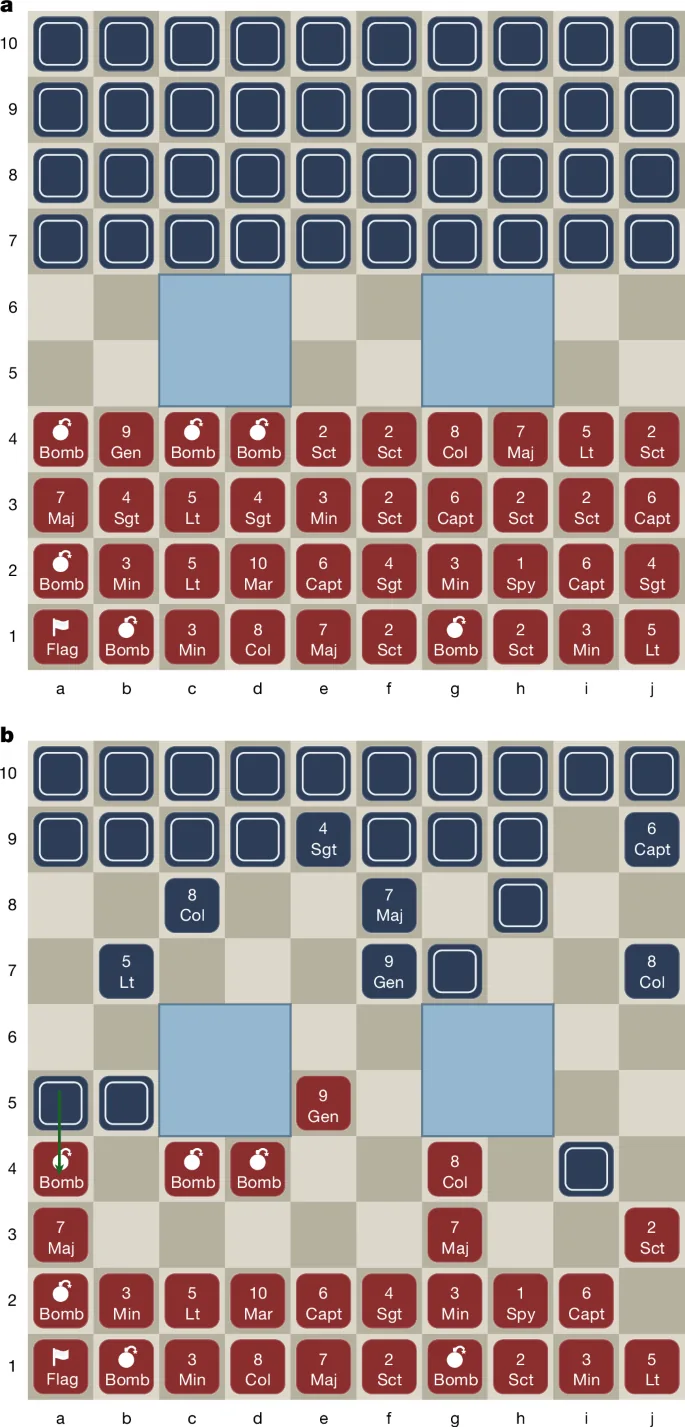
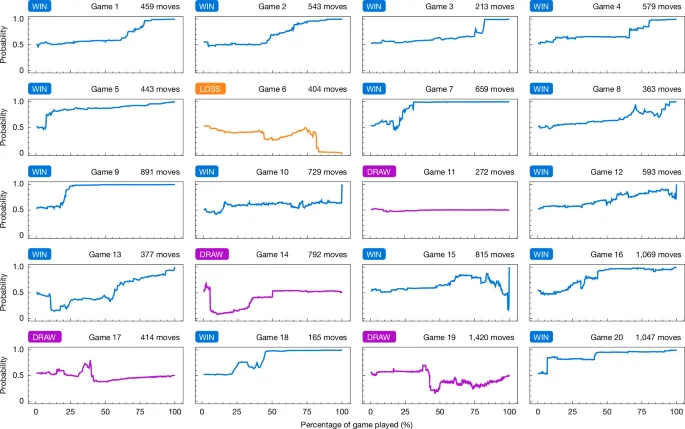
Ataraxos achieved decisive victory against the most decorated human Stratego player, marking the first superhuman result in Stratego’s history and breaking a decades-long human dominance barrier despite sustained industrial investment.
The cost efficacy stands in stark contrast to prior efforts: years of multi-million-dollar industrial research involving dozens of researchers failed to surpass top human players. Ataraxos achieved superior performance at only a few thousand dollars’ training cost.
The same techniques were applied across diverse game types:
- Barrage Stratego (a Stratego variant): Defeated three-time world champions; described as the first superhuman result for this variant
- Hanabi: Achieved state-of-the-art performance in this cooperative imperfect-information benchmark
- Dou dizhu: Defeated state-of-the-art bots for this popular Chinese card game
Stratego is uniquely challenging due to its massive hidden state space: over 10^33 possible piece configurations, dwarfing games like Texas hold’em (1,326 possible hands). Traditional public-information-based methods fail here because their computational cost scales with hidden information volume, making them infeasible at this scale.
Methodological Breakthrough
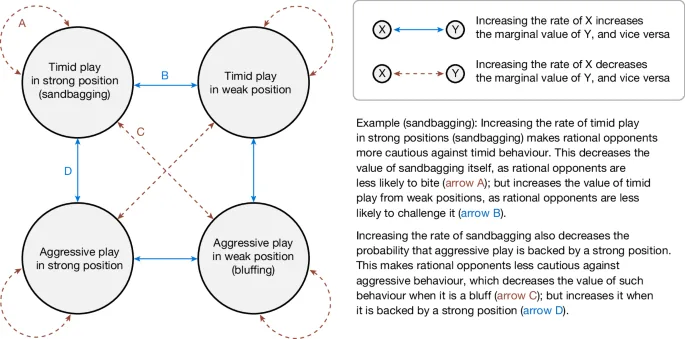
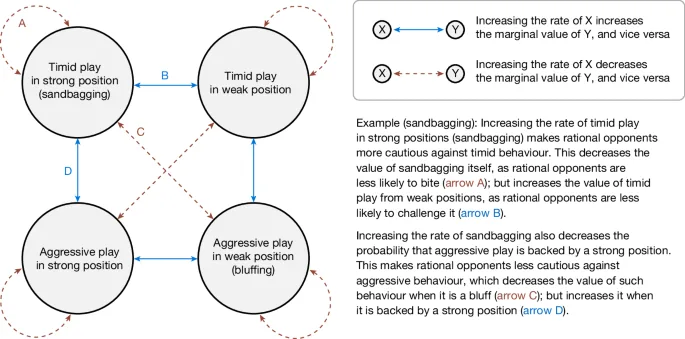
Ataraxos rests on general techniques developed for scalable decision-making under massive hidden information. The key insight is that in imperfect information settings, decision value depends not only on future policies but also on past and concurrent ones—because these determine the posterior distribution over hidden information. Figure 1 illustrates this via a graphical model where nodes represent decisions and edges encode how changing decision frequencies affect marginal values.
Prior approaches rely heavily on problem transformations based on public information, whose cost escalates with hidden information volume. Ataraxos sidesteps this limitation, demonstrating effectiveness across adversarial (Stratego), cooperative (Hanabi), and team (dou dizhu) settings—suggesting a broadly applicable design pattern.
Notably, the paper omits implementation details (GPU hours, hyperparameters, network architecture) and does not benchmark against DeepMind or OpenAI systems. The focus remains squarely on methodological scalability and cost efficiency.
Practical Recommendations
Consider Ataraxos if you:
- Research multi-agent systems: The counterfactual dependency modeling offers a template for distributed coordination under partial observability (e.g., robot swarms, resource scheduling).
- Build game AI with budget constraints: Its Barrage Stratego success implies robustness to rule variations; the few-thousand-dollar training budget may appeal to startups or academic labs.
- Model strategic scenarios with private information: Auction design, negotiations, or military simulation where public/private state separation is natural.
Do not adopt if:
- Your application demands tight real-time constraints (no inference latency data provided)
- You require full model explainability (search implementation details remain unspecified)
Final Thoughts
Ataraxos disproves the long-held intuition that more hidden information necessarily impedes AI performance, offering a scalable foundation for imperfect-information games. Its success in three distinct game classes suggests broad applicability—but real-world domains introduce additional uncertainty dimensions untested here, meaning industrial adoption will require further validation.