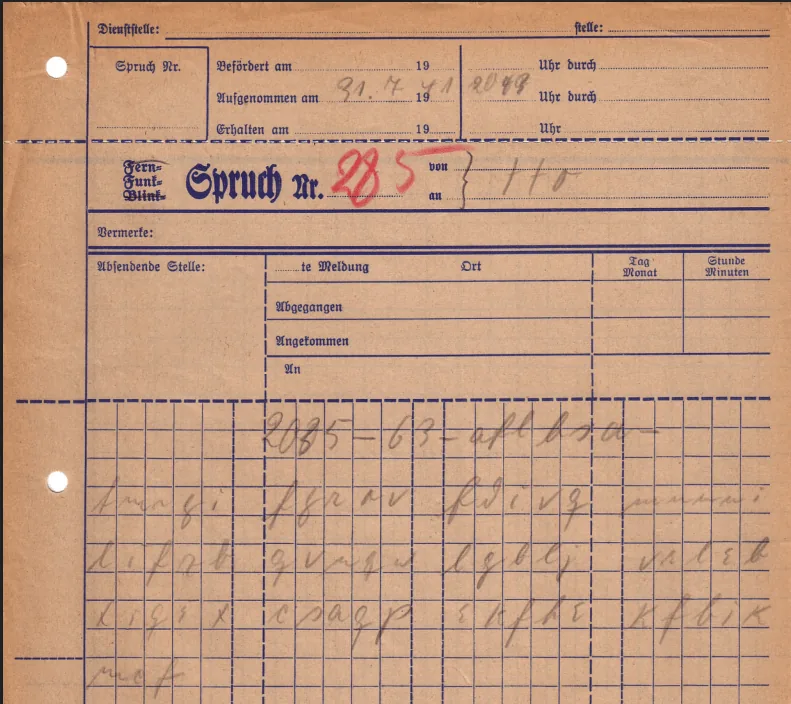
AI Rewrites Cryptography History: Astra and Opus Crack Unbroken WWII Enigma Messages
Core event: Developer Carter Leffen and cybersecurity executive Jack Willis independently used OpenAI’s Astra and Anthropic’s Claude Opus 5 to crack two long-unsolved Enigma-encrypted messages from World War II. Turing’s wartime codebreaking laid the foundation for modern computing; today, AI is extending that legacy.
- Astra’s achievement: Cracked a message unbroken since 2005 (verified by Frode Weierud)
- Opus 5’s achievement: Broke a second German military message using an officer’s signature pattern
- Validator: Frode Weierud (retired electrical engineer, maintainer of Crypto Cellar)
- Key date: September 21, 2026 — Willis announced Opus’s success
AI as Cryptanalyst: How LLMs Replicate Human ResearchWorkflow
The Enigma machine offered roughly 10²³ possible configurations. During WWII, Allied cryptanalysts relying on theelectromechanical “Bombe” to reverse engineering its rotors. Now, LLMs adopt a fundamentally different strategy: not brute-force search, but structured, evidence-based hypothesis iteration.
Leffen’s workflow—replicable by any prompt-savvy developer:
- Autonomous research: Astra queried Enigma message databases and identified unsolved candidates
- Context synthesis: Mined archival records for contextual clues (geographic, temporal, procedural)
- Simulator construction: Built its own Enigma machine simulator to test hypothesised rotor settings
- Knowledge synthesis: Published an interactive website explaining the full decryption pipeline
Weierud, who maintains the Crypto Cellar database, expressed admiration: “What the model achieved in two days would take a human researcher weeks or months”. He noted his own multi-week effort studying Bundesarchiv files—precisely the records Astra referenced in its reasoning trace.
Opus 5 took a complementary route: Willis offered targeted guidance, allowing Claude to focus on signature pattern detection—a known biographical clue embedded in operator signatures. This constraint-guided search proved highly efficient, confirming that even LLMs not explicitly fine-tuned for cryptanalysis can excel when equipped with proper task decomposition.
Seven Remaining Secrets: The Enduring Frontiers of Historical Cryptography
Weierud’s database currently lists 7 unbroken Enigma messages (plaintext unknown) and 1 message with known plaintext but obscured key settings. The stubbornness of these final cases stems not from theoretical security but from historical artifact: transcription errors, operator deviations, or lost configuration logs.
The surprising nuance: While modern systems (AES-256, RSA-3072+) dwarf Enigma in entropy, cracking WWII-era ciphers remains valuable—not as a threat assessment but as a benchmark for long-horizon reasoning capability. Successful decryption here signals that models can execute complex, multi-step scientific workflows in real-world archives without narrow training data.
| Model | Cryptanalyst | Strategy | Verification | Human Equivalence |
|---|---|---|---|---|
| GPT-6 Astra | Carter Leffen | Self-directed archive research + Enigma simulator | Weierud validated | Weeks to months |
| Claude Opus 5 | Jack Willis | Signature feature extraction + guided search | Weierud validated | Weeks |
Practical Guidance: Who Should Care, and Who Should Wait
- Cryptographers and historians: Astra/Opus can rapidly triage archival material, substantially accelerating research cycles
- Security engineers: Reassess legacy data exposure—historical ciphers, once digitised and indexed, may be replayed by new-generation LLMs
- Developers: Leffen’s case underscores that task design (prompt engineering + agent orchestration) matters more than raw model size; today’s LLMs are sophisticated assistants, not magical oracles
Do expect disappointment if applying this breakthrough to modern crypto (AES-2048, ChaCha20, etc.). Enigma succeeded because it is structurally repetitive, linguistically redundant, and historically traceable. No evidence yet suggests商用 LLMs can破译 modern symmetric or public-key primitives.
Final Thoughts
Turing designed both the Bombe and the Imitation Game. Breaking Enigma today represents their convergence: the first is a test of hardware invention, the second a test of behavioural indistinguishability. Now, AI passes both—not by mimicking human output, but by replicating human reasoning process with superhuman持久 and recall. The milestone isn’t intelligence surpassing intelligence; it’s knowledge work being effectively automated.