
A Self-Hosted Appliance Compromised: CVSS 9.3 Zero-Day Added to CISA’s Must-Patch List

BeyondTrust has published a security advisory confirming a zero-day vulnerability that has been exploited in the wild in the internal messaging component of Remote Support (formerly Bomgar), identified as CVE-2026-102764, with a CVSS score of 9.3. A China-linked cyberespionage group tracked as Armory Castle (formerly UNC5221 or Warp Panda) used it in attacks in late August 2026.
- Vulnerability nature: “Improper origin validation” in the internal messaging component—it does not carefully verify the source when receiving messages, and under certain conditions can be used to perform file operations on the appliance.
- Exploitation date: August 29, 2026, against a self-hosted Remote Support appliance.
- Patching progress: Patches for SaaS customers were fully rolled out by October 9, 2026.
- Affected versions: Self-hosted 24.3.1 through 26.2.3, requiring manual update to the BT26-05-RS patch; versions below 24.3.1 must first be upgraded.
- Regulatory action: CISA issued an advisory on October 16 and added it to the KEV catalog; federal civilian executive branch agencies must complete patching by October 19.
Attack Chain: A PHP Web Shell, Plus a Custom Tunnel
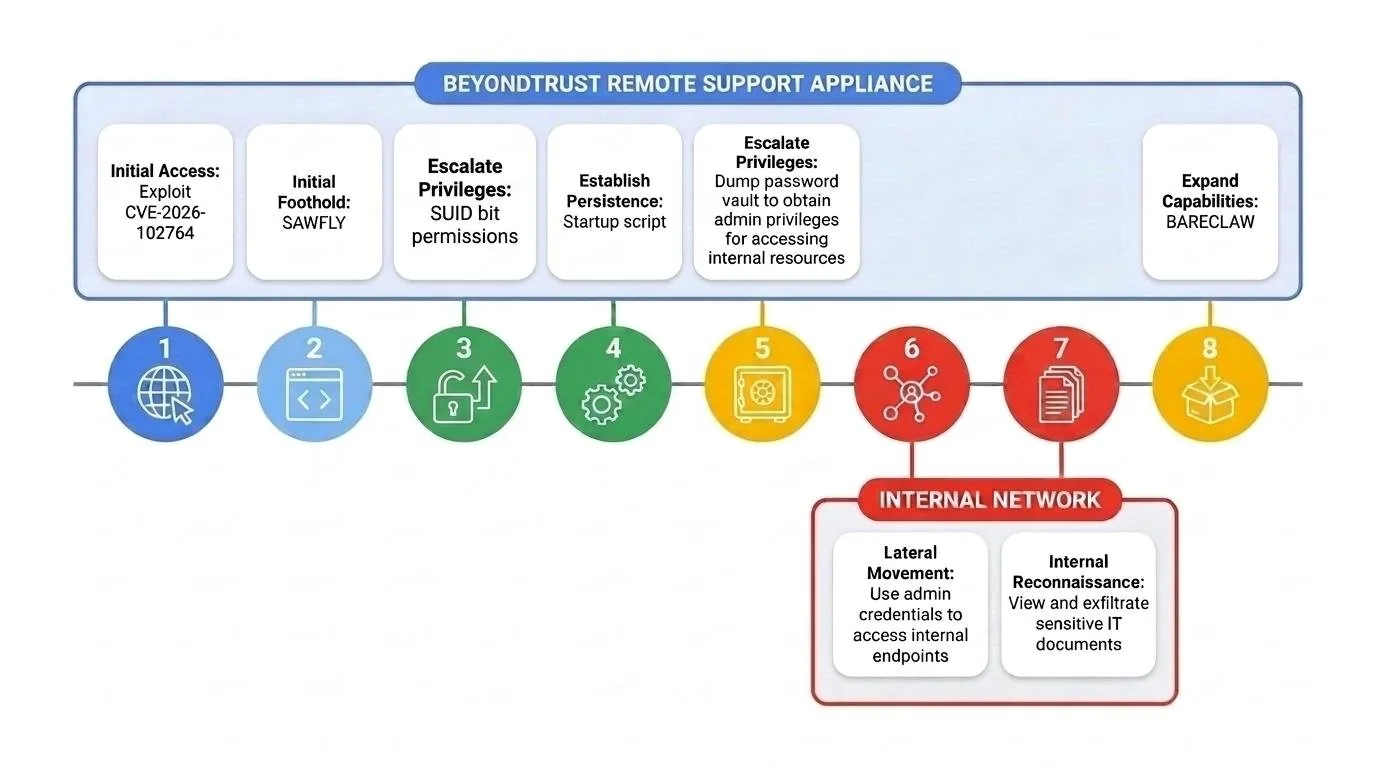
Google-owned Mandiant provided additional exploitation details. After compromising the appliance, the attacker dropped a lightweight PHP web shell, SAWFLY, for interactive remote access and bidirectional encrypted command-and-control communications—C2 being the “remote-control channel” between the compromised appliance and the attacker’s server.
BeyondTrust’s timeline also shows that on September 27, news became public that another security appliance vendor had been successfully exploited, prompting it to launch an investigation and hunt for similar activity.
In terms of intrusion tradecraft, Armory Castle used commercial VPN exit nodes and compromised home and small-office routers to blend into normal traffic, then used the web shell as a springboard to escalate privileges, gain full administrative access to the appliance, and establish persistence that survives reboots.
Follow-on actions included: copying the system shell (/bin/sh) to /usr/bin/dbus-authd, changing its owner to root, and setting the SUID bit to obtain root privileges on the host; using BeyondTrust’s built-in /ns/sbin/bt-secrets command-line tool to search the local secrets store and harvest passwords, API keys, and endpoint credentials; tampering with configuration templates to obtain passwordless root access for the site service account; and using administrator credentials to conduct in-app reconnaissance and initiate remote sessions to downstream systems in the Jump Item list, gaining full file system access to internal endpoints and downloading and exfiltrating internal documents.
In the final stage, the attacker used BARECLAW, a custom C-language SOCKS5 proxy tunneling tool, to tunnel traffic out of the appliance, and modified /ns/config/haproxy.conf to make it directly accessible from the public internet; they also systematically deleted system, web server, and application-layer logs to slow detection.
A notable contrast is that despite a CVSS score of 9.3, it was only used in a precision strike against a single self-hosted appliance. BeyondTrust assesses that this group pre-selects high-value software targets and continuously uses AI to maintain a working model of target products to develop exploit chains—zero-days are reserved for specific targets first, and once a vulnerability becomes public, the group shifts to broad exploitation of all unpatched instances.
Who Patches Automatically, Who Must Patch Manually
| Deployment Model | Affected Versions | Patching Method |
|---|---|---|
| SaaS | All | Automatically pushed on October 9, 2026 |
| Self-hosted | 24.3.1 – 26.2.3 | Manually update to the BT26-05-RS patch |
| Self-hosted (older) | Below 24.3.1 | First upgrade to a newer version, then patch |
CISA’s requirements are more granular: patch; restrict external access to the appliance to only required services; conduct network and memory forensics; isolate suspected or confirmed compromised appliances and investigate unfamiliar privileged or administrator sessions; and finally rebuild from a known-good state and reapply patches.
Who Should Act Now, and Who Can Wait
- Act immediately: Organizations that exposed self-hosted Remote Support to the public internet between late August and October and are running versions 24.3.1–26.2.3. According to Mandiant, vulnerable-version appliances reachable from the internet during the exploitation window should be treated as potentially compromised until an investigation is completed.
- Can wait a bit but should self-check: SaaS customers have already had patches automatically delivered, but are still advised to check for unfamiliar administrator sessions; self-hosted users who have not exposed the appliance to the public internet for a long time and have already finished patching can return to a routine log review cadence.
Final Thoughts
Armory Castle has been active since October 2023 and has previously used zero-days in Citrix NetScaler and Ivanti Connect Secure to attack legal, SaaS, outsourcing, technology, and government organizations. This time, the entry point shifted from VPN gateways to remote support appliances, showing that edge devices that can reach directly into internal networks while carrying high privileges remain a top target. Patching is only the first step; the job is not finished until an adversary focused on long-term intelligence collection is evicted from the network.