
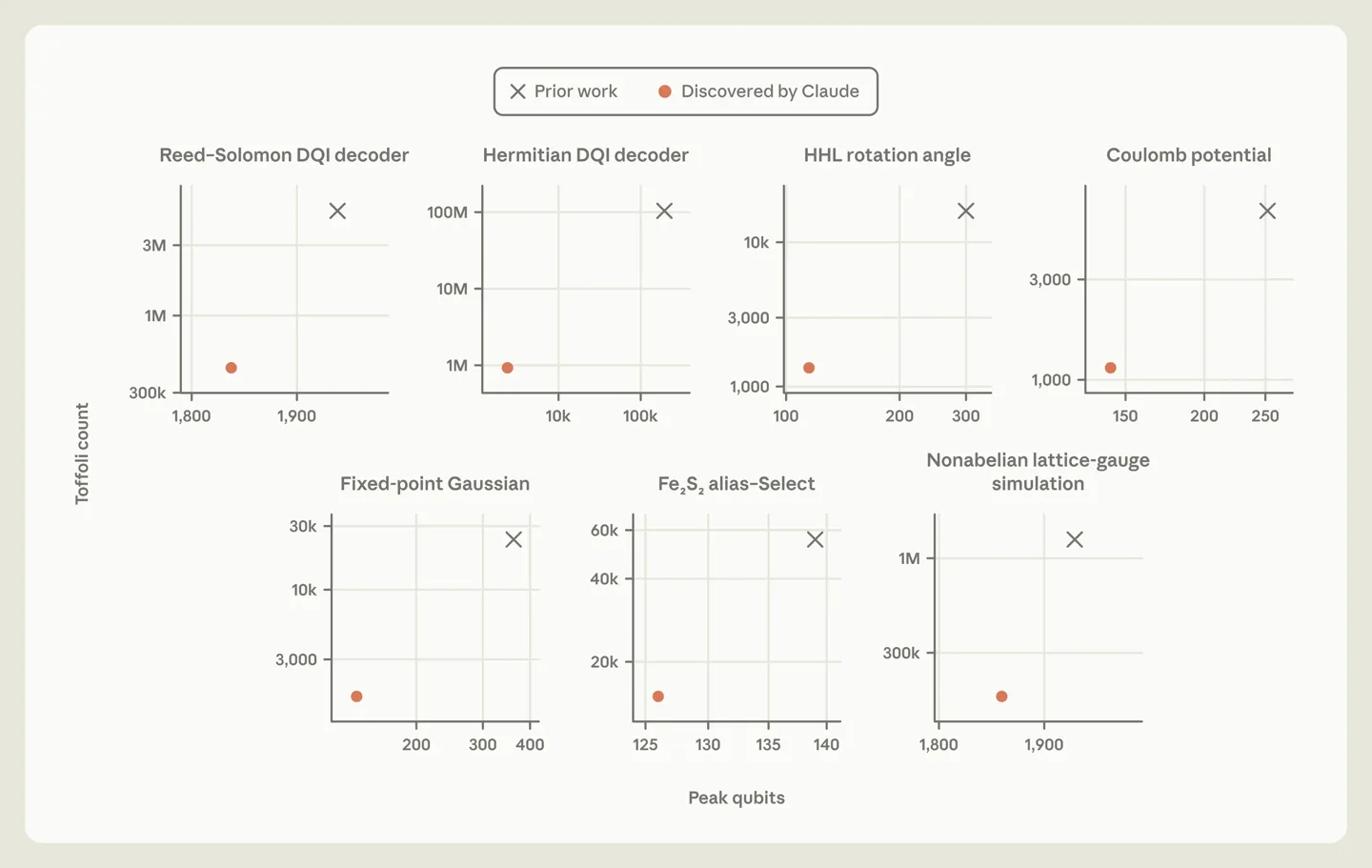
Anthropic announced research on October 16 saying that its AI model Claude designed, with almost no human intervention, more efficient schemes than the best published circuits for eight categories of quantum computing tasks.
- Publication date: Anthropic released the research on October 16; IT之家 reported it on October 17.
- Task scope: Eight categories of quantum computing tasks, spanning chemistry, optimization, physics simulation, number theory, and numerical computation.
- Degree of human involvement: Almost none. Anthropic described the tasks in plain language; an automated evaluator checked circuit correctness and assigned scores, and Claude then iterated based on feedback, forming a closed loop.
- Results: The new designs are more economical in both qubit count and gate count, and they are not minor tweaks to existing approaches but new mathematical and structural ideas.
- One quantifiable point: In the decoding stage of a quantum optimization algorithm, Claude reduced the cost of the most expensive step to 1/12 of the original.
- Version and availability: The study does not mention Claude’s specific version number, whether its weights will be open, or whether its code will be released, nor does it give any productization or launch timeline.
Every qubit a circuit saves is worth money
Quantum computers run on quantum bits (qubits). A classical bit can be only 0 or 1; a qubit can be in a superposition of 0 and 1—carrying probability amplitudes for both states at once. This is both why it can compute quickly and why it is fragile. Heat, vibration, and electromagnetic noise all cause decoherence and computational errors, so current devices typically have only hundreds to thousands of qubits and still rely on extreme cooling, isolation, and error correction as a backstop.
Quantum gates, meanwhile, are unitary transformations applied to one or more qubits. They can be understood as the quantum version of classical logic gates (AND, NOT, and so on), except that they act on superposition and entangled states. Arranging a set of quantum gates in time order and adding steps such as initialization and measurement yields a quantum circuit.
Quantum circuit “cost” is usually measured by two things: how many qubits are needed and how many quantum gates are needed. The lower both are, the smaller the hardware pressure, runtime, and noise accumulation generally are. Anthropic’s automated evaluator scored circuits precisely by “qubit count × gate count.”
Iron sulfide, 1/12, and 53 hours
Several specific examples appear in the research. When simulating an iron sulfide molecule, Claude exploited the molecule’s own symmetry and repeating structure to compute some results once and reuse them, rather than brute-forcing each piece. In the decoding stage of a quantum optimization algorithm, it cut the cost of the most expensive step to 1/12 of the original.
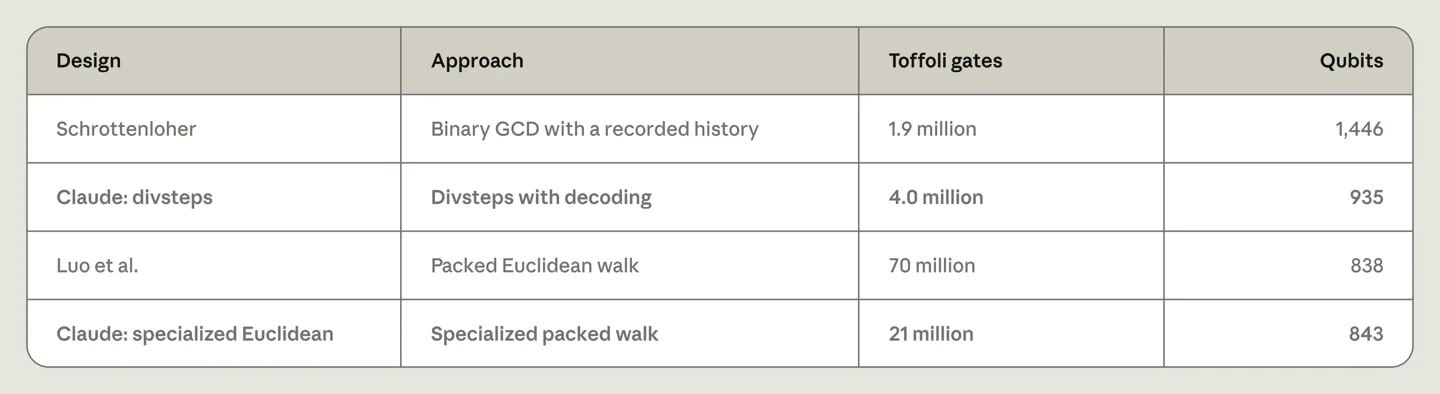
The most time-consuming result was elliptic curve point addition: after about 53 hours of autonomous exploration, Claude proposed a reversible algorithm that can run backward without storing the full branch history, along with a series of new designs that strike different balance points between qubit count and runtime. The figure in the original shows that the bolded rows are Claude’s designs, while the rest are previously published best designs.
The most noteworthy contrast here is this: Claude did not merely “tune parameters” on existing circuits; it changed the mathematical and structural approach. For readers accustomed to “AI can only assist with some optimization,” this is more surprising than any single number.
| Comparison dimension | Previously published best design | Claude’s design |
|---|---|---|
| Design source | Existing published approach | Autonomously generated from a plain-language task description and iterated using automated evaluation feedback |
| Nature of improvement | Baseline | Reduces qubit and gate counts, and proposes new mathematical and structural ideas |
| Most expensive step in quantum optimization decoding | Baseline | Cost reduced to 1/12 |
| Elliptic curve point addition | Previously published best design | About 53 hours of autonomous exploration, yielding multiple qubit–runtime trade-off options |
Who should pay attention, and who should wait

If you are a researcher or engineer working on quantum algorithms or quantum compilation, this study is worth tracking down and reading in full: it does not offer the vague conclusion that “AI can write code,” but a reusable closed-loop process—describe a task in plain language, automatically verify correctness, score by resource use, and iterate on feedback. The framework itself can be carried over to other circuit synthesis problems.
If you expect quantum computing to soon land in practical scenarios such as drugs and batteries, you will need to wait longer. Anthropic itself notes that quantum circuit design is only one part of building fault-tolerant quantum computers; error correction, hardware control, and other problems still require coordinated breakthroughs. No matter how economical the circuit, it cannot solve the two problems of hardware and error correction. The new drug design, efficient batteries, new catalysts, and cleaner fertilizer production mentioned in the study are directional judgments about what “could land earlier,” not a timeline.
Final thoughts
The significance of this research is not that Claude immediately built a usable quantum computer, but that it handed the search space of circuit design over to AI to probe. The real test will be whether these designs can run on real hardware and whether they can be accommodated by error-correction systems. Until then, it is more a persuasive methodological sample than an endpoint.