
Key Event: Claude Delivered Eight Classes of Quantum Circuit Designs
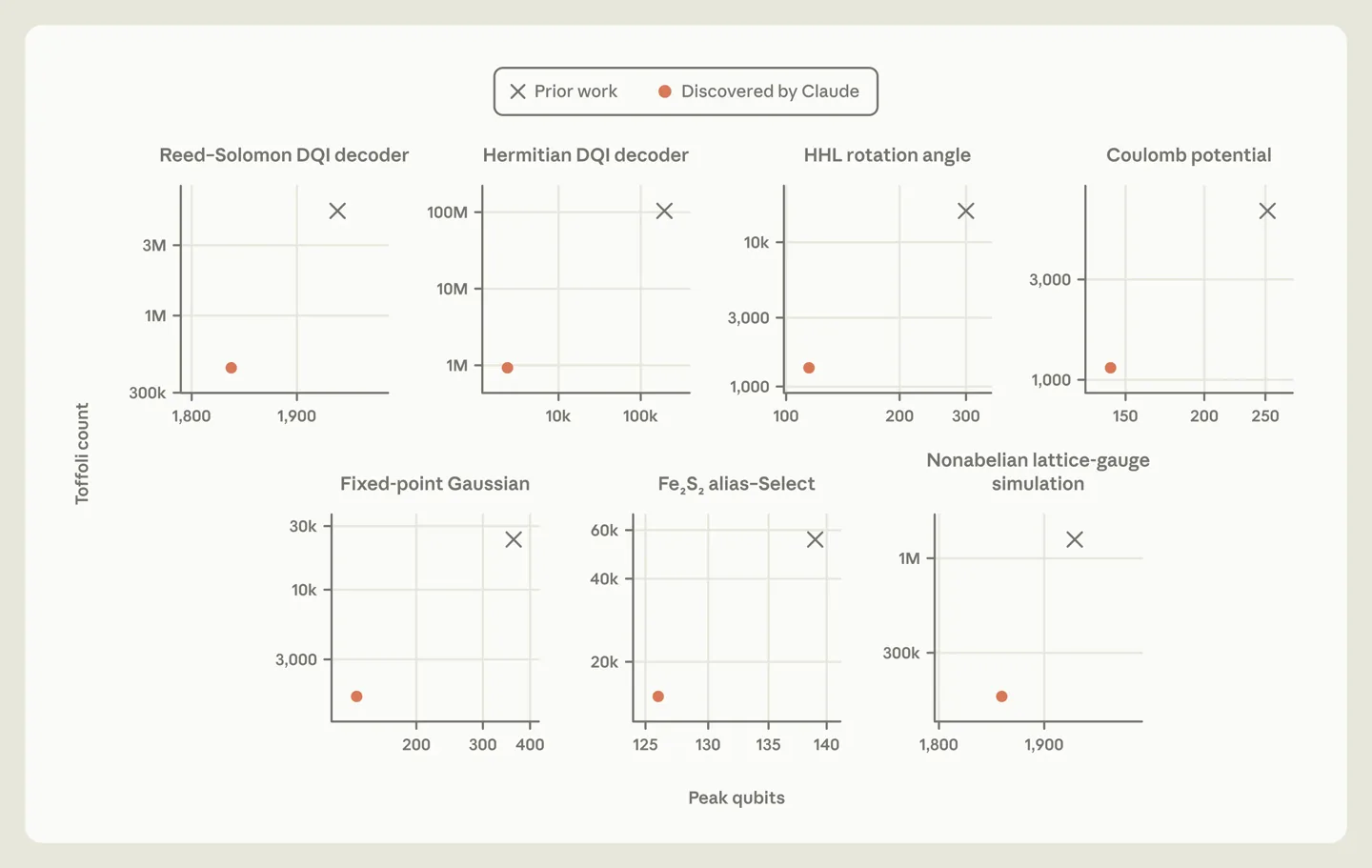
Anthropic released research on October 16 claiming that its AI model Claude, with almost no human intervention, designed schemes more efficient than the best published circuits for eight classes of quantum computing tasks.
Hard facts at a glance:
- Publisher and date: Anthropic released the research on October 16; IT之家 reported on October 17.
- Number and domains of tasks: 8 tasks, spanning chemistry, optimization, physics simulation, number theory, and numerical computation.
- Degree of human involvement: Almost no human intervention; researchers simply described the tasks to Claude in plain language.
- Evaluation and iteration method: An automated evaluation program checked whether the circuits were correct and scored them by “qubit count × gate count”; Claude improved based on feedback, forming a closed loop.
- Availability: The source material does not mention whether the code or weights are open, nor does it give a timeline for productization or launch.
First, two terms. A qubit is the unit of information in quantum computing. A classical bit can only be 0 or 1, whereas a qubit can exist in a superposition of both; a quantum gate is the quantum version of a classical logic gate (such as AND or NOT), except that it acts on superpositions and entangled states; a quantum circuit is a set of quantum gates arranged in temporal order, plus steps such as initialization and measurement.
Why “Less” Matters So Much
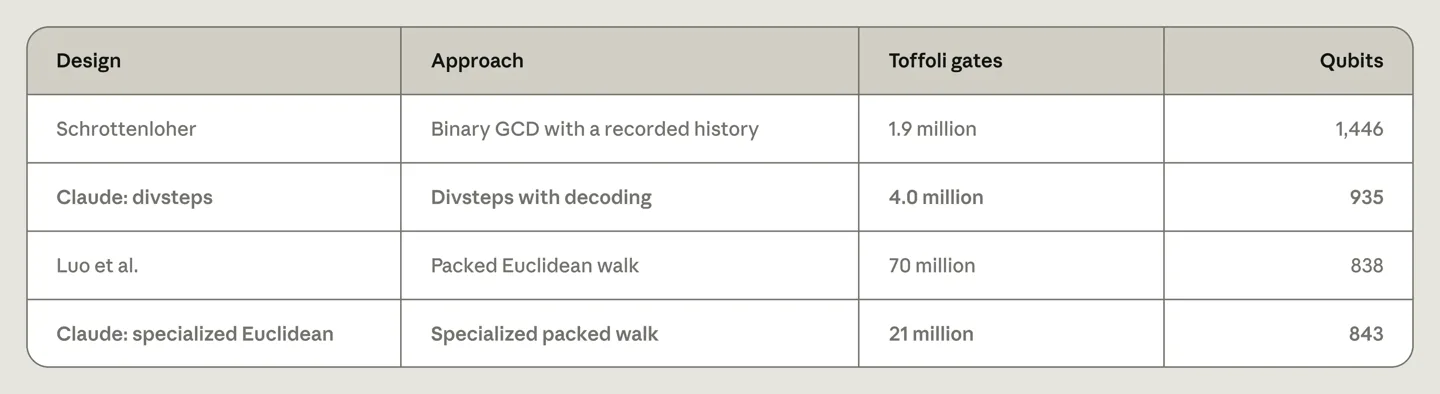
Current quantum devices typically have only hundreds to thousands of qubits and are extremely sensitive to heat, vibration, and electromagnetic noise. Noise causes decoherence and computational errors, so these devices require extremely low temperatures, isolation, and error-correction mechanisms. Both qubit count and runtime are scarce resources, and the two metrics for measuring the cost of a quantum circuit are: how many qubits it uses and how many gates it uses. The fewer both are, the lower the hardware pressure, runtime, and noise accumulation typically are.
Anthropic’s approach has a clear “automatic problem generation + automatic grading” flavor: describe the task in natural language, have an automated program check whether the proposal is correct, then score it by the product of “qubit count × gate count.” Proposals with unsatisfactory scores are sent back to the model for further revision. The entire process requires almost no human involvement, which is the most noteworthy aspect of this research at the methodological level.
The Surprise: Not Minor Tweaks
The real contrast is here: the new designs Claude produced were not minor tweaks to existing approaches, but new mathematical and structural ideas.
- Decoding stage of a quantum optimization algorithm: reduced the cost of the most expensive step to one-twelfth of the original.
- Elliptic curve point addition: after about 53 hours of autonomous exploration, Claude proposed a reversible algorithm that can run in reverse without storing the complete branch history, and produced a series of new designs that achieve different trade-offs between qubit count and runtime.
- Iron sulfide molecule simulation: used the molecule’s inherent symmetry and repeating structure to compute some results only once and then reuse them.
| Scenario | Result given in the source material |
|---|---|
| Decoding stage of a quantum optimization algorithm | Cost of the most expensive step reduced to 1/12 of the original |
| Elliptic curve point addition | About 53 hours of autonomous exploration; proposed a reversible algorithm that can run in reverse without storing the complete branch history |
| Iron sulfide molecule simulation | Reused the molecule’s symmetry and repeating structure; some results computed only once |
| Overall comparison benchmark | Compared against the best published circuits; not minor tweaks |
Who Should Read It, and Who Can Wait

- Worth reading closely: people working on quantum algorithms, quantum compilation, and circuit optimization, as well as researchers using quantum computing to explore chemical simulation and combinatorial optimization. What is actually more worth studying here is the method itself: breaking circuit cost into scorable metrics and letting the model repeatedly self-iterate in a closed loop. This approach can be transferred.
- Can wait: If your basis for judgment is that “quantum computing is about to become usable,” this research is not enough to support that. It solves a design problem at the circuit layer; it does not mean the hardware problem has already been solved.
The research team’s own assessment is that this kind of progress could reduce the hardware scale required for practical quantum applications, allowing quantum computing solutions for new drug design, high-efficiency batteries, new catalysts, and cleaner fertilizer production to arrive sooner. However, the research also notes that quantum circuit design is only one part of building a fault-tolerant quantum computer; error correction, hardware control, and other issues still need to be tackled in tandem.
Final Thoughts
The most memorable thing about this research is not “AI won again,” but that it turned quantum circuit design into a problem that can automatically generate problems, automatically score them, and automatically iterate. Whether these designs can be realized on real hardware still awaits validation on the experimental side.