
Anthropic has replaced Git, a version control system that has served software development for more than two decades, with an in-house system called Scion — and its core code repository has already been migrated.
- Who built it: 7 engineers, 5 months
- Why now: roughly 2,500 merged changes per day in May, over 30,000 per day by September, and about 25 million CI checkouts daily
- What changed: CPU and memory demand is roughly 1/200 of the old Git mirror setup, checkouts dropped from minutes to seconds, and CI freed about 25% of its CPU capacity
- The trade-off: offline autonomy is gone, and running the service is a new cost
Git’s offline design became an online burden

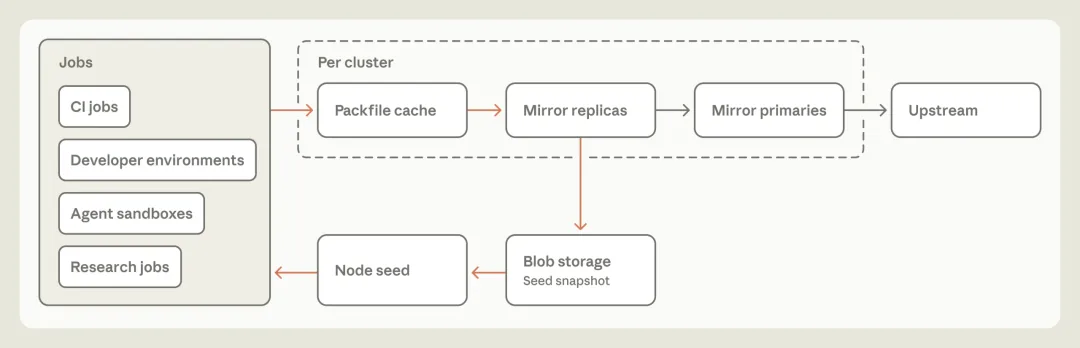
Git’s distributed model lets an engineer clone a repository and still commit, merge and read history without a network. But most of Anthropic’s code reading comes from always-online CI jobs and Agent sandboxes that live for a few minutes and may need only a few files, a diff, or confirmation that one commit is an ancestor of another. Preparing a full local repository for each of those operations gets more expensive every day.
Anthropic’s main branch history is close to 100 GB, and a compressed working copy exceeds 25 GB. If each of the 25 million daily checkouts pulled a full copy, theoretical traffic would exceed 600 PB. Shallow clones, sparse checkout, snapshots and hundreds of Git mirrors help, but mirrors must sync, snapshots expire, and history queries still need objects fetched.
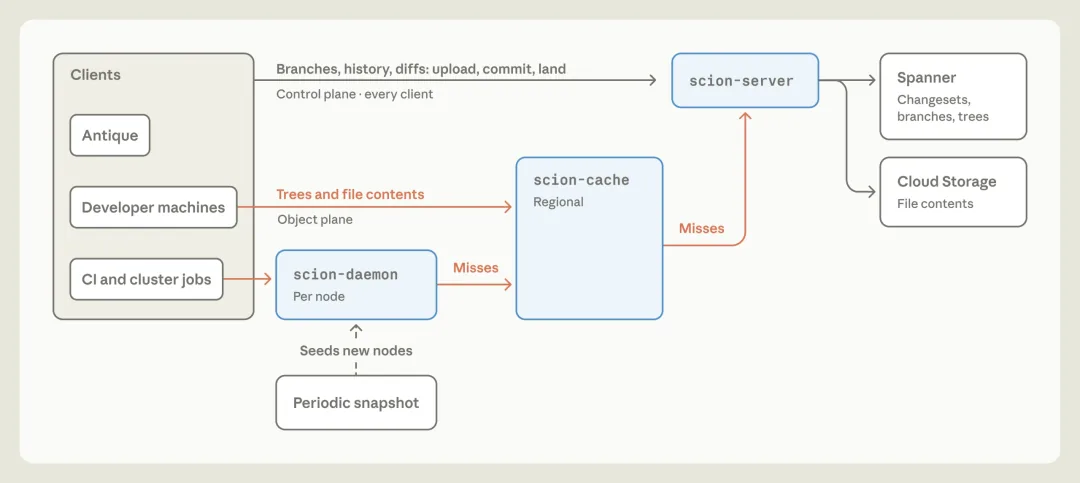
Scion shrinks the client to a thin entry point: commit creation, merging, rebasing and history queries move to a central service, while the local side only watches file changes and keeps a small cache. The commit format changed too. A Git commit points to a tree describing repository state; a Scion changeset is a write-ahead log entry recording files modified relative to its first parent, referencing data through content-addressed pointers. Reference updates such as main are applied as a compare-and-swap on a single row in Spanner, concentrating contention at the moment a branch moves.
One contrast is worth flagging: the 200x figure describes infrastructure resource usage, not an overall speedup of Git operations. Anthropic also had to build Antique code review, source search, IAM and batch merge tooling for the new protocol, and operating an online service is a cost of its own.
Secret scanning: swapping a general LLM back for a classifier
GitHub went the other direction. It keeps regex as the candidate filter and hands the judgment to a fine-tuned ModernBERT. An encoder returns a class in a single forward pass instead of generating token-by-token explanations like a generative LLM, which suits batched, repeated decisions. The hard part is hard negatives — strings that look like secrets but are harmless. GitHub combined product feedback, human labels, high-recall candidates from real repositories and synthetic hard negatives, splitting train and eval sets by repository, candidate value and relationships. For deployment the model is exported to ONNX and quantized to 8 bits.
Offline Precision rose 13% and Recall 19%. In online A/B tests, median Post-push scan execution time fell 86%, model serving cost fell more than 98%, and the repository-owner-weighted alert acceptance metric rose 11.5%. That 98% covers model serving cost only, not the total cost of the security system, and a classifier can only judge candidates regex has already found.
Turning waveforms into SQL for Agents
Chip verification hits a different wall. VCD and FSDB waveforms from RTL simulation can reach tens of GB or even TB, and converting raw waveforms to text quickly fills an Agent’s context with timestamps, signal names and repeated toggles. BTTF, proposed by Columbia University, Google DeepMind and others, moves waveforms into SQLite: signal_metadata holds names, types and hierarchy, while signal_changes stores signal ID, timestamp and the value after each change, joined by ID.
Pruning shows both gains and costs: an unpruned database used 1,420 MB with queries around 410.5 ms; filtering clocks and non-toggling signals cut that to 395 MB and 94.8 ms; dropping signals whose toggle rate is below average shrank it to 185 MB, but activity coverage fell to 64.23%. On 4.2 GB of waveforms, 18,450 signals and 150 expert-labeled queries, the approach reached 95.33% execution accuracy. Multi-Agent quality scores were 17.3% higher than a single agent, average latency grew about 1.96x, and static SVA checking accuracy was 84.62%.
| Project | Replaced | Key results |
|---|---|---|
| Scion (Anthropic) | Git mirror setup | CPU/memory down ~200x; checkouts minutes→seconds; ~25% CI CPU freed |
| ModernBERT secret scanning (GitHub) | General LLM judgment | Offline Precision +13%, Recall +19%; median scan time −86%; model serving cost −98% |
| BTTF (Columbia, DeepMind et al.) | Raw waveform files | Database 1,420 MB→395 MB; query 410.5 ms→94.8 ms; 95.33% execution accuracy |
Who should act, and who should wait
- Teams that can start now: if your repository already suffers slow CI checkouts, expensive mirror syncing or queued tests, invest first in dependency analysis, incremental testing and build caching.
- Cases to wait on: Scion is designed around Anthropic’s own workload and cloud infrastructure, so rebuilding version control is rarely the right first move; and once waveform pruning deletes data, later Agents cannot recover the evidence.
Final thoughts
Agents raise not only how fast code is written but the load on infrastructure built around human pacing — version control, secret scanning, simulation debugging. Anthropic already faces a new problem: before one test round finishes, the main branch may take in hundreds or thousands more changes. The bottleneck keeps moving down the delivery chain, and infrastructure value increasingly lies in whether fast-changing code still gets a trustworthy basis for delivery.