On Oct 28, Ant Group’s Biling large-model team officially open-sourced Ling-3.1-flash-1019. The new version is further trained and optimized on top of Ling-3.1-flash and scores 44 on the Artificial Analysis Intelligence Index v4.3.2, three points higher than the previous version.
Biling also open-sourced its base model, Ling-3.1-flash-base, which it says lays the groundwork in knowledge, reasoning and compute efficiency for long-horizon tasks.
Benchmarks: Built for Personal Agent Scenarios
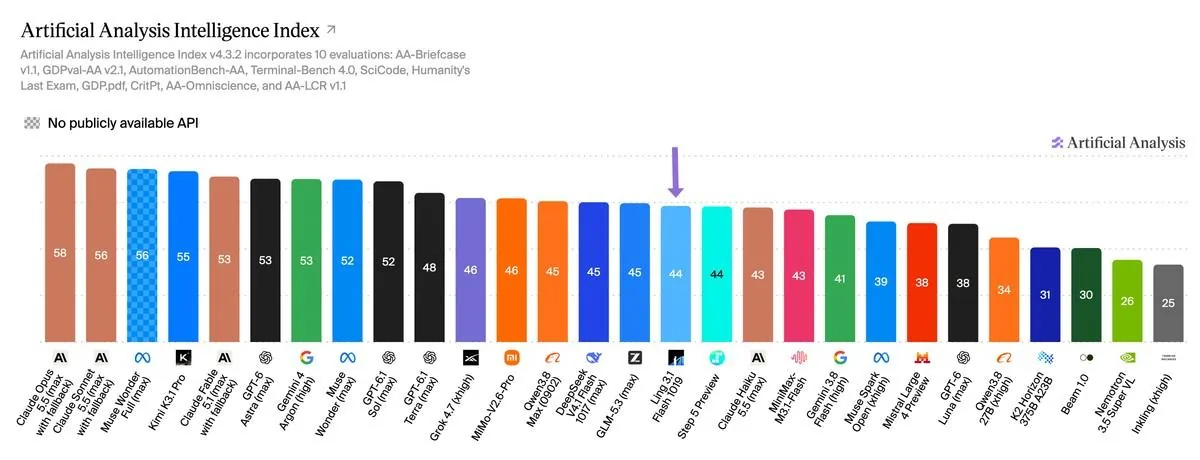
Ling-3.1-flash-1019 targets Personal Agent scenarios and improves how the model handles complex workflows and multi-step tasks. On AA-Briefcase, which covers complex knowledge work, the score rose from about 1,400 to 1,524 Elo; GDPval-AA from about 1,618 to 1,644 Elo; AutomationBench-AA from 62% to 68%; CritPt from 18% to 26%; and SciCode from 54% to 57%.
The Ling-3.1-flash-base Foundation Model
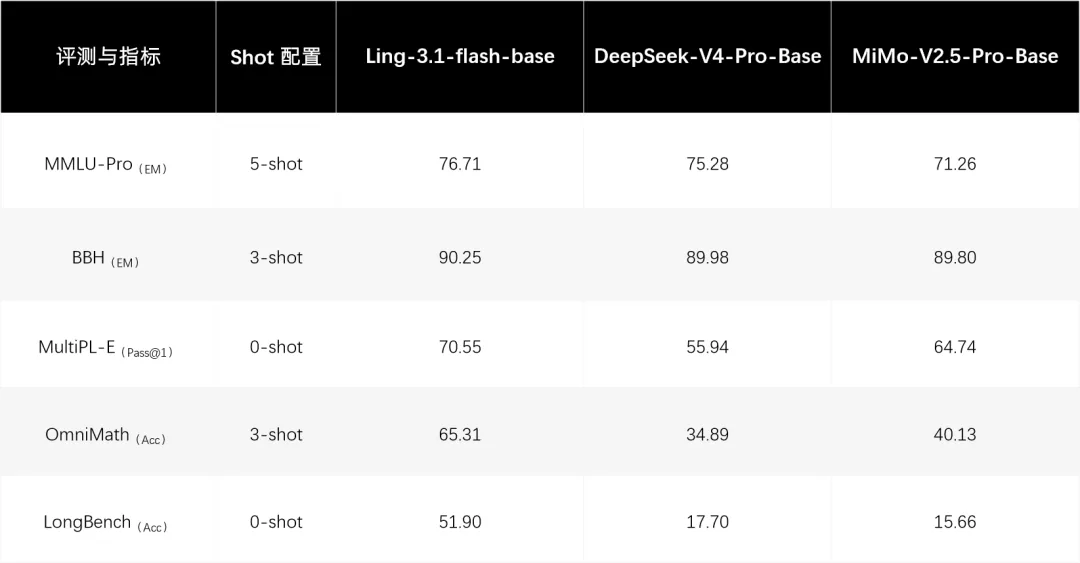
Ling-3.1-flash-base uses a hybrid linear MoE architecture with roughly 560B total parameters and about 25B activated per token, balancing model capacity, long-sequence processing and per-step compute.
Across 47 benchmarks in 8 domains, Ling-3.1-flash-base scored highest on 32 of them, beating DeepSeek-V4-Pro-Base and MiMo-V2.5-Pro-Base. It is released as BF16 base weights under the MIT license, so developers can run continued pre-training, domain adaptation and post-training with their own knowledge, processes and tools.
Ties to Lingguang 2.0

On Oct 27, Lingguang 2.0 was upgraded into a “personal AI assistant that gets things done,” with cross-session memory, long-horizon task scheduling and an independent cloud host, allowing it to follow up on tasks and manage complex matters more proactively within the user’s authorization.
To handle multimodal information in personal tasks, Biling trained a vision-language model, Ling-3.1-flash-VL, on Ling-3.1-flash, adding visual understanding to its reasoning, planning and tool-use abilities. It has been applied in Lingguang first and will be released publicly later. Ling-3.1-flash has also been alignment-trained on feedback from applications including Lingguang and the Afu Doctor edition.
Source: QbitAI