Overview of Key Developments
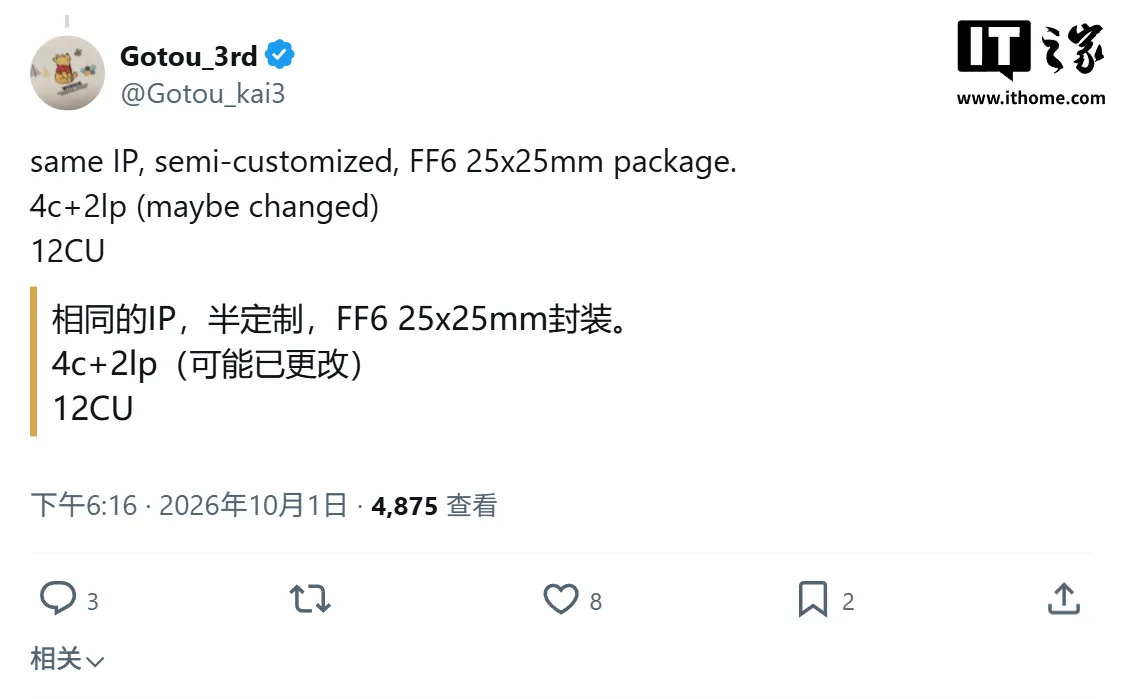
AMD’s next-generation handheld gaming SoC, the Ryzen Z3 series, has revealed several critical parameters, indicating its focus on enhanced performance for portable gaming. According to Wccftech’s October 1 report, confirmed details include:
- Packaging: 25×25mm FF6 package, smaller than Strix Point’s FP8
- Architecture platform: Medusa Point
- CPU configuration: Projected 4 Zen 6 cores + 2 low-power Zen 5 LP cores (6 cores, 12 threads)
- GPU configuration: 12 RDNA4m compute units (CUs), exceeding standard Medusa Point’s 8 CUs
- Power targets: ~15W for Ryzen Z3, ~25W for Ryzen Z3 Extreme
- Release timing: Unspecified; pending AMD’s official announcement
Note: Final product specifications may be adjusted; leaked figures represent a prototype configuration, not the final shipping version.
Architecture and Performance Details
The Ryzen Z3 series adopts a mixed-performance CPU design optimizing for both peak capability and efficiency. The Zen 6 cores deliver current-generation performance, while Zen 5 LP focuses on power efficiency during light workloads. This hybrid approach aligns with prevailing mobile design trends, though scheduling specifics and clock speeds remain undisclosed.
Notable tradeoff: To enable the GPU upgrade, Ryzen Z3 reduces 4 Zen 6c CPU cores compared to baseline expectations. Standard Medusa Point implementations would typically prioritize more CPU cores, while this variant reallocates silicon area and power budget toward graphics processing.
Graphics use RDNA4m architecture—a derivative of RDNA3, somewhat intermediary between RDNA3 and a potential RDNA4. Its defining enhancement is matrix-optimized RDNA 4-class ALUs, enabling native hardware support for FSR 4 and future upscaling technologies. Clarification: RDNA 5 is not employed; this represents an incremental refresh.
Packaging uses FF6 (Folded Frame 6), a fan-out wafer level packaging technology. By folding interconnect structures, FF6 achieves higher pin counts and improved thermal performance within compact footprints—essential for handheld device constraints.
Configuration Comparison
The table below summarizes device differences as reported:
| Feature | Ryzen Z3 Series | Standard Medusa Point |
|---|---|---|
| CPU Cores | 4 Zen 6 + 2 Zen 5 LP (6C/12T) | More Zen 6/6c cores expected |
| GPU CUs | 12 | 8 |
| Package Size | 25×25mm FF6 | Larger than 25×25mm FP8 |
| GPU Architecture | RDNA4m | RDNA3 / RDNA3.5 (?) |
Practical Recommendations
Consider if you: Currently use Steam Deck or Switch and seek higher resolution (1080p handheld mode) with complex game compatibility (e.g., ported AAA titles); or professionally develop using FSR 4 and want early hardware insight.
Wait if you: Require verified battery-life figures from real-world testing; need multithreaded CPU performance for content creation; or expect late-2027 launch with mature architecture—release timing remains unconfirmed.
Final Note
AMD’s tradeoff of CPU cores for GPU performance highlights the industry’s shift from “just sufficient” toward “desktop-class” handheld experiences. FF6 adoption also signals AMD’s accelerating progress in advanced packaging technologies.
Final note: When thermal budgets cap at 15-25W, balancing CPU-GPU allocation outweighs raw parameter races—this has become the defining challenge for next-generation handheld SoCs.