
The New Fork Behind the Open Weights Boom
Recent moves by Meta, Moonshot AI, and Alibaba around open models signal that AI open source is shifting from “whether models are open” to “how openness can be sustained.”
According to a Reuters report on August 10, Meta released Muse Glimmer, an open-weight model designed for local Agent workloads, and previewed that larger model weights would follow—emphasizing that AI capabilities should be more broadly accessible and usable. Open weights typically refer to the public release of a model’s trained parameters, allowing developers to deploy locally or continue fine-tuning, though this does not amount to full open source.
On the other side, when Moonshot AI released the Kimi K3 weights in late July, it included commercial clauses in the license: enterprises and their affiliates operating a MaaS (Model-as-a-Service) business with cumulative revenue exceeding $20 million over any consecutive 12-month period must reach a separate agreement with Moonshot AI before using Kimi K3 or its derivatives commercially; commercial products reaching a certain scale must also meet brand attribution requirements. A Reuters report on August 7 also noted that Alibaba is exploring a new mechanism for Qwen3.8-Max aimed at large-scale commercial use, though specific details have yet to be announced.
Competition Is About Control, Not Just Capability
Over the past two years, comparisons between open and closed models have largely revolved around benchmark scores. But as model capabilities increasingly approach the threshold of production readiness, developers and enterprises are focusing on more practical questions: Can it be deployed privately? Does data leave the enterprise environment? Is fine-tuning for business needs supported? How high are inference costs? And will migration be possible down the road?
Open models are evolving from a technical choice into an infrastructure decision. Enterprises adopt open models not necessarily to make an open-source statement, but to reduce costs, protect data, lessen dependence on a single API provider, and retain control over their system architecture. Especially in Agent scenarios, a single user request may involve task planning, multi-round reasoning, tool calls, and context read/write operations—cost is no longer a simple matter of “one model invocation.”
Key shifts include:
- Changing cost units: Tokens are becoming the new unit of technology spending;
- Changing deployment models: Moving from cloud APIs toward local and hybrid deployments;
- Changing commercial relationships: Value needs to be reallocated between model developers and MaaS platforms.
This past August, the Linux Foundation launched the Tokenomics Foundation, aiming to establish open standards for measuring AI costs and value creation. The questions it tackles are straightforward: How much does AI cost, and how much value does it create? This also explains why the Kimi K3 license terms drew so much attention: when commercial platforms deliver large-scale services built on open models and generate revenue, whether the original model developer should share in that value has become an unavoidable question.
“Open Source Model” and “Open Weights” Are Not the Same Thing
The boundaries of AI open source are also being redefined. Under the Open Source AI Definition published by the Open Source Initiative, open source AI should grant users the freedom to use, study, modify, and share the system, along with sufficient information and materials to modify it. Merely releasing final weights does not mean the entire AI system is open source—training code, data sources, data processing pipelines, and evaluation frameworks may all remain inaccessible.
This isn’t terminological pedantry. In traditional software, source code largely explains how a program is constructed; behind a large model, however, lies an entire engineering chain encompassing training data, cleaning pipelines, training code, weights, evaluation methods, and deployment tools. At which layer does openness suffice for others to understand, modify, or even reproduce the system? The industry has no unified answer yet.
In the Chair’s Statement from the 2026 World Artificial Intelligence Conference and High-Level Meeting on Global AI Governance, “open source and openness” was listed as a key pathway for advancing inclusive AI development, while also emphasizing intellectual property protection, data security, risk governance, and the decision-making authority and behavioral boundaries of intelligent agents. In other words, the deeper the openness, the more responsibility boundaries and governance mechanisms cannot be treated as an afterthought.
From Open Models to Open Buildability
As models themselves become easier to obtain, scarce resources are shifting toward engineering, tooling, protocols, data, and collaboration systems. The value of an open project can no longer be judged solely by GitHub stars, download counts, or model leaderboards—it depends on whether there is runnable code, clear interfaces, deployment documentation, verifiable experiments, and transferable capabilities.
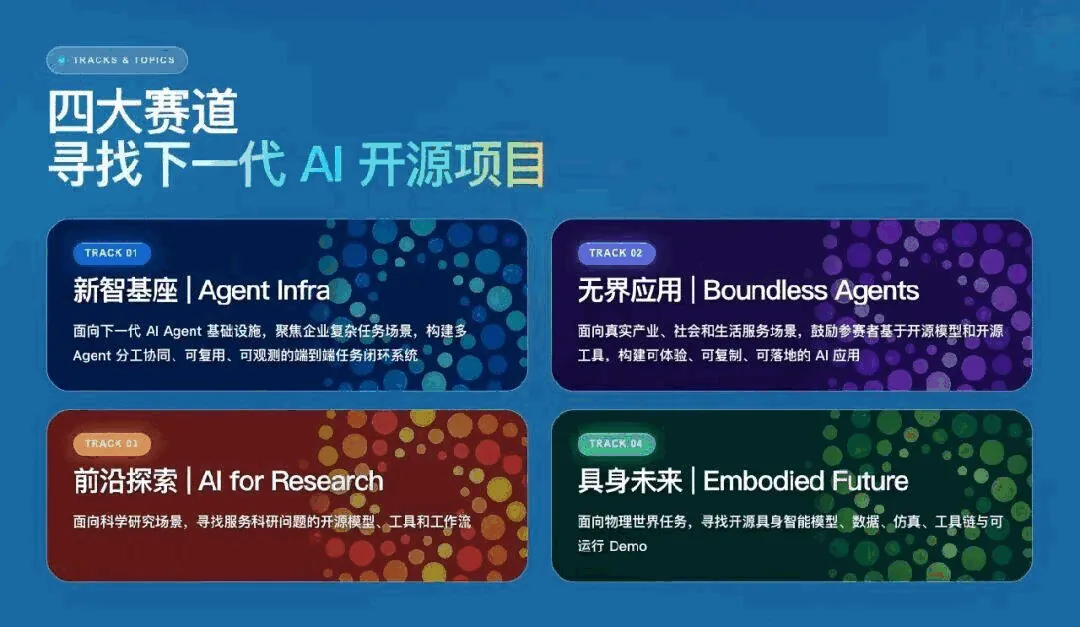
The World Artificial Intelligence Open Competition GOAI, initiated by the Hangzhou Open Source AI Foundation, offers a case study. The competition is supported by the Agentic AI Foundation and the LF AI & Data Foundation as global open source partners, with the slogan “Open. Share. Build.” It features four competition tracks: Agent Infra, Boundless Agents, AI for Research, and Embodied Future, with a total prize pool of 5 million RMB and a grand prize of 1 million RMB.
The four tracks each target critical questions that arise after models are deployed: Agent Infra focuses on task decomposition, tool calls, result verification, and execution evidence for multi-role Agents; Boundless Agents addresses real-world scenarios spanning eyewear, automotive, finance, education, and industrial manufacturing; AI for Research emphasizes explainability, inspectability, and extensibility, and welcomes negative results; Embodied Future pushes validation into physical-world tasks such as dual-arm manipulation and industrial park patrol.
Industry Assessment: The Core of Openness Is Sustainable Co-Building
The second half of AI open source won’t be decided by “who released the stronger model.” Training and inference costs, commercial licensing boundaries, safety responsibilities, reproducibility, and ecosystem collaboration will collectively determine whether open models can endure over the long term.
Open is only the first step; Share and Build are what determine an ecosystem’s vitality. If openness amounts to a few companies continuously subsidizing the industry, the model is unsustainable; if licensing terms tighten too far, they stifle developer innovation. The more likely trajectory is a landscape where open weights, commercial licenses, hosted services, industry applications, and community governance coexist. The truly influential AI open-source projects of the future will need to make models usable while also enabling those who come after to keep building on top of them. Models have release dates; ecosystems have no finish line.