
TL;DR: As of the five leaderboards captured on Oct 6, 2026, the top three models for writing novels and short stories are Claude Opus 5.5 (composite 98.1), Claude Fable 5 (97.3), and Claude Fable 5.1 (97.0). Gemini 4 Argon leads the Text Arena creative-writing category (1519 pts, still flagged Preliminary), with Opus 5.5 right behind at 1516. GPT-6 Astra tops EQ-Bench with 2173 Elo, but with no human-judged data it is excluded from the synthesis.
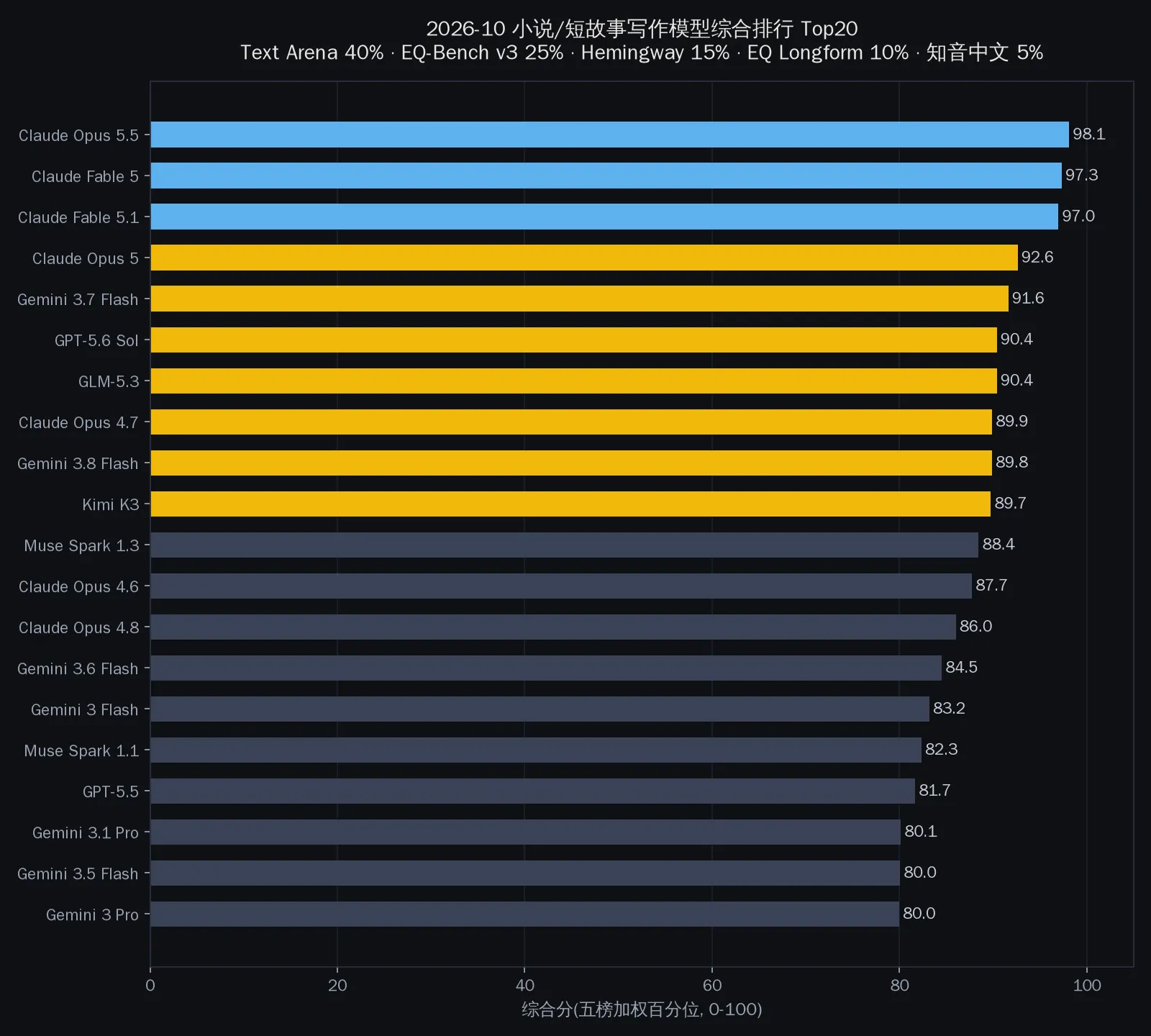
Long-form writers have two recurring complaints: models forget their own world-building by chapter 30, and the “AI smell” shows through in the first paragraph. Picking a model from a single headline leaderboard doesn’t help — that table is a math problem, not a writing problem. Here I pulled the data from five leaderboards, computed a weighted ranking, and kept every screenshot and the full methodology.
Why these five leaderboards
They fall into three classes: human voting (Text Arena, Hemingway), LLM judges (EQ-Bench v3/Longform, Zhiyin), and a web-novel research paper (WebNovelBench). The third class is a cross-check only — it gets no weight.
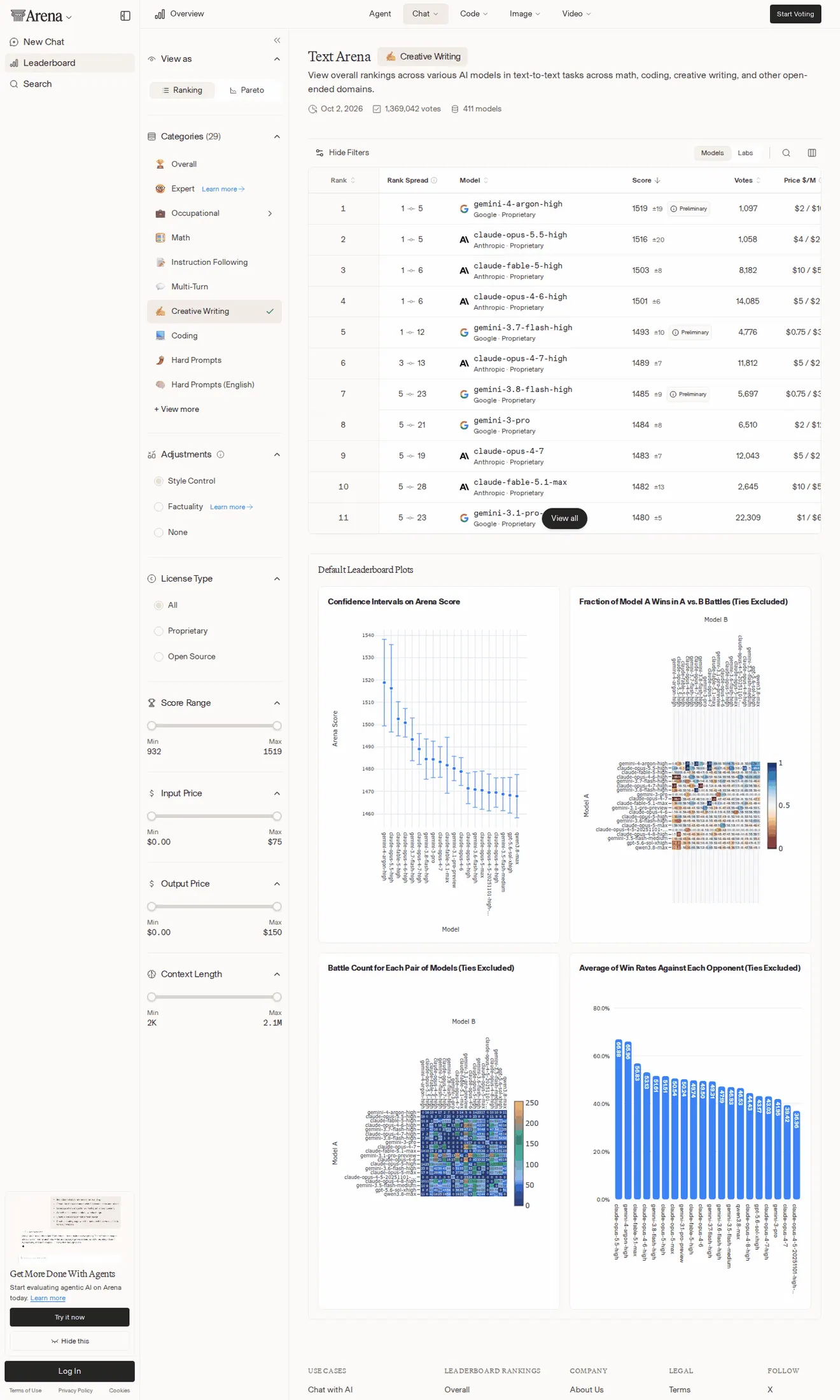
Text Arena creative writing (lmarena.ai) — blind human votes on side-by-side outputs; 1.37M votes across 196 listed entries. All head-to-head human preference, no model judging. Most trustworthy by construction. Weight 40%.
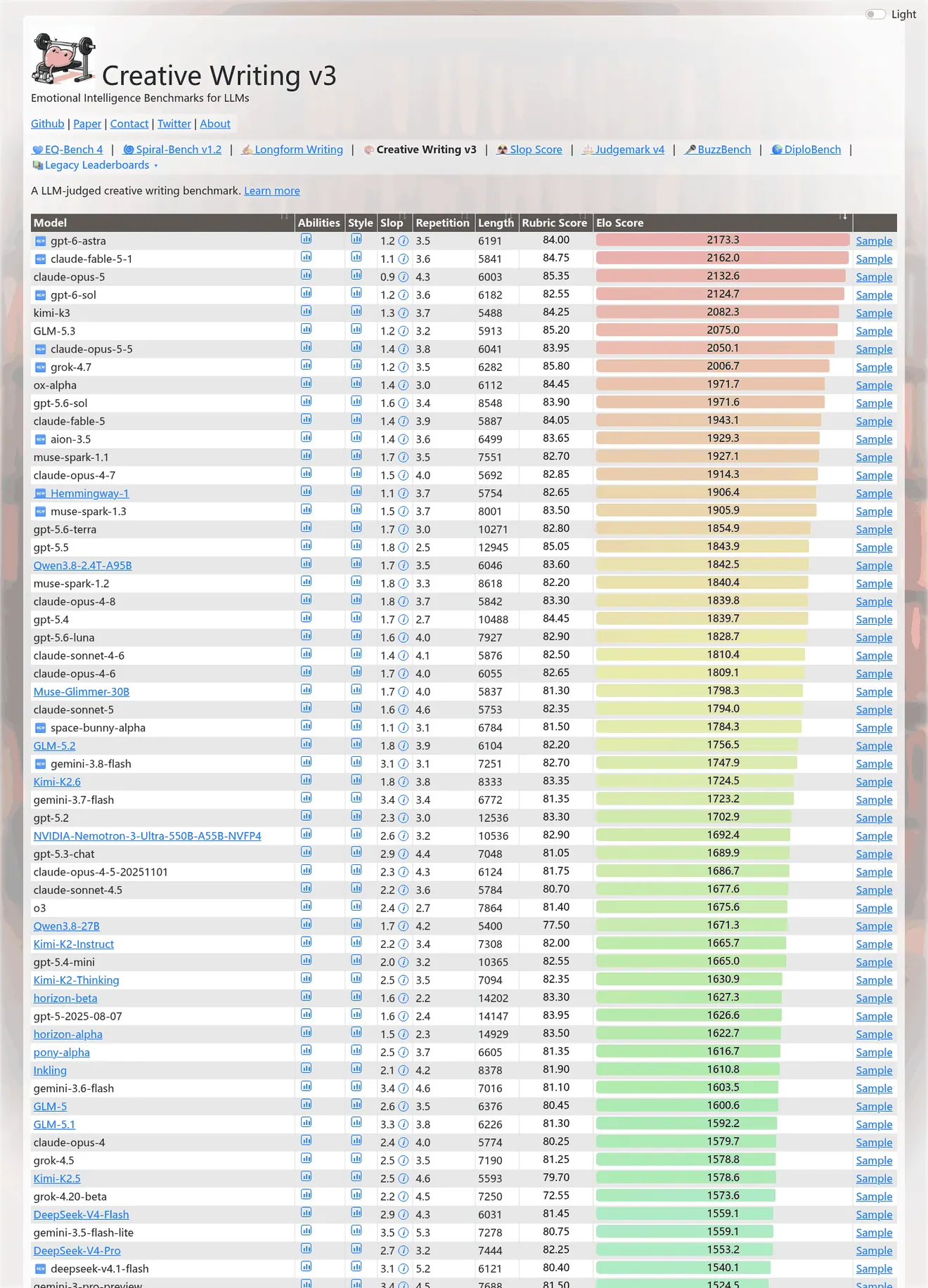
EQ-Bench Creative Writing v3 — dedicated creative-writing benchmark; the CSV I pulled today has 252 model rows and it updates almost daily. Catch: the judge is another model. Research shows LLM judges favor their own family by ~23 percentage points, and OpenAI judges are ~37 points more lenient toward their own models. Use it to filter junk, not to crown a winner. Weight 25%.
Hemingway-Bench — Surge AI ran 5,000+ blind comparisons with professional screenwriters, poets and editors, grading taste, originality, coherence and emotional intelligence. The rare human-literary standard in a model leaderboard. Weight 15%.
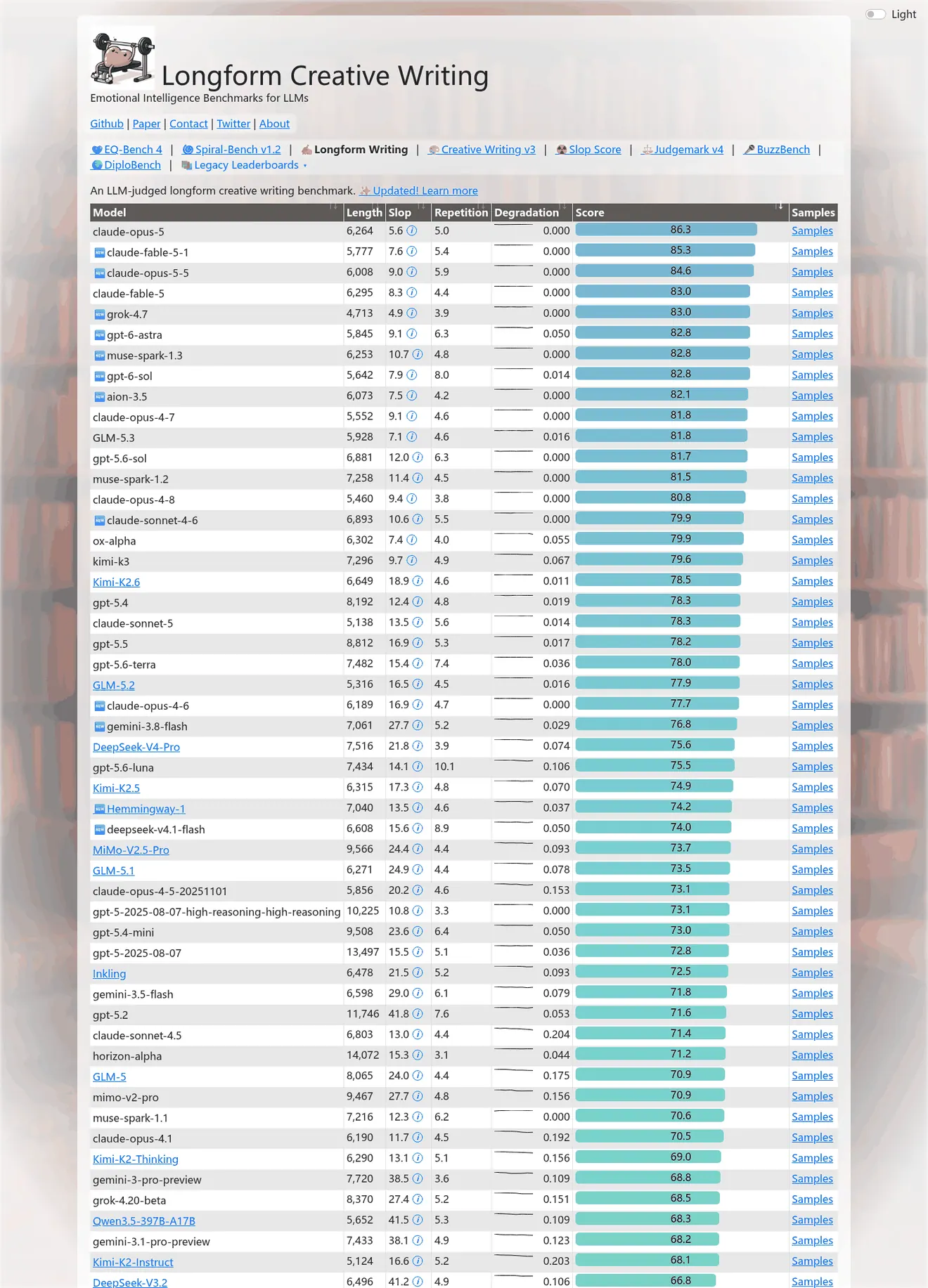
EQ-Bench Longform — an 8-chapter × 1,000-word serialized writing task with a quality-degradation metric, aimed exactly at the novel writer’s pain point. Weight 10%.
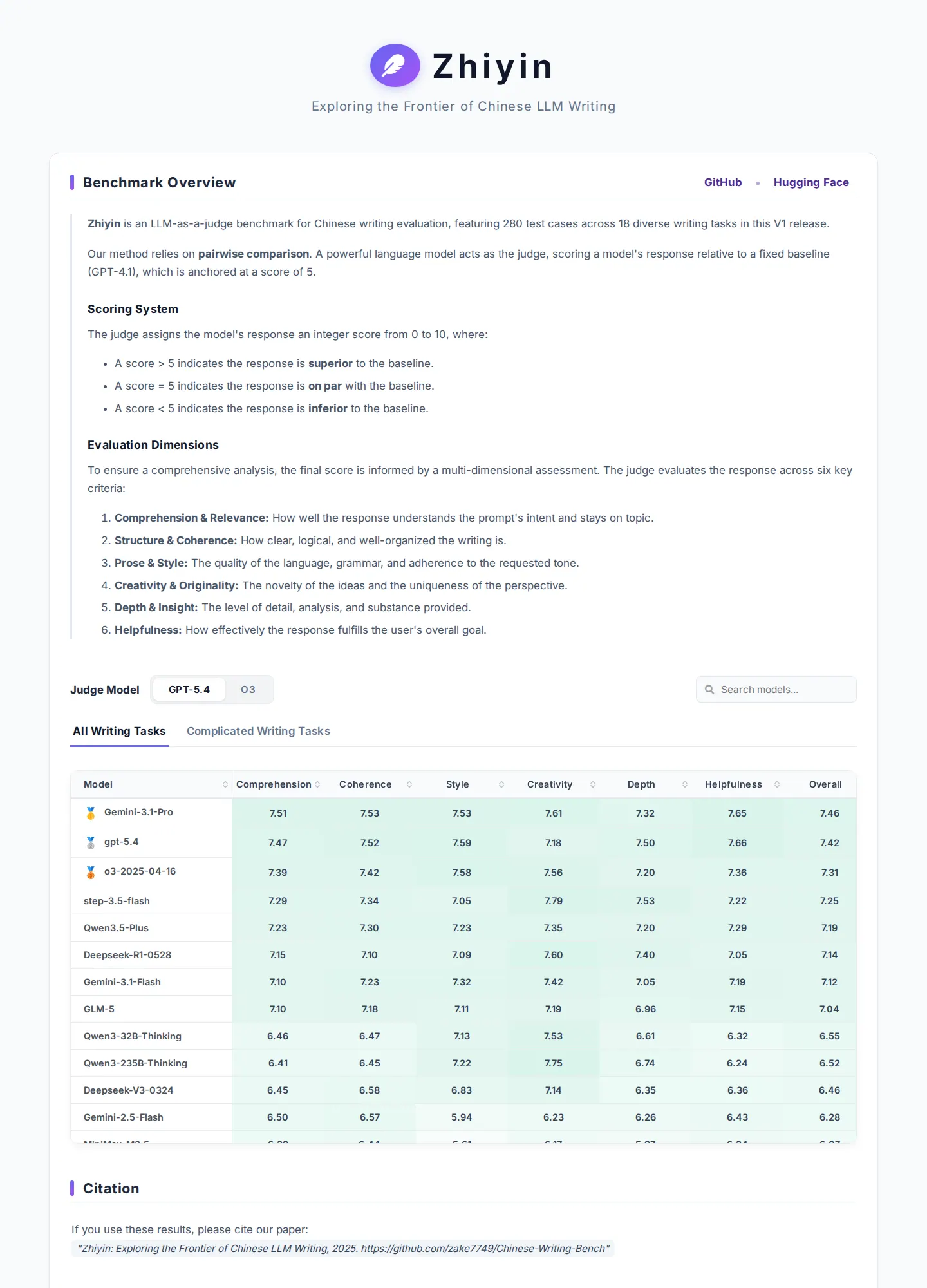
Zhiyin (zake7749/chinese-writing-benchmark) — a Chinese-writing LLM-judge dataset: 280 tasks scored by two judges (GPT-5.4 and O3) against a GPT-4.1 baseline fixed at 5. The only Chinese-writing benchmark of the five. Weight 5%. Two caveats: prompts are Traditional Chinese; GPT-5.4 is itself one of the judges.
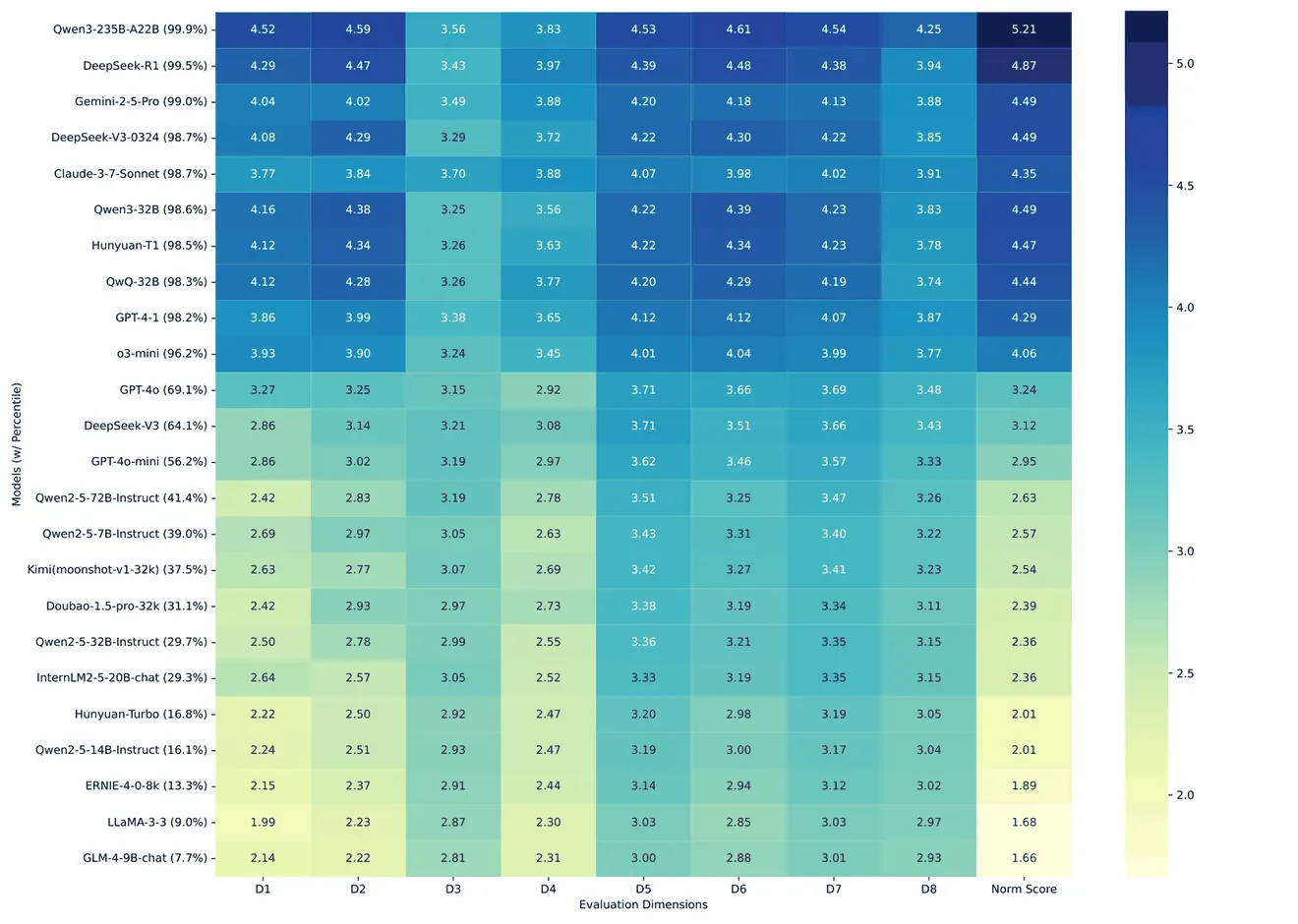
WebNovelBench (arXiv 2505.14818) — synopsis-to-story evaluation of 24 models against 4,000+ real Chinese web novels; closest to actual web-fiction pipelines. Two problems: the paper is from May 2025 so every model is dated, and there is no public per-model table — only Figure 3. So: qualitative cross-check, zero weight.
Method: percentile position per leaderboard, then a weighted mean
Raw scales aren’t comparable (an Elo of 1516 vs. a score out of 100 vs. a judge mean of 7.16). So:
- Convert each model’s rank in each leaderboard to a percentile position (#1 ≈ 100%, bottom ≈ 0%);
- Composite = weighted average over the leaderboards the model actually appears in — Text Arena 40% + EQ-Bench v3 25% + Hemingway 15% + EQ Longform 10% + Zhiyin 5%;
- Gate: a model must appear on at least 2 leaderboards and on at least one human-judged leaderboard (Text Arena or Hemingway). Models praised only by other models are excluded on principle.
Multiple variants of one family (e.g., Opus 5.5 high / vertex) are collapsed to the family’s best result.
The Top 20 table (captured 2026-10-06)
TA = Text Arena rating ±CI (votes) | EQv3 = EQ-Bench v3 Elo | EQLF = EQ Longform score | HW = Hemingway expert Elo | Zhiyin = mean of both judges. “—” = not listed there.
| # | Model | Composite | Text Arena | EQ v3 Elo | EQ Longform | Hemingway Elo | Zhiyin |
|---|---|---|---|---|---|---|---|
| 1 | Claude Opus 5.5 | 98.1 | 1516±20 (1,058) | 2050.1 | 84.6 | — | — |
| 2 | Claude Fable 5 | 97.3 | 1503±8 (8,182) | 1943.1 | 83.0 | 1110 | — |
| 3 | Claude Fable 5.1 | 97.0 | 1482±13 (2,645) | 2162.0 | 85.3 | 1095 | — |
| 4 | Claude Opus 5 | 92.6 | 1471±7 (13,263) | 2132.6 | 86.3 | 1047 | — |
| 5 | Gemini 3.7 Flash | 91.6 | 1493±10 (4,776) | 1723.2 | — | 1105 | — |
| 6 | GPT-5.6 Sol | 90.4 | 1468±8 (7,537) | 1971.6 | 81.7 | 1057 | — |
| 7 | GLM-5.3 | 90.4 | — | 2075.0 | 81.8 | 1053 | — |
| 8 | Claude Opus 4.7 | 89.9 | 1489±7 (11,812) | 1914.3 | 81.8 | 1042 | — |
| 9 | Gemini 3.8 Flash | 89.8 | 1485±9 (5,697) | 1747.9 | 76.8 | 1093 | — |
| 10 | Kimi K3 | 89.7 | 1460±9 (5,694) | 2082.3 | 79.6 | 1069 | — |
| 11 | Muse Spark 1.3 | 88.4 | 1459±12 (2,631) | 1905.9 | 82.8 | — | — |
| 12 | Claude Opus 4.6 | 87.7 | 1501±6 (14,085) | 1809.1 | 77.7 | 1045 | — |
| 13 | Claude Opus 4.8 | 86.0 | 1470±7 (12,798) | 1839.8 | 80.8 | 1044 | — |
| 14 | Gemini 3.6 Flash | 84.5 | 1471±8 (7,580) | 1603.5 | — | 1075 | — |
| 15 | Gemini 3 Flash | 83.2 | 1457±9 (4,814) | — | — | 1052 | — |
| 16 | Muse Spark 1.1 | 82.3 | 1447±8 (7,706) | 1927.1 | 70.6 | — | — |
| 17 | GPT-5.5 | 81.7 | 1456±10 (4,346) | 1843.9 | 78.2 | 1035 | — |
| 18 | Gemini 3.1 Pro | 80.1 | 1480±5 (22,309) | — | — | 1073 | 7.16 |
| 19 | Gemini 3.5 Flash | 80.0 | 1469±7 (9,445) | 1559.1 | 71.8 | 1071 | — |
| 20 | Gemini 3 Pro | 80.0 | 1484±8 (6,510) | 1524.5 | — | 1056 | — |
Names worth remembering that missed the composite: Gemini 4 Argon tops Text Arena creative writing (1519±19, 1,097 votes, Preliminary) — once its vote count settles, the top three will likely reshuffle. GPT-6 Astra holds the EQ-Bench v3 crown at 2173 Elo but appears on neither human leaderboard. GPT-5.4 posts Zhiyin’s best dual-judge mean of 7.24 — and it is one of the judges, so take that with the usual salt.
Three reads per leaderboard
Text Arena: the top three are all 15xx — it’s a margin-of-error fight
Argon’s 1519 vs. Opus 5.5’s 1516 is a 3-point gap inside overlapping error bars (±19 vs ±20). The one that is truly “settled” is Claude Fable 5 — 1503 points on 8,182 votes, the most-voted non-Google model in the top ten. Also note Claude Opus 4.6 at 1501±6 on 14,085 votes: more human votes and a tighter CI than EQ-Bench’s 1809 Elo would suggest.
EQ-Bench v3: it ranks writing that machines praise
GPT-6 Astra 2173, Fable 5.1 2162, Opus 5 2132 — this leaderboard rewards metaphorical density, which Hemingway’s experts explicitly called out (“nearly every sentence reaches for a metaphor”). A high EQ score proves only that a model judge likes you; cross it against a human board.
Hemingway: the experts put Fable 5 first — and Flash models outrank Pros
The expert Elo leader sits Fable 5 at 1110, with Gemini 3.7 Flash second at 1105 and Fable 5.1 third at 1095. Flash-tier models outrank Pro tiers in these writers’ eyes (Gemini 3 Pro sits at 1056, #10) — almost the opposite of EQ-Bench’s ordering. GPT-5.6 Sol is #9 (1057) and Kimi K3 is #8 (1069): two Chinese models holding their own in a human writers’ board.

Zhiyin: on the Chinese track, self-judging is the loudest signal
Under the GPT-5.4 judge, Gemini-3.1-Pro leads at 7.46 with GPT-5.4 itself second at 7.42; switch to O3 and O3 lands second at 7.31, with GPT-5.4 still first. The judging models and their kin trade the top two spots while the domestic Chinese models (Step 3.5 Flash 7.04, Qwen 3.5 Plus 6.99, DeepSeek-R1 6.96) sit in a tight pack below. Its value is the relative ordering of Chinese models, not the absolute scores.
WebNovelBench: as of mid-2025, Chinese open-source wins the web-novel line
Qwen3-235B-A22B tops with a 5.21 normalized score, ahead of DeepSeek-R1 and Gemini-2.5-Pro, with Claude-3-7-Sonnet and GPT-4.1 close behind; GPT-4o and DeepSeek-V3 sit mid-tier (2.5–3.8), GLM-4-9B and LLaMA-3-8B at the bottom. The eight-dimension chart of all 24 models is in the paper’s Figure 3 below — the only quantitative chart aligning LLM output against the distribution of human web-novel authors.
Practical tiers: web novels, short stories, budget
Daily web-novel volume: GLM-5.3, Kimi K3, Qwen 3.8 Max — all in the Top 25 across the professional boards (GLM-5.3 #7, Kimi K3 #10, Qwen 3.8 Max #25 composite but 1468 on Text Arena with 4,555 votes), cheap, high-volume, strong Chinese prose. Good skeleton writers for a daily-update pipeline.
Short stories / premium pieces: Claude Opus 5.5 and Fable 5.1 are the ceiling; for value, Gemini 3.8 Flash posts a 1093 expert Elo (#4 on Hemingway) at a fraction of flagship pricing.
Local gateway check (CPA gateway, 102 models, verified 2026-10-06): claude-opus-5-5-high, gemini-3.7-flash, gemini-3.8-flash(-high), glm-5.3, kimi-k3, qwen3.8-max, gpt-5.6-luna/terra, gpt-6-luna, grok-4.7, deepseek-v4-pro(-0813). The Claude Fable / Muse Spark families in the table are not on the gateway.
Five traps in the method (all hit first-hand)
- Models praise their own family. Reported magnitude: ~23 percentage points of self-family bias; Hemingway’s team measured EQ-Bench’s autograder agreeing with professional writers as little as 43% of the time. Hence a hardened gate: every listed model must clear a human-judged board.
- “Preliminary” means the votes aren’t in yet. Argon’s rank interval is 1–5; next refresh could reorder the podium. Read votes and CIs before scores, always.
- The five boards live on different timelines. WebNovelBench is a May 2025 paper; Zhiyin V1 still evaluates the GPT-5.4 generation; EQ Longform’s judge is Claude Sonnet 4.6 (v1.11, Feb 2026). Only Text Arena, EQ-Bench v3 and Hemingway are “today”.
- Language drift in the Chinese boards. Zhiyin evaluates with Traditional Chinese prompts — Simplified Chinese results may differ; WebNovelBench has no public per-model table, so it stays qualitative.
- Family collapsing hides tier gaps. Best-variant-per-family (arena-style convention) can mask that a model’s low/medium tier is a different animal. Check the variant suffix before you pay for it.
Sources (all captured live on 2026-10-06)
- Text Arena creative writing: lmarena.ai/leaderboard/text/creative-writing (browser capture, 196 entries)
- EQ-Bench: eqbench.com/creative_writing.html and /creative_writing_longform.html (embedded CSVs: 252 / 105 rows)
- Hemingway-Bench: surgehq.ai/benchmarks/hemingway-bench (48 entries)
- Zhiyin: zake7749.github.io/Chinese-Writing-Bench/data/*.json (GPT-5.4 and O3 judges)
- WebNovelBench: arXiv 2505.14818 (Figure 3, 24 models)
Every number in the table can be re-verified against the URLs above; all screenshots and captured data are archived. Next refresh comes after Gemini 4 Argon sheds its Preliminary flag — that’s when the top three of this table will most likely reshuffle.