Bottom Line: First Place on Three Lines, Two Were Already in Your Hands
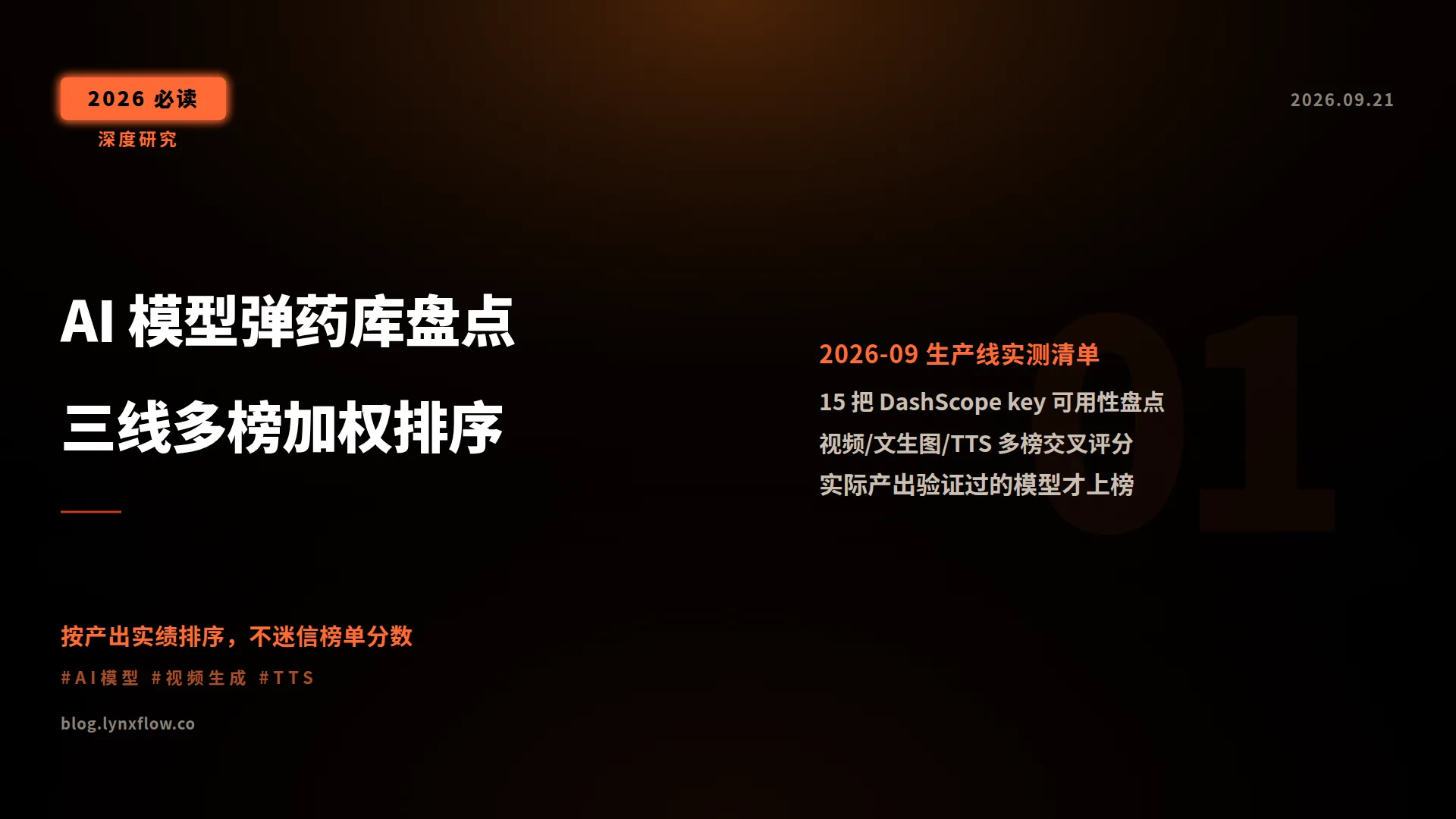
While wrapping up the manhua-drama pipeline this week, I ran a full inventory: pulled out every video, image, and audio model I could actually route through my production line, then weighted-ranked them against the various blind-test leaderboards from September 2026. The subject wasn’t “what models exist on the market” but “what in my Lumenx pipeline + CPA gateway can I fire requests to today.”
Of the top model on each of the three lines, two are already running in production: the video line’s Wan3.0-video (Arena image-to-video Elo 1481, #3 overall, 53 points ahead of the pipeline’s original Wan2.7), and the image line’s GPT-Image-2.5 Sunburst (Arena text-to-image 1421, topping the chart). The only one that needs action is the audio line—I recommend shifting your main TTS from CosyVoice to Qwen3-TTS-Flash.
One incidental finding deserves its own callout: the day before I’d judged “all DashScope video keys are dead,” but this time I took all 15 keys in CPA and tested them one by one against the video-synthesis endpoint. All 7 worked. That old “channel is dead” diagnosis was often just “I haven’t tried them all yet.”
Why I Did This: A Lesson From a “Key Is Dead” False Alarm
Here’s the timeline. On the evening of September 20, I ran Lumenx production tests and all three video channels (DashScope / Vidu / Kling) errored out. I logged the evening’s conclusion in memory: “wait for the user to fix the keys.” Two days later, as I pushed forward, I sent minimal requests (1-second clips, X-DashScope-Async: enable) against all 15 keys in my CPA config one by one—and 7 returned 200 + task_id immediately. The one I’d tested before happened to be the broken one.
The lesson: channel-level judgments must be exhaustive; sampling will lie to you. So the first thing I did in this inventory wasn’t look at leaderboards—it was to figure out exactly “what do I actually have.” I audited the model directory in the toolchain (Lumenx’s model_catalog.json, 38 models across 8 families), the channel list in the gateway (CPA config.yaml, 90+ model names across 16 channels), the audio registry (both CosyVoice and Qwen3 voice families registered in tts.py), and then overlaid per-key live tests. Only after the inventory was complete did I move on to ranking.
Method: Cross-Reference Multiple Leaderboards, Discount Single-Engine Sources
Here are the ranking rules, stated plainly without false objectivity:
- Primary weight to LMArena / Arena.ai blind-test Elo—millions of human blind votes, closer to “real aesthetic preference” than any technical spec;
- Secondary weight to Artificial Analysis video arena, SuperCLUE Chinese leaderboard, and厂商 six-dimensional evaluations, used for cross-validation and blind-spot coverage;
- Data gaps are downgraded honestly: there is no mature Arena leaderboard for TTS, so that ranking is a weighted judgment of features + reputation, and I flag it explicitly in the text;
- The Tavily search engine was on a full SSL disconnect that day, so all data is cross-referenced between Grok + Metaso, with every key figure requiring at least one independent source.
When the same model appears in different leaderboards with conflicting numbers (e.g., Kling 3.0 is 1092 on the T2V-with-audio sub-ranking but significantly higher on the main leaderboard), I keep the range rather than force a single number.
Video Line: Wan3.0’s +53 Points Aren’t Inflated
First, the image-to-video tier on the Arena.ai blind-test leaderboard for the third week of September:
| Weighted Rank | Model | Arena Elo (I2V) | My Status |
|---|---|---|---|
| 1 | Wan3.0-video | 1481 (#3), +53 vs. Wan2.7 | ✅ Joined this week, set as default |
| 2 | Seedance 2.0 | 1474 (#5); Seedance 2.5 has since climbed to 1477 (#4) | ✅ Channel available (mulerouter) |
| 3 | Kling 3.0 | Main leaderboard ~1460; sub-ranking 1092 | ⚠️ SecretKey is empty |
| 4 | Wan2.7-r2v/i2v | 1426–1428 (#10–11) | ✅ 7 keys tested live, original main |
| 5 | Vidu Q3 Pro | 1363 (#18) | ⚠️ Key returns 401 |
| 6 | PixVerse V5.6/C1 | Was #2 on AA leaderboard (earlier readout) | ✅ Channel available |
| 7 | happyhorse-1.0 | April “Happy Horse” chart dominance (Elo 1375, far ahead) | ✅ Pipeline default i2v |
| 8 | grok-imagine-video | 480p tier at 1381 (earlier readout) | ⚠️ Gateway submit returns no response, watching |
What does the top look like? #1 MiniMax-H3 is 1494, #2 Gemini Omni 1.1 Flash is 1488, and Wan3.0’s 1481 is just 7 points behind—a 57% win rate. It launched officially only in late August and entered the rankings in the top three on its first appearance. That 53-point generational gap lands exactly on my white-model-anchoring pipeline: Wan3.0 supports first_frame / last_frame strong semantics (reference image and first/last frames are mutually exclusive and cannot be sent together), meaning the anchor frames rendered programmatically from white models can be fed in as “strict first frame / last frame,” rather than the Wan2.7-r2v approach of “approximate anchoring via multiple reference images.” Composition locking upgrades from “approximate” to “strict.”
Cross-referencing also clarifies per-scenario choices: Zhidx’s six-dimensional evaluation of Seedance 2.0 (image quality / motion / image preservation / semantics / audio / text) ranked #1 across all dimensions, in the 3.31–3.70 range, with facial realism and precise motion control pulling ahead of Kling 3.0; Kling 3.0’s moat is native 4K60fps output and cinematic camera movement. For my manhua-drama scenario: Wan3.0 as the white-model anchoring main, Seedance for close-ups, and Kling for camera-move showcases once the key is restored.
Image Line: The Current Default Is Already #1—Lucky Break
This line is the easiest—after the audit, the existing default was already sitting on top:
| Weighted Rank | Model | Arena Elo (T2I) | My Status |
|---|---|---|---|
| 1 | GPT-Image-2.5 (Sunburst/Flare) | 1421/1399; editing榜 1520 | ✅ Default in .env |
| 2 | Gemini-3-Pro-Image-Preview | Range 1050–1420, trades wins with GPT-Image | Not in production chain |
| 3 | Qwen-Image-2.0/2.1 | 1029–1237; open-source line Qwen-Image-2512 is open-source #1 | ✅ Pipeline default is same-vendor wan2.7-image-pro |
| 4 | agnes-image-2.5 | Qwen Image Bench 57.53 (beats Seedream 4.5/4.0) | ✅ CPA agnes channel |
| 5 | Seedream 4.0/4.5 | Lower-mid tier on AA | No direct connection |
| 6 | grok-imagine-image-lite | No leaderboard data | ✅ Available in CPA, light tier |
GPT-Image-2.5’s position is unambiguous: text-to-image Sunburst variant at 1421, roughly 40 points ahead of the previous generation; the image editing leaderboard is even more dominant at 1520 vs. 1461, with multi-turn editing fidelity and 4K support creating a wide margin in editing-heavy scenarios. The Beijing News report cites Qwen-Image-2.0’s text-to-image score of 1029 (global #3) from the February AI Arena; versions since April (2512/2.1) have topped the open-source line, but the overall tier still trails GPT by one step.
The practical takeaway is a single sentence: leave the default as-is. One scenario-specific fallback—when generating Chinese posters or text-dense images (manhua covers / title cards), switch to Qwen-Image, whose Chinese text rendering is a genuine advantage in that context.
Audio Line: The Only Switch Worth Making
Let me be upfront: there is no authoritative blind-test leaderboard for TTS. Artificial Analysis’s Speech Arena covers the full speech-to-speech pipeline, not pure TTS scoring; specs like 97ms Time to First Audio and 17 voice options are vendor claims. This ranking is a weighted judgment of features + reputation, and the evidence strength is one tier below the previous two lines—read accordingly:
| Rank | Model | Key Features | My Status |
|---|---|---|---|
| 1 | CosyVoice-v3.5-plus | Alibaba’s latest; cloning / designed voices; same-vendor Qwen-Audio-3.0-TTS-Plus previously topped Speech Arena | ✅ Default in tts.py |
| 2 | Qwen3-TTS-Flash | 97ms TTFA, 17 voices, 9+ Chinese dialects, cloning / designed, Dual-Track streaming | ✅ Registered in tts.py |
| 3 | Gemini-3.1-Flash-TTS | Controllable narration tags, low latency, multilingual | ✅ CPA aistudio-gemini |
| 4 | CosyVoice v2/v3-flash | Dozens of dragon-family voices, previous generation | ✅ |
Ranks 1 and 2 are actually the same vendor’s previous and current generations—the gap isn’t quality but scenario fit: Qwen3-TTS’s dialect coverage (9+ dialects) and instruction-based voice adjustment are more useful for distinguishing character lines in historical-style manhua dramas, and the 97ms TTFA is friendly to streaming synthesis. The switching cost is near-zero—both families are already registered in tts.py, and the voice table (the Cherry/Serena/Ethan/Chelsie Qwen3 voices) is just sitting there waiting.
Limitations and Reproducibility
Three caveats, written down to prevent my future self from taking this too literally:
- Elo is a moving target. Arena weekly leaderboards fluctuate ±10–20 points per week; Seedance 2.5 knocked 2.0 off its perch just two weeks ago. The numbers in this article are frozen to a 2026-09-22 snapshot—recheck in a month.
- TTS evidence is one tier weaker, flagged as noted in that section.
- The “My Status” column is verified key-by-key or via source code. The 15-key endpoint tests used minimal requests (duration=1 second; error responses confirmed the auth and billing chain is alive—actual rendering is separate); a channel being “available” doesn’t mean it’s “working.” Kling’s SecretKey and Vidu’s 401 are both one-line verifications.
Reproducibility path: model inventory from /config/model_catalog/generated/model_catalog.json (38 models) plus the CPA config.yaml channel section; blind-test leaderboards at arena.ai/leaderboard/image-to-video and lmarena.ai/leaderboard/image-to-video; Chinese-side cross-reference via SuperCLUE video leaderboard and Arena.ai Chinese weekly report. The key-testing request templates are fully documented in Lumenx’s phase0-verdict doc.
Closing with one number: the entire inventory took under two hours, and the single most valuable move was those 15 per-key curls—which recast “the video channel is dead” as “8 are dead, 7 are alive.”
Data sources: LMArena I2V leaderboard · Arena.ai official tweet: Wan3.0 image-to-video #3, 1481 Elo · Arena.ai Week 36 weekly report (NetEase repost) · Zhidx: Seedance 2.0 six-dimensional all-#1 review · CometAPI: GPT-Image-2.5 benchmarks · Beijing News: Qwen-Image-2.0 launch · Qwen3-TTS technical deep-dive · The Paper: Happy Horse chart-dominance record