
From Computational Intelligence to Experimental Execution
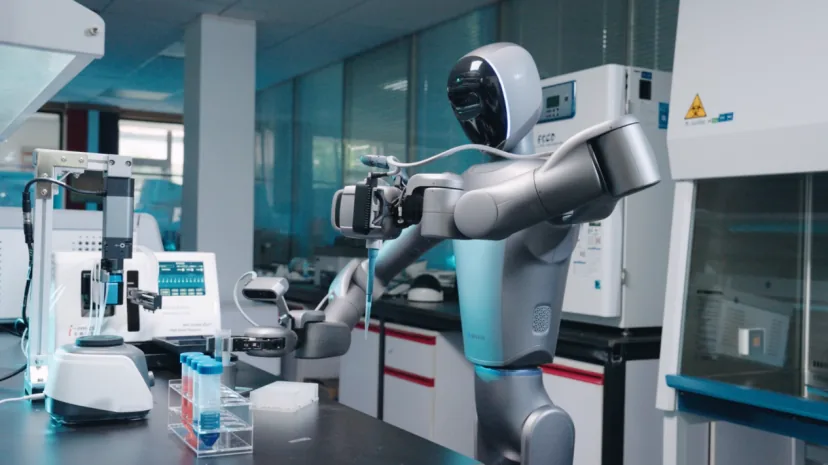
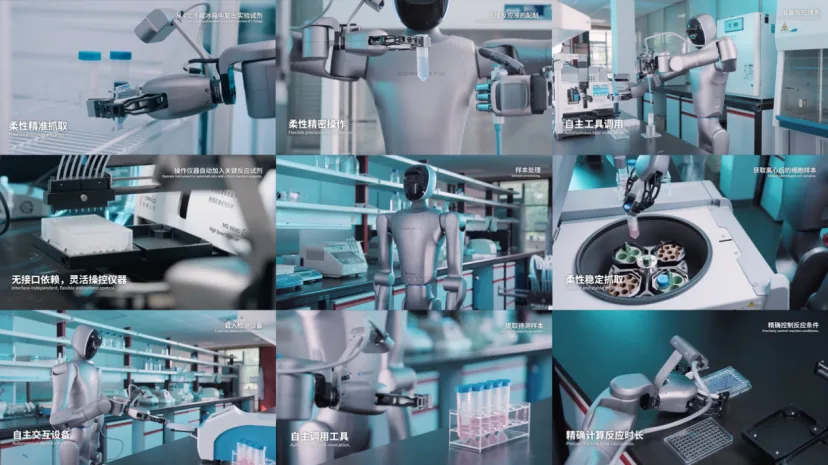
AI for Science is shifting from “able to compute” to “able to run experiments.” According to InfoQ AI, in mid-July this year, a national-level research platform laboratory introduced its first batch of humanoid robots named Monte2, jointly developed by 源络科技 and the laboratory. They are already performing real-lab tasks such as reagent retrieval and placement, reagent preparation, automated liquid dispensing, and cytotoxicity assays. They can also coordinate across multiple instruments, with no need for continuous human supervision during experiments.
Monte2’s design doesn’t chase a sci-fi aesthetic — it’s built around bench-side operations: two robotic arms, a streamlined torso, with the emphasis on executing fine motor tasks like micro-volume reagent transfer, instrument handling, tool invocation, nucleic acid extraction prep, and cell toxicity culture cultivation. Unlike typical six-axis industrial robots fixed on production lines, it targets longer-sequence, more flexible research workflows, with the goal of replicating the operational logic of a human experimenter at the lab bench.
Autonomous Labs Become a Global Race
Laboratory automation isn’t a new concept, but the key shift with autonomous labs is this: AI doesn’t just control equipment — it also participates in judging whether the next experiment is worth pursuing. In 2024, a team at the University of Liverpool in the UK demonstrated a system that could run continuously for 8 days, autonomously switching between chromatography, NMR, and other instruments, with AI determining the direction of reaction progress. It completed 680 experiments, and the results were published in Nature. Berkeley’s A-Lab in the United States focuses on materials synthesis, where AI generates plans from literature and robots synthesized 41 new materials in 17 days. Research at UNC achieved a 10x speedup in data acquisition through workflow optimization, compressing what used to take months of screening into weeks.
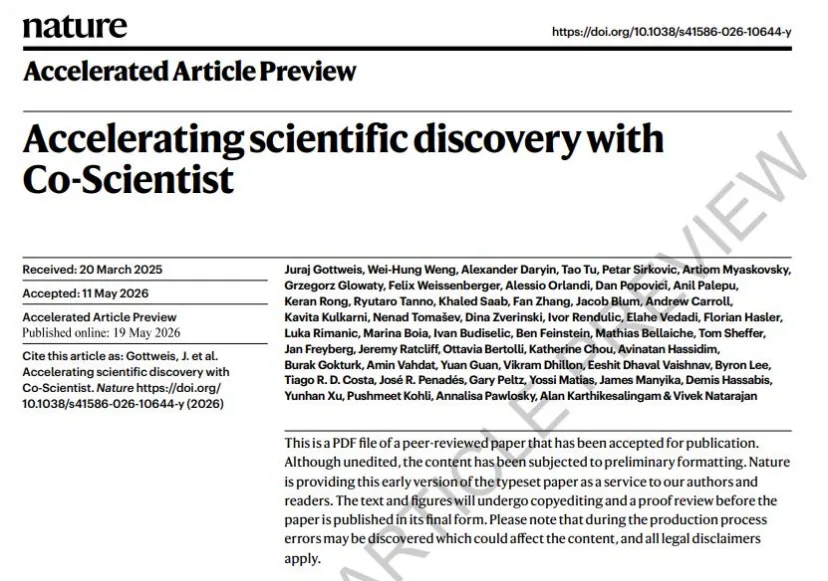
At the same time, large language models are becoming the “brain” of the lab. Here, large models refer to AI systems that can understand text, images, or other data and generate reasoning outcomes. Carnegie Mellon University’s Coscientist, Google DeepMind’s Co-Scientist, and Sakana AI’s AI Scientist are all exploring literature comprehension, experiment design, generating testable hypotheses, and even assisting with paper writing. China’s approach is pushing AI4S from scientific computing into real-world experimental execution.
Three Capabilities of Lab 3.0
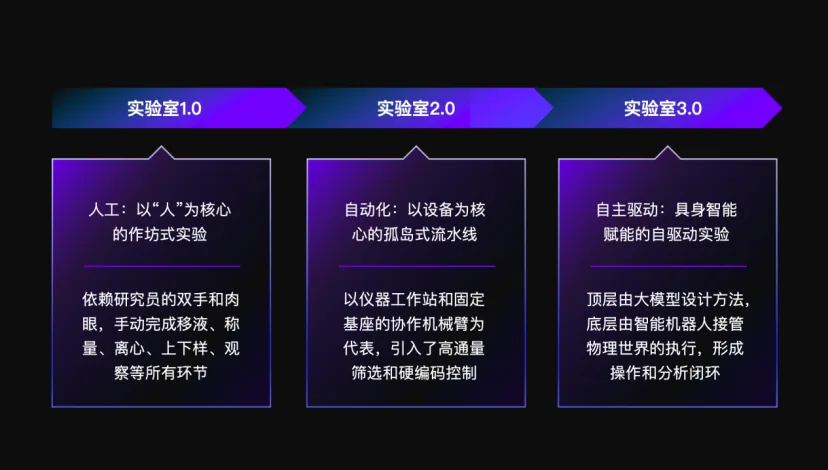
The report categorizes lab evolution into three generations: Lab 1.0 relies on researchers’ experience for pipetting, weighing, centrifugation, and observation; Lab 2.0 relies on equipment and fixed programs, boosting efficiency but functioning more like “automation silos”; Lab 3.0 leverages large models for method design and embodied intelligence robots for physical execution, forming a closed loop of operation and analysis. Embodied intelligence, simply put, means enabling AI to perceive and act upon the real world through a robot’s body.
The core technology proposed by 源络科技 is OPN — an “object-centric physical native model” — designed to help robots understand the relationships between experimental objects, tools, and environments, rather than merely executing pre-programmed actions. Its Lab 3.0 capabilities center on three points:
- Understanding experimental objects and scene relationships: identifying reagents, test tubes, cells, and instruments, and assessing the impact between different operations;
- Stable execution of long workflows over hours: maintaining task continuity across multi-step, multi-instrument procedures;
- Multimodal perception with real-time adjustment: fusing vision, force sensing, and tactile feedback to handle variations in liquid surface, angle, and grip force, achieving sub-millimeter operational precision.
The significance of these capabilities is that robots are no longer just “button-pressing arms” — they can organize a sequence of actions around an experimental goal and correct execution in dynamic environments.
Real-World Deployment: Cell Experiments Benefit First
Cytotoxicity assays, cell culture passaging, and other biopharmaceutical experiments are scenarios where the value of autonomous labs is most readily apparent. They typically involve numerous granular steps — sample collection, working solution preparation, repeated pipetting, instrument operation — where each step affects the final result. Manual operations are susceptible to fatigue and experiential variability; subtle differences in pipetting depth or sample volume, for instance, can introduce experimental bias.
According to the report, after 源络科技’s robots were deployed at the national-level research platform, they can autonomously complete full workflows including cell passaging and cytotoxicity testing, coordinating across multiple instruments to perform over 40 types of refined biological experimental operations. The lab’s lead researcher believes that introducing humanoid robots can alleviate throughput bottlenecks and consistency issues caused by manual operation, and plans to scale up to approximately 100 robots by the end of 2027, with AI unifying the scheduling of the robot fleet.
Collaboration, Not Replacement
The value of robotic labs isn’t about excluding researchers — it’s about freeing people from repetitive, high-intensity, long-duration值守. Milad Abolhasani, a professor at North Carolina State University, has pointed out that autonomous labs will serve as collaborators for human researchers, reducing the time and cost needed to reach scientific solutions, but won’t replace the expertise and creativity of human researchers.
This assessment also applies to the current state of AI4S deployment. Robots excel at stable, repetitive, data-intensive experiments; large models excel at helping form hypotheses from literature and data. But judging whether a discovery is significant, whether a mechanism holds up, or whether a direction is worth investing in still depends on scientists’ insight. 源络科技 has launched the “原点计划” (Origin Plan), seeking the first 100 partners to validate embodied intelligence applications across biopharmaceuticals, materials science, chemical analysis, and other scenarios. It’s foreseeable that future lab competitiveness will come not just from the number of instruments, but from the协同效率 of AI, robots, experimental workflows, and scientists’ judgment.