「One creator, plus an IP and AI tools, can complete the entire comic-drama production pipeline.」
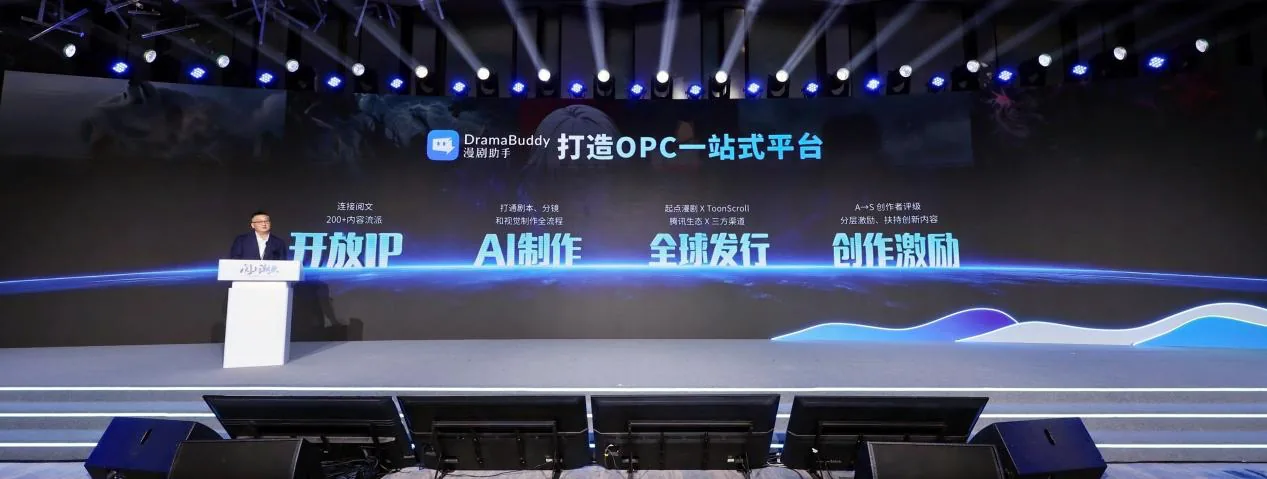
That is how Yuewen Group CEO Hou Xiaonan described the emerging 「one-person company」 at last week’s Yuewen Creation Conference. That day, Yuewen announced its first batch of premium AI animation projects, upgraded its DramaBuddy comic-drama assistant into the OPC one-stop platform, and introduced an 「IP Committee」 model meant to link the journey from text to screen and on to downstream development.
On the surface, the opportunities AI creates seem to keep expanding. But the people working the front lines of comic dramas are feeling something more real and much sharper.
After the conference, GeekPark joined interviews with Chen Weiyu, head of Yuewen’s AI platform; Huang Haonan, founder of Jiangyou Culture (known in the industry as 「Jiangyou」); and San Xing, former general manager of Weihou Culture. Jiangyou, among the first to dive into the AI comic-drama track, has lived through both last year’s boom and this year’s red ocean—his experience is almost a microcosm of the industry’s shift: shows get made faster, output multiplies, yet making money has become harder.
1. Output Multiplied, Revenue Barely Moved
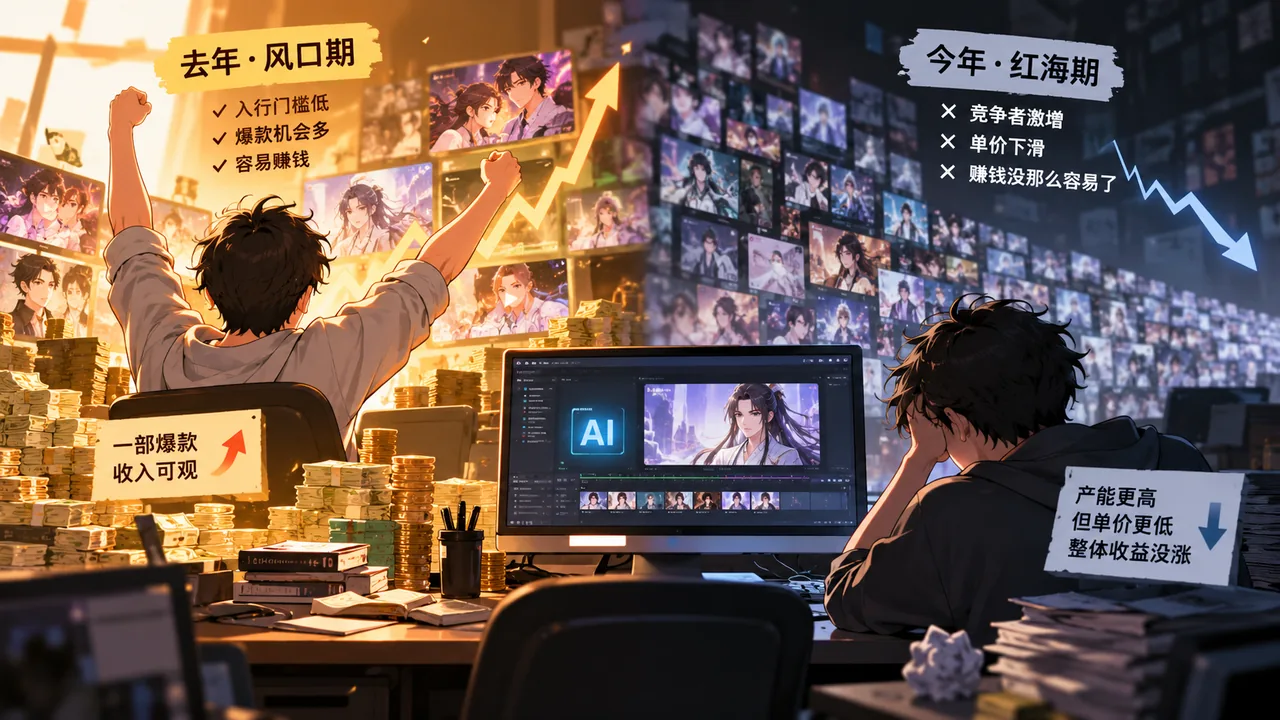
In Jiangyou’s memory, the business was far easier a year ago.
Around this time in 2025, the industry’s default production standard was 1,000 yuan per minute; an 80-minute comic drama cost about 100,000 yuan to make. His team of 10 people could grind out just one show a month. Even with low output, margins were considerable—a phase where 「you could make money lying down.」
In just one year, the entire cost and output model flipped.
Today a standardized, quality 80-minute comic drama is down to 400 yuan per minute—about 40,000 yuan total, a 60% drop from last year. Efficiency per person has risen severalfold: from 10 people producing one show a month to one person producing three a month.
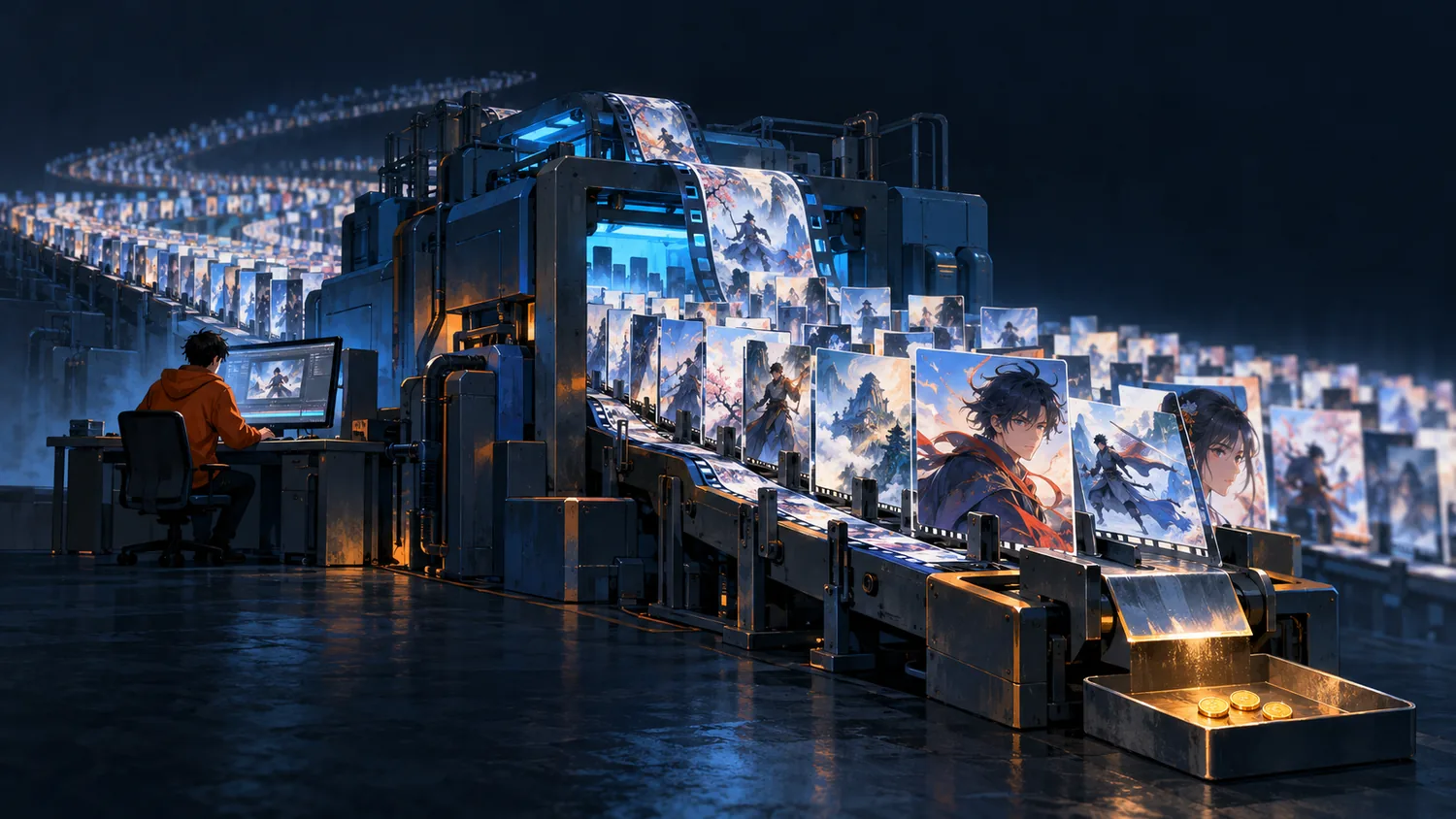
But the output explosion did not bring matching revenue growth. Jiangyou did the math: last year the company made 40 to 50 shows a month, generating roughly 20 to 30 million yuan. Now monthly output has surged to 200 or 300 shows, and domestic monthly revenue is still around 20 million yuan. 「Volume went up, unit price came down, overall earnings barely moved」—that is his most direct takeaway.
The industry’s entire cost structure has inverted. Last year the bulk of costs went to labor, editing, and voice acting, with AI compute tokens at only 20%-30%. Now it is the reverse: tokens account for half, labor is down to 20%, and the rest is scripts and miscellaneous expenses. 「You save on people, but compute gets expensive,」 Jiangyou sums up.
Chen Weiyu observes that the industry has actually split into two extremes. In batch production, labor is pressed below 30% and compute takes 60%-70%, with one person able to turn out a show a day. Premium productions are the opposite: upfront art, directing, and art-direction costs remain high. 「People with experience and distinctive judgment are becoming more valuable in the AI era, because output below can be scaled infinitely—taste at the top becomes the key.」
The bar for a hit is visibly falling too. Last year a show needed over 10 million yuan in revenue to count as an industry hit; now 100,000 to 200,000 yuan puts you in the top tier.
The race to the bottom has spread overseas as well. Jiangyou observed that TK platform’s monthly new releases jumped from under 1,000 in June to roughly 200,000 in just three months; views keep climbing while revenue share keeps falling—early on, 100 million views earned $140,000; later, 500 million views earned $120,000; recently, 300 million views brought only $40,000.
The market’s风向 shifts so fast that practitioners must constantly turn. At the start of the year, photorealistic-style subjects enjoyed platform perks and the whole industry piled in; when students came online during summer vacation, 3D subjects exploded and everyone switched again; now it has settled back to a 50/50 split between photorealistic and 3D. 「It used to be that heaven fed you; now you beg heaven for a chance to fight for scraps」—the joke hides real anxiety.
2. Agencies Are Shrinking as OPC Ushers In an Era of Comic Dramas for Everyone
At this Yuewen conference, the OPC one-stop platform was officially launched, along with disclosure that more than 5,000 individuals and studios have signed on, with the top ten OPC creators each earning over a million yuan a year. To Jiangyou, this is not a new signal but a change that has already happened—agencies’ advantages are weakening, and individual creators are becoming the main productive force.
He even offers a more radical judgment: 「After 2026 ends, China may no longer have AI comic-drama agencies in the traditional sense—the future is all OPC.」
The underlying logic is that the relationship between platforms and the industry has changed. Agencies used to be the platform’s 「low-maintenance partner」—no need to deal with tens of thousands of people, just manage a few top companies—which is why agencies got minimum guarantees, policy subsidies, and exclusive rights. But platforms have now pivoted to OPC: rather than binding capacity to a handful of agencies, it is better to support hundreds of thousands or even millions of individual creators, which means more supply and stronger risk resilience.
Technological leveling has completely removed the barrier to entry. Jiangyou calls AI comic dramas 「the lowest-cost startup opportunity in five years」: three to five people pool together tens of thousands of yuan, take advantage of free AI tool quotas, and produce a show in a week or two—whatever they earn is net profit. He has heard more extreme cases: a middle-school girl using a phone plus AI tools made a short video with 3 million likes.
「Production no longer has a barrier,」 he says. What is genuinely scarce now is not production capability but people who understand content, can pick IPs, and can control pacing. Yet the industry’s reality is exactly a shortage of content talent.
Before entering the industry, San Xing even went 「undercover」 at a comic-drama company and found that its head of scripts came from writing murder-mystery games. The boss had fished him out of the crowd, and he in turn picked a batch of writers who likewise had no content background. 「The boss didn’t understand content himself, and didn’t even know the people he picked didn’t either.」
In his view, people from a web-novel background have a 「dimensional strike」 advantage in comic dramas. Qidian’s recommendation mechanism is a four-tier elimination tournament—only 2 of the first 60 advance—and any work that appears on the front page has hundreds or thousands of 「corpses」 beneath it. That market instinct, honed in free pirated web novels, is exactly what most comic-drama companies lack.
Leading agencies have long since begun contracting. Jiangyou Culture shrank from a peak of 1,500 employees to a few hundred today—not because of mismanagement, but because technological iteration means it no longer needs that many people. San Xing’s company simply went the premium route, capping output at 10 to 20 shows a month—essentially a 「super individual」 who directs almost every work and cuts his own storyboards, with colleagues only assisting.
3. However Many Hits, Few Classic IPs?
Exploding output, an influx of individuals, collapsing costs—on the flip side of the excitement is a worry Jiangyou has observed: in the AI era, comic dramas may never produce a truly classic IP again. 「From the very first day AI appeared, it sealed off the road to fame,」 he says—his deepest feeling after two years in AI comic dramas.
A show like the classic 《铁齿铜牙纪晓岚》 could be passed down for thirty years. Today, even a work of the same caliber could never achieve the same reach and memorability. The reason is simple: there is too much. Hundreds of thousands of new shows launch each month, ten 「hits」 appear in a single day, and audiences simply cannot watch them all, let alone remember them.
It is like childhood anime, where the same few titles—Naruto, Bleach, One Piece—were watched over and over and left a deep impression on everyone. Now, with 300,000 animations a month, even the most brilliant content gets drowned out. 「It spreads fast but leaves no memory, so a real IP can’t form.」
This creates an industry paradox: there are more talented creators than ever, and they are worth less and less. An ordinary person getting 5 million likes on one work would have been a genius-level performance in the past, but today it carries almost no long-term commercial value—audiences don’t remember the person and won’t pay for their next work. 「Today you blow up, tomorrow I blow up—it’s like a lottery.」 Such hits are more like one-off traffic consumables: they cannot settle into a personal brand or become a long-lived IP.
Last year Jiangyou was still thinking about how to expand the team and scale output. Now he admits he spends considerable energy looking for the next风口. The company is still running and producing more shows than ever, but the growth phase of hiring while revenue climbed fast is over.
From the 「make money lying down」 boom a year ago to today’s red ocean flooded by everyone, no track in the wave of AI rewriting content production has iterated more violently than comic dramas. The industry’s sprint continues—and now that production is no longer a barrier, agencies no longer hold an edge, and hits no longer equal IPs, a new contest has begun.