
A conversational AGI summit that shipped no model
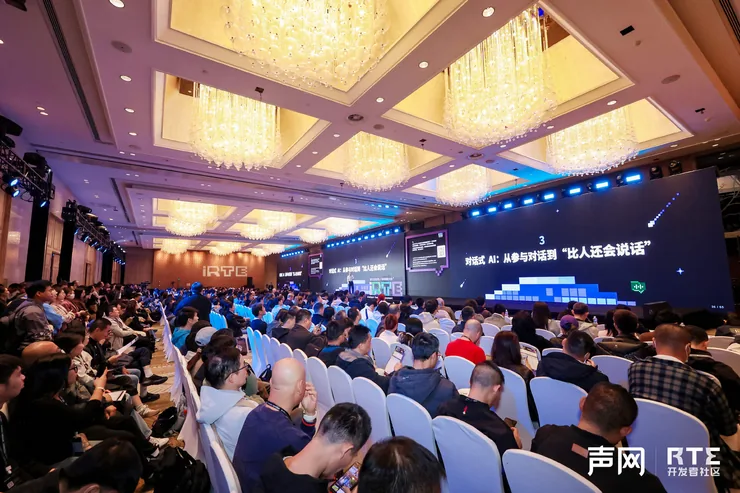
At the iRTE2026 real-time intelligence conference in Beijing on October 23, Agora founder and CEO Zhao Bin used his main-stage keynote, “Conversational AGI: The Next Chapter of Real-Time Interaction,” to propose a five-level conversational capability framework. Notably, the event announced no new model and no pricing.
The hard facts first:
- When and where: October 23, 2026, Beijing, iRTE2026 main forum
- Speaker: Agora founder and CEO Zhao Bin
- Main output: a five-level conversational capability framework (L1–L5) describing how conversational AI moves from reactive answering to long-term relationship understanding
- Product and pricing: according to the keynote, no new model was launched, and no version number, price or open-weight timeline was disclosed
- Also on stage: Nvidia chief architect and AOMedia video coding group co-chair Andrey Norkin on AV2; two panels on whether personal agents become the next interface, and on where conversational AI creates real business value
L5 is not about being smarter — it is about understanding one person

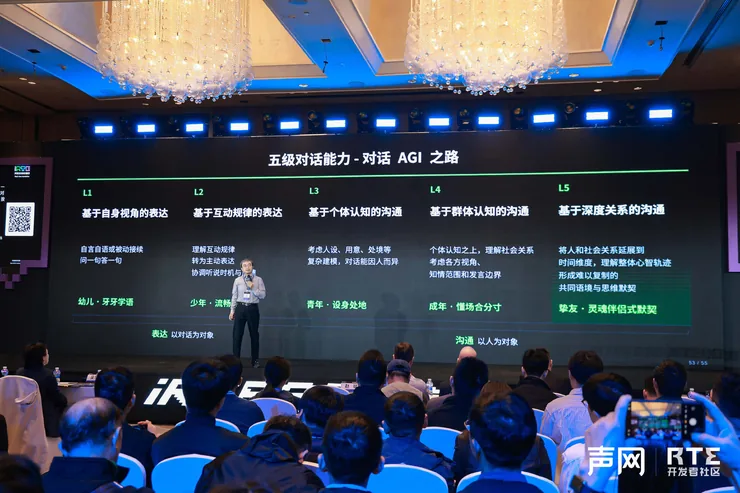
Zhao’s argument is that answer speed and language fluency are insufficient yardsticks. What matters is whether a system grasps the intent, situation and relationships of the person it is talking to. The five levels:
- L1, expression from one’s own perspective: self-expression and passive turn-taking, one question, one answer
- L2, expression shaped by interaction patterns: from passive response to proactive expression, making dialogue more natural and coherent
- L3, communication grounded in individual cognition: understanding identity, intent and situation, adapting per person
- L4, communication grounded in group cognition: understanding social relations and role differences in multi-party settings
- L5, communication grounded in deep relationships: long-term context and evolving relationships, moving from understanding a moment to understanding a person
Two terms, briefly: full-duplex means both sides can speak at once and interrupt freely rather than waiting their turn; WebRTC is the open standard for real-time audio and video between browsers and apps. Zhao said conversational AI is shifting from passive turn-taking toward proactive, natural full-duplex dialogue, and is beginning to model personality, situation, emotion and relationships. The next hurdles, he argued, are role division and conversational order in complex social settings, plus long-accumulated personal context.
Supporting this, he described a real-time intelligence stack: a global real-time transport network, distributed cloud-edge-device inference, real-time orchestration and full-duplex interaction. Agora’s conversational AI engine sits between models, agent runtimes and users; for developers the company offers SDKs, Skills, CLI tools and Recipes, its reusable development templates.
The tension: latency dismissed on stage, latency decides deployments
The sharpest contrast: Zhao argued progress should not be measured only by response speed and naturalness, yet corporate panelists treated latency as the first gate. GuanKe Technology founder Geng Xianglei said AI voice agents must solve latency, interruption timing and human-likeness, with latency potentially determining whether a task succeeds at all. Rokid co-founder Cai Guoxiang said hardware and model strength collapse if conversation feels unnatural; the goal is low-latency, stable interaction plus long-context understanding, so users stop noticing they are talking to AI.
A second contrast concerns who is pulling the technology forward. According to Zhao, the past year’s wider attention to real-time interaction in conversational AI came largely from OpenAI and others adopting WebRTC deeply — demand from model builders rather than from real-time vendors themselves.
Other panelists added their own angles. Tech blogger Eugene Wei put context at the center and proposed measuring whether a new interface is real by daily agent interactions and by who initiates more, the user or the agent. Pan Luan argued AI value is shifting from capturing attention to completing tasks, with agents proactively absorbing well-defined chores. Hardware entrepreneur Hua Jianxin expect no single form factor to win; glasses, earbuds and other environment-sensing devices all have a shot. Xiyue Intelligence founder Chen Wei framed embodied AI as turning human intent into robot action through fused vision, speech and internal state, while Titan Qiming CEO Wu Kan said AI recruiting needs industry data, long-term agent memory and evaluation tied to real events such as interviews and onboarding.
Who should start now, who should wait
Start now if you are building real-time voice agents, AI support desks, AI glasses or companion hardware. Treat L1–L5 as a self-audit: can your system only handle single turns (L1), does it cope with several speakers at once (L4), does it carry memory across sessions (L5)? The full-duplex, interruptible, listen-think-act-at-once requirement is fundamentally an engineering problem, and it is cheaper to solve in the transport layer early.
Wait if you need quantitative benchmarks, comparable metrics, open weights or cost figures for procurement. The framework is qualitative; the keynote offered no public benchmark, dataset or performance numbers, so cross-vendor comparison remains impossible. Selection still requires stress-testing in your own scenarios.
Final word
The most concrete output of the summit was not a model but a vocabulary for describing at what level an AI should be talking to a person, shifting competition from fluency toward context, real-time behavior and task completion. For that vocabulary to matter industrially, it still needs measurable metrics — otherwise the gap between L4 and L5 is a matter of feel.