
Free Agent Knocks on the Door of Low-Level Engineering
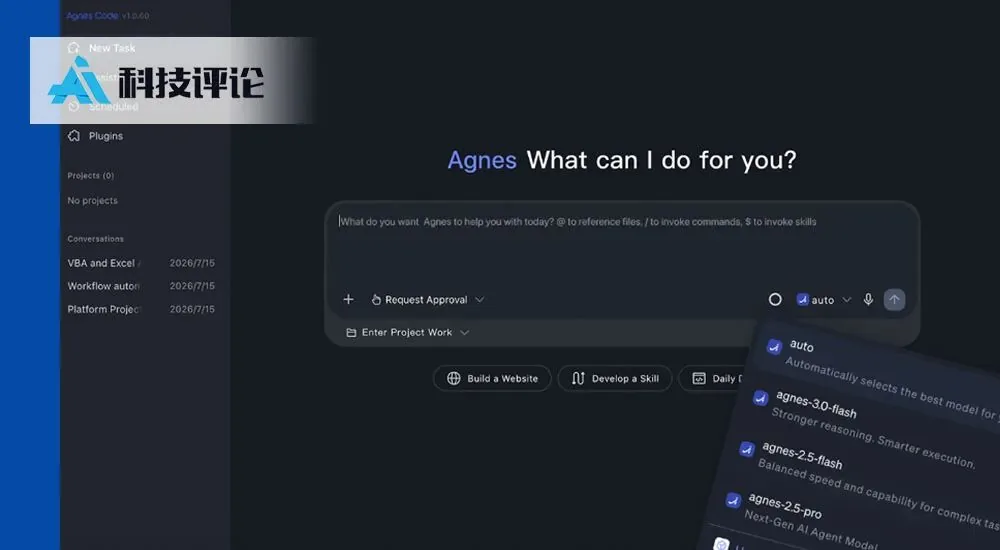
In October 2026, the AI engineering field saw an empirical result: the free, open-source AgnesCode + Agnes 3.0 Flash combination demonstrated performance on par with or even surpassing the paid Codex in professional-grade operator optimization tasks. This test was conducted jointly by AI Technology Review and the Zhongzhi FlagOS Open Computing Global Competition. The test task was the fused QKV-A down-projection operator in the decoding phase of DeepSeek-V3 within the SGLang framework (Task66: dsv3_fused_a_gemm), evaluated automatically across 8 chip platforms.
Key facts at a glance:
- Test period: October 2026 (Competition Season 2, Track 1)
- Participating models: AgnesCode + Agnes 3.0 Flash (free) vs. Codex + GPT-5.6 Sol (paid)
- Evaluation chips: 2 international chips + 天数智芯, 沐曦, 燧原, 海光信息, 昆仑芯, 华为 (8 total)
- Operator task: write optimized code for the fused projection operator in DeepSeek-V3’s decoding phase and adapt it across multiple chips
Key Data: A Contrasting Observation of Performance and Efficiency

AgnesCode’s overall delivery time was 20 minutes 36 seconds (including prompting), while Codex took only 8 minutes 57 seconds, showing a clear speed advantage. But speed is not the ultimate judging criterion—on the 5 chips that both passed, AgnesCode achieved higher speedup ratios in 4 of them:
- 天数智芯: AgnesCode 2.16× vs. Codex 1.72×
- International general-purpose chip B: AgnesCode 4.81× vs. Codex 3.71× (speedup ratio 29.6% higher)
- 昆仑芯: Only AgnesCode passed the test, achieving 2.56×
Codex held an advantage in chip adaptation count (7 passed vs. 6), but AgnesCode delivered higher-performance optimization results on the tasks it passed. Notably, operator optimization is a “high-frequency micro-tuning” task: each token generated by the model requires repeated calls to low-level operators such as matrix multiplication, attention, and normalization. Accelerating a single operator by a few percentage points can translate into meaningful differences in inference latency, memory usage, and serving cost.
Cost-Performance Advantage of Free Models

The model parameters used in this test were not disclosed, but data from Artificial Analysis (AA leaderboard) shows:
| Metric | Agnes 3.0 Flash | GPT-5.6 Luna (max) | Codex (industry reference) |
|---|---|---|---|
| Intelligence Index | 36 | 38 | Not separately disclosed |
| Unit price | ~$0.03/M tokens | Higher | Paid subscription |
| Positioning | Pareto frontier range | High capability, high price | High capability, high cost |
Agnes 3.0 Flash sits on the Pareto frontier in the “intelligence × token price” comparison chart—its price is significantly lower than models at the same intelligence level, and among similarly priced models, its intelligence performance ranks higher. For long-running task scenarios (e.g., an Agent repeatedly reading files, modifying code, running tests), free or extremely low cost can substantially boost the willingness to experiment—an engineering flexibility that closed-source models struggle to offer.
Practical Recommendations: Fitted Scenarios and Areas for Improvement

Users who should try it now:
- Small AI infrastructure teams needing multi-chip operator optimization adaptation;
- Cost-sensitive engineers who require repeated iterative debugging;
- Developers focused on the domestic chip ecosystem (昆仑芯, 天数智芯, etc.).
Users who should wait:
- Production environments demanding extremely high delivery stability that cannot tolerate occasional submission convention errors (e.g., entry naming, file dependencies);
- Projects requiring full coverage of all 8 chips simultaneously.
In practice, AgnesCode can already drive the complete workflow of “write implementation → cross-chip adaptation → self-check packaging → development logging.” Model capability determines the ceiling; workbench capability determines whether that ceiling can be reliably reached—the current version has crossed the usability threshold for low-level engineering tasks, but still needs refinement in the details.
Final Thoughts
When AI begins “tightening its own low-level screws,” the value of free models is shifting from “reducing costs” to “expanding possibilities”: only when the cost of experimentation drops can Agents transition from ‘occasionally helping’ to ‘continuously working’. This test does not declare free models as a wholesale replacement for paid solutions; rather, within the boundaries of specific tasks, it validates the feasibility of “clear workflow + evaluation loop.” Beyond the foundry model, AI Infra is embracing a new engineering paradigm.