
Core Announcement & Key Details
Volcengine ADrive has officially released its cross-product collaboration framework based on ve-adrive-cli v1.0.2, establishing a unified file-based workspace for Agent interoperation. The core innovation lies in treating the file system as the communication substrate between intelligent agents.
Key facts:
- Version: ve-adrive-cli v1.0.2
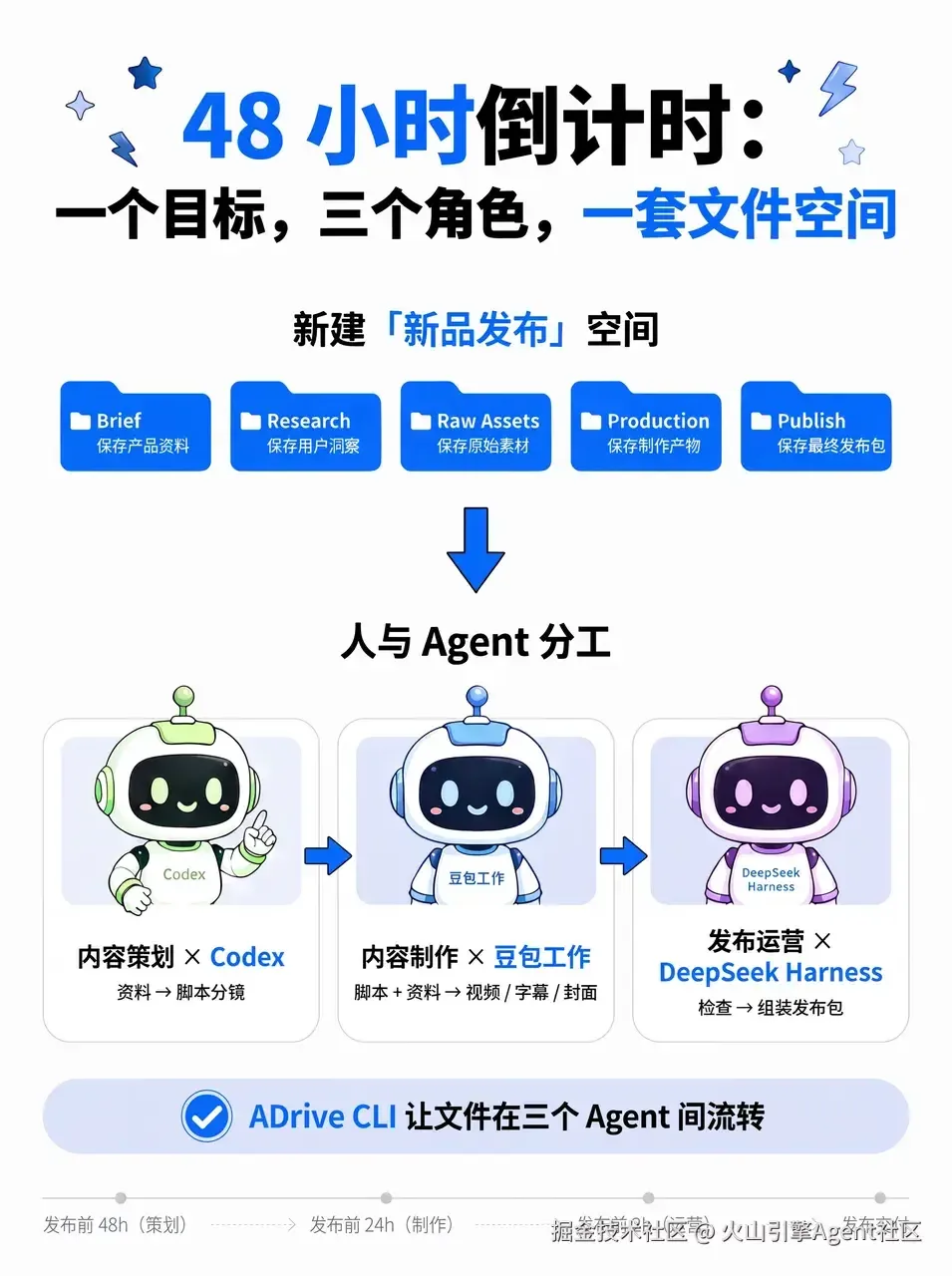
- Demo case: 48-hour video project with multi-Agent handoff
- Safety mechanism: high-risk operations require manual confirmation
- Distribution: open via GitHub Release
- Access: requires direct application to ADrive team for activation
Notably, this launch emphasizes framework validation rather than commercial availability—ADrive remains in application-based trial mode, with no public pricing or open-access timeline disclosed. The community expects broader access in upcoming iterations.
Technical Workflow & Unexpected Simplicity

ADrive enables Agent coordination through standardized file structures—specific directories, versioned metadata, and task-queue files—that allow agents to pass work and status synchronously. This approach reduces coupling between agents, enabling heterogeneous systems (even those written in different languages or running on disparate platforms) to coordinate merely via file contracts.
In the demo, a 48-hour video production pipeline was modularized: material sorting, script generation, visual composition, captioning, and dubbing. Each Agent consumed the previous stage’s output and produced its own, achieving seamless handoff with built-in version tracking and recovery.
A surprising aspect is the operator overhead: the documentation does not disclose how many agents participated or the depth of the call chain. Yet the implementation required only the CLI tool—no additional middleware or heavyweight frameworks. This dramatically lowers entry barriers for small teams aiming to prototype multi-Agent workflows.
Access & Target Use Cases
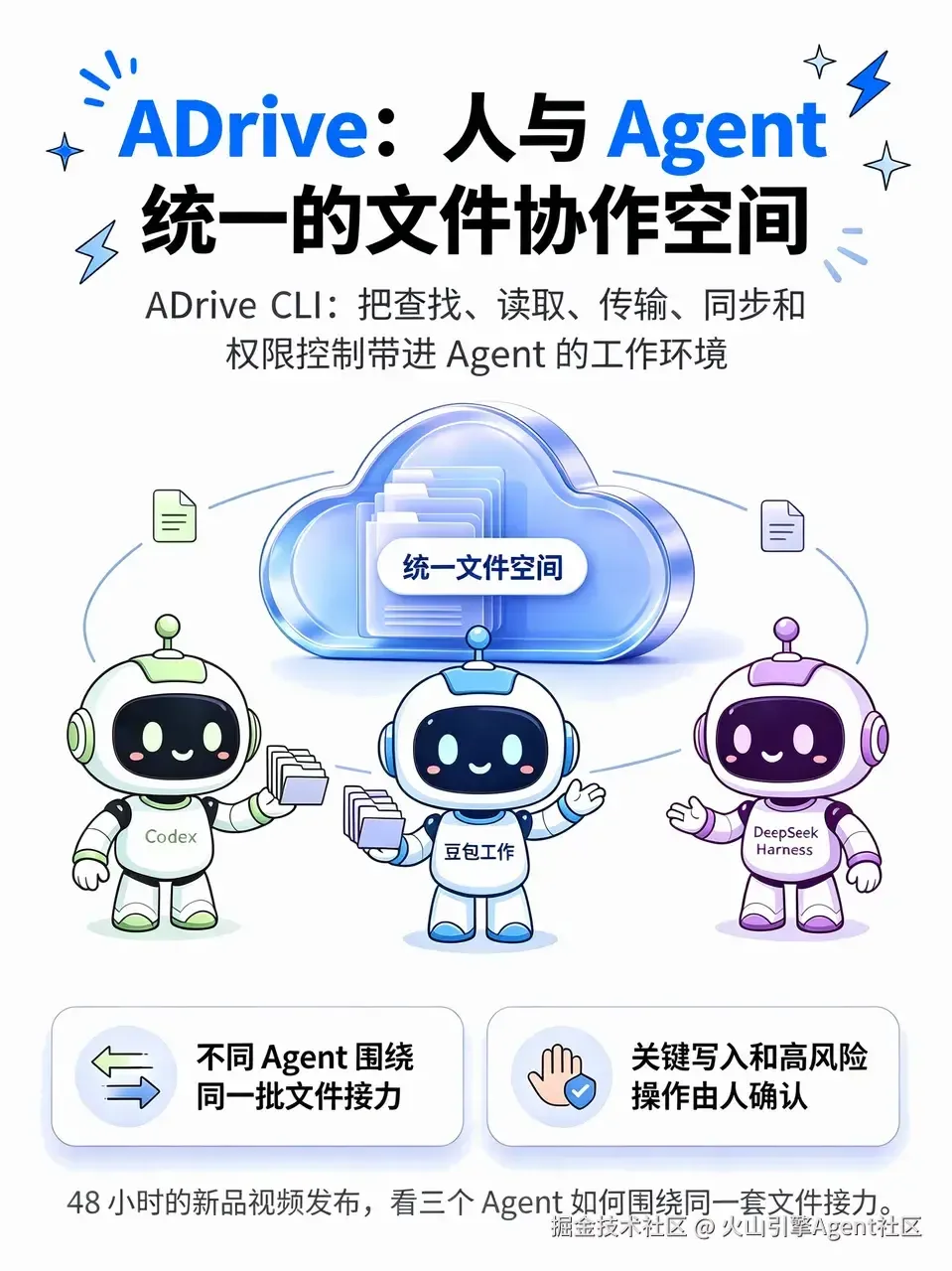
Developers can download ve-adrive-cli from GitHub and configure collaborative workspaces per the docs. The demo focused on text and code-based tasks; no Adobe or Figma integrations were shown. Applicable scenarios include:
- Multi-stage content generation: long-form video, technical documentation with sequential dependencies
- Heterogeneous Agent handoff: agents built with different technologies can interoperate via standardized file formats
- Workflow safety controls: manual confirmation for destructive operations suits sensitive domains like content moderation
The emphasis on “cross-product” collaboration—not just internal lines—suggests third-party Agent providers could eventually integrate, though the openness of such onboarding remains unconfirmed.
Practical Guidance
Teams evaluating Agent collaboration architectures should consider:
Ready to adopt now: if you have CLI proficiency, multi-stage generation needs (e.g., video, docs), and require cross-team or cross-model handoff with versioned artifacts.
Wait for stability: if your use case demands proven high-concurrency performance or production-critical reliability—v1.0.2’s stress-test data has not been published.
Final Thoughts
When collaboration protocols become versioned files instead of brittle APIs, cross-system coordination finally scales. ADrive’s pragmatic insight—that files are the most universal serialization format for agents—may well define the next coherence frontier in multi-Agent systems.