
If you’re combing through the endless stream of new GitHub projects for something truly special, MiroFish is well worth your attention.
It claimed the top spot on GitHub’s Trending list today (amassing 73,000 stars in short order) not through flashy technical parlor tricks, but with a complete “digital sandbox” solution — letting thousands of agents with distinct personalities and memories interact freely in a virtual world, undergoing social evolution, to effectively reason about future events. While others are still debating the conversational prowess of large language models, MiroFish has already moved the battlefield to the dimension of collective intelligence.
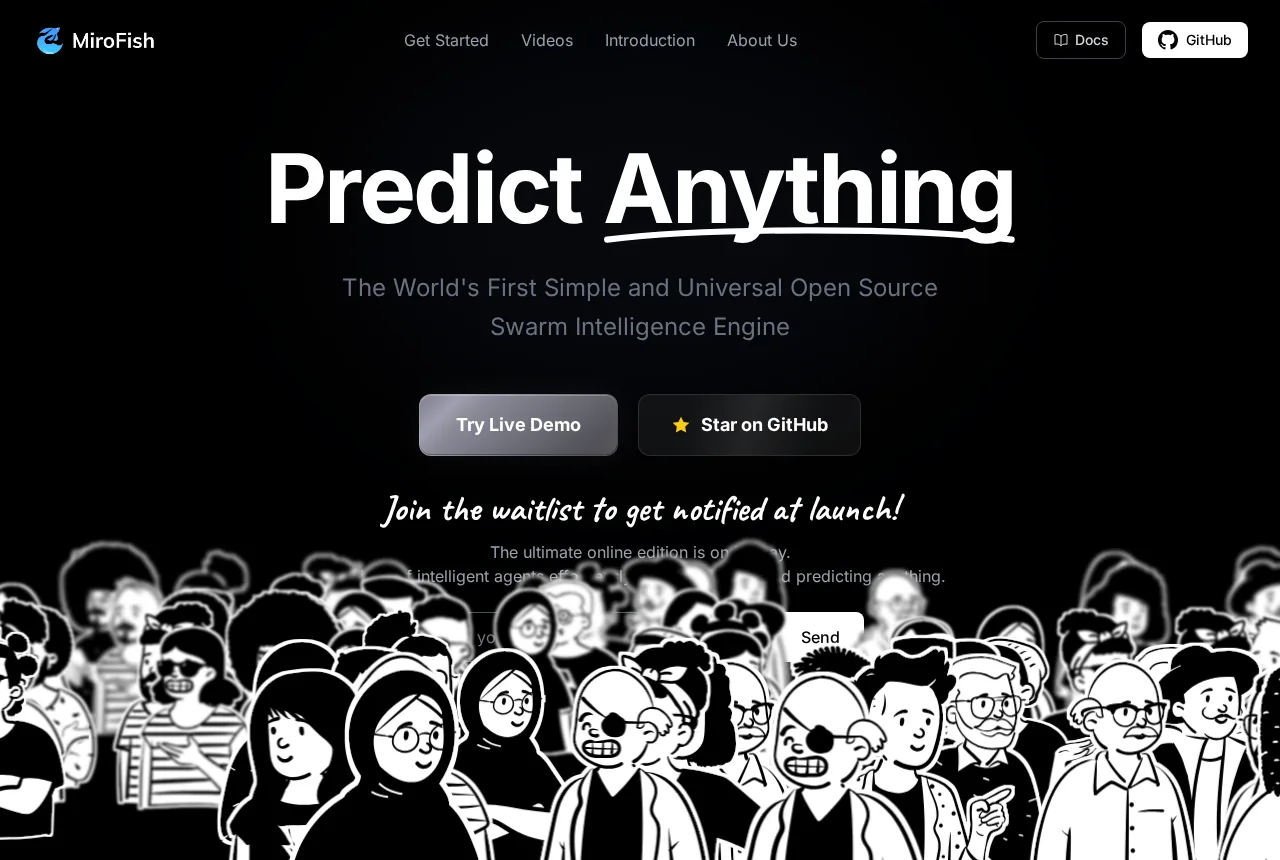
Core Capability: Building a Navigable Digital Parallel World
MiroFish’s working principle isn’t mystical, but its implementation is remarkably clever. It pulls seed information from the real world — a breaking news story, a policy draft, or a segment of financial report data — and uses it as a starting point to construct a high-fidelity simulated world in a digital space.
Within this world, each agent carries its own personality profile, long-term memory, and behavioral logic as it interacts with others. You can inject variables dynamically from a god’s-eye view and watch how events ripple outward like a stone dropped into water. This is no longer a traditional predictive model — it’s more of a “future rehearsal lab”:
- At the macro level, decision-makers can test policy outcomes and PR strategies in a zero-risk environment;
- At the micro level, creators can use it to explore how a novel might end, or investigate historical “what-ifs” where different choices were made.
Three Steps to Get Started, No Need to Build from Scratch
The installation process is approachable, with two official paths offered. Source deployment suits users who want deep customization:
- Prepare Node.js 18+, Python 3.11–3.12, and uv (a Python package manager);
- Copy
.env.exampleto generate a config file, and fill in your LLM API keys and Zep cloud service credentials; - Run
npm run setup:allto install all dependencies in one shot; - Finally,
npm run devto launch both frontend and backend services simultaneously.
Visit http://localhost:3000 locally to access the interactive interface. Upload an analysis report or a passage from a novel, describe your prediction needs in natural language, and the system returns a forecast report alongside a deeply interactive digital world.
Docker users have it even easier — after configuring .env, a single docker compose up -d command brings up the entire environment.
Technical Highlights and Design Trade-offs
MiroFish’s backbone comes from the OASIS framework open-sourced by the Camel-AI team, a foundational engine designed specifically for social interaction simulation. On top of this, the project team made several deliberate trade-offs:
Multi-agent collaborative architecture. Rather than a single large model directly answering questions, it assigns multiple agents with distinct role specializations to form a social structure. When a “policy adjustment” variable is injected, the evaluator role assesses the impact, the Evaluator recommends adjustments, and the reporter handles summary output. This division of labor reduces single-point complexity and more closely mirrors real-world decision-making chains.
Dual-path parallel simulation mechanism. The simulation process runs along a main path and a parallel verification path — the former ensures smooth progression of the inference, while the latter periodically backtracks to check logical consistency. This design sacrifices some computational efficiency but significantly boosts the credibility of results — after all, the value of a prediction lies not in speed, but in accuracy.
Long-term memory fused with knowledge graphs. Each agent’s conversation history isn’t simply discarded; instead, it’s structured into a knowledge graph via GraphRAG technology. This allows agents to remember key relationships and cause-and-effect context even after hundreds of interaction rounds, sidestepping the “amnesia” problem that plagues traditional conversational systems.
Who Should Pay Attention? Comparison with Similar Projects
MiroFish’s target user base is fairly clear:
- Researchers: Those studying social phenomena, public opinion evolution, or policy effects, where traditional surveys and experiments are too costly;
- Content creators: Novelists, screenwriters, or game designers who want to explore the plausibility of different plot branches;
- Corporate strategy teams: Those conducting careful market pre-tests to surface potential risk points before making real decisions;
The market isn’t without similar attempts. Compared to other projects in this space:
- Stronger than single-agent simulations: Most projects focus on single-agent planning capabilities, whereas MiroFish emphasizes collective social evolution;
- More stable than pure LLM-based prediction: Instead of relying on a single model’s reasoning chain, MiroFish lets multiple agents debate, revise, and reach consensus;
- More usable than research-grade frameworks: Camel-AI’s OASIS is inherently academic, while MiroFish adds extensive engineering adaptation and interaction optimization.
There are当然 limitations: the current version depends heavily on LLM APIs, and Zep’s cloud service free tier suits lightweight experimentation — frequent use requires cost consideration.
Final Thoughts
What’s most compelling about MiroFish is that it doesn’t aim to replace human judgment. Instead, it extends a hand and says, “I’ll think through this alongside you.” When we can’t recreate those “what-ifs” in reality, it offers a gentle alternative: lay your imagination bare in a safe digital sandbox.
If the day comes when we can truly predict economic fluctuations or public opinion storms — I believe it won’t come from a single prophet’s intuition, but from the collective wisdom that emerges after thousands of agents repeatedly collide and iterate in a virtual world.
Perhaps that’s the truly captivating posture of collective intelligence.