
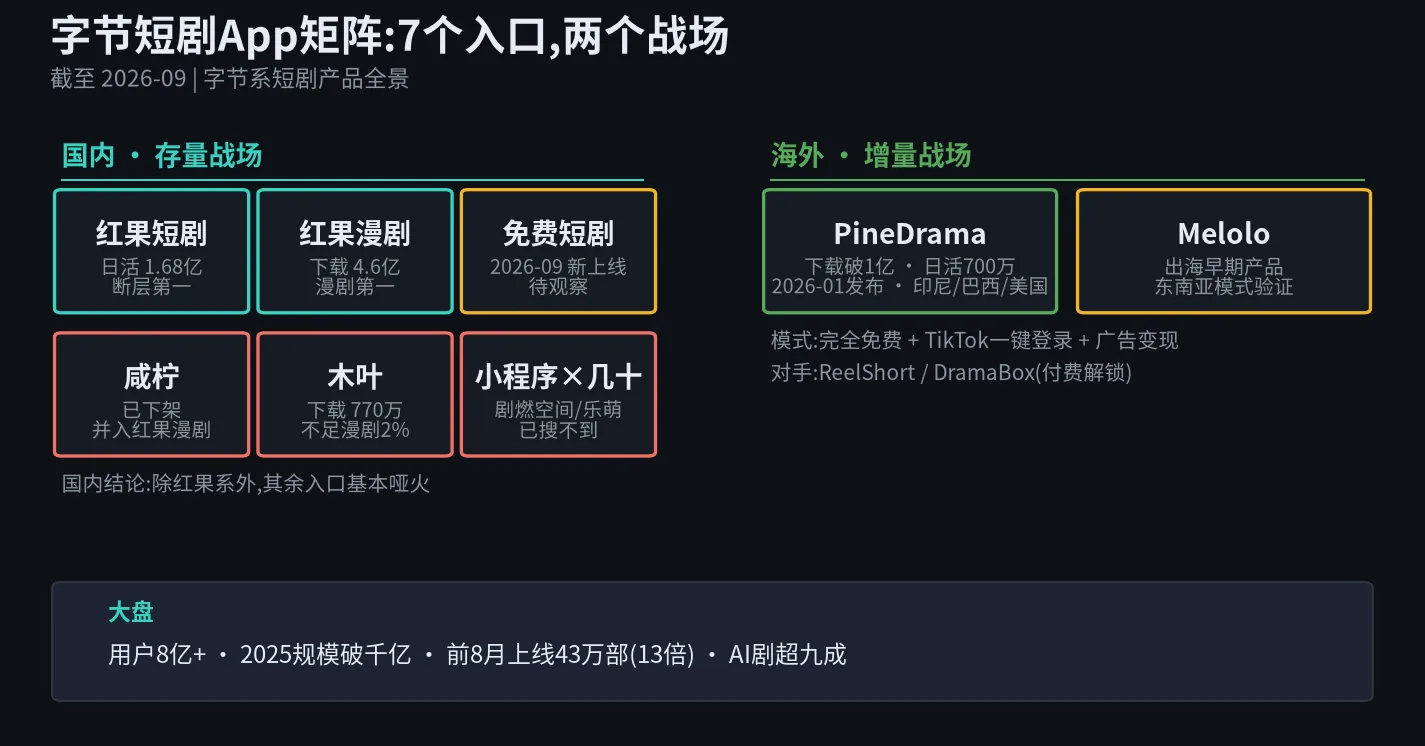
Bottom line: Of ByteDance’s 7 drama matrix entries, only 2 are truly competitive — Hongguo (168M DAU, far ahead of the pack) and overseas PineDrama (100M+ cumulative downloads). The other five domestic entries are either taken down or have downloads less than 2% of Hongguo’s. The real question isn’t the number of apps but whether they’re all drawing from the same content library.
After Hongguo’s Reign, ByteDance Opens Another Entry
In late September 2026, a new app called “Free Drama” (免费短剧) appeared in the app stores. The developer info points to ByteDance, with the slogan “Free dramas, great shows always on.” The content covers urban drama, sweet romance, workplace and marriage, underdog comeback, and fantasy/xianxia genres.
Adding it to ByteDance’s product list makes it the 7th drama app. Alongside Hongguo, Hongguo Free Manhua, Xian Nian, Mu Ye, and the overseas Melolo and PineDrama, the picture of a “drama app factory” is now fully visible.
The curious thing is: ByteDance doesn’t lack entry points. Beyond Hongguo, Douyin, Toutiao, Fanqie, and TikTok all have drama channels. With the overseas ecosystem included, ByteDance’s coverage of free drama entry points was already comprehensive. The five domestic drama apps also don’t differ much in users’ eyes — they all just look like another place to watch free short dramas.
So why open yet another one?
The Big Picture: The Pie Is Growing, But Growth Is Slowing Sharply
Let’s look at the macro data first. On September 17, at a State Council Information Office press conference, the head of the Network Audio-Visual Department of the National Radio and Television Administration released a set of official figures:
| Metric | Value | Source |
|---|---|---|
| National micro-drama users | Over 800 million | NRTA (2026-09-17 Press Conference) |
| 2025 market size | Surpassed 100 billion yuan | Ibid. |
| Micro-dramas released (Jan–Aug 2026) | 430,000 titles | Ibid., 13× the full-year 2025 total |
| AI-generated drama share | Over 90% | Ibid. |
| 2026 projected market size | 121 billion yuan | 2026 Short Drama Industry Trend Insights |
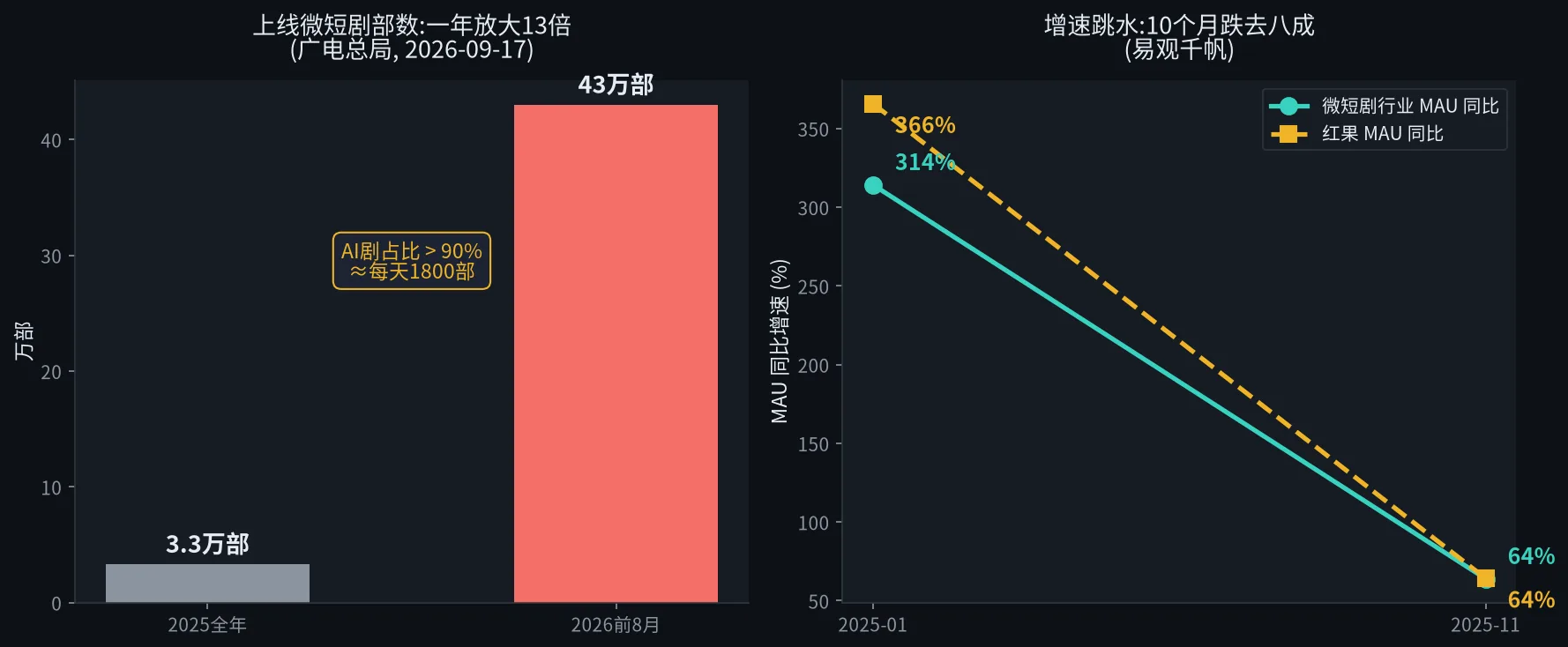
430,000 titles means nearly 1,800 new releases per day on average. Compared to roughly 33,000 titles for all of 2025, production capacity has expanded 13-fold in a single year. This isn’t content prosperity — it’s a production stampede. Nine in ten titles are AI-generated, production costs have hit rock bottom, barriers to entry on the supply side are nearly nonexistent, and traffic simply isn’t enough to go around.
At the same press conference, the NRTA also did something every drama creator should have noticed: 68,000 non-compliant micro-dramas were taken down, while the authority guided platforms to open “live-action drama” sections and strongly support live-action productions. AI works must now carry content labels and undergo manual review, with strict bans on “AI distortions.” The regulatory stance is clear: cool down AI dramas and tighten the production spigot.
The reason behind the regulatory move is even more obvious when you look at data from the creator side.
Growth Collapses: From 314% to 64% in Just 10 Months
Analysys data shows that the year-on-year growth rate of monthly active users in China’s micro-drama industry fell from 314.23% in January 2025 to just 63.91% by November 2025. Hongguo’s own MAU YoY growth rate dropped from 365.78% to 64.2% over the same period.
In 10 months, growth rate fell by 80%. Drama user penetration is already very high, and the market is approaching its ceiling — Hongguo, as the leading platform, is the first to hit the growth bottleneck.
Internal data from the Hongguo platform reveals more nuances:
- The top three titles on the Must-Watch chart are Eighteen-Year-Old Great-Grandmother 3, Eighteen-Year-Old Great-Grandmother 4, and Inside and Outside the Family — two are older titles from 2025, and the third is a continuation of an established IP;
- All ten titles on the Favorites chart are last year’s older dramas;
- This year’s new dramas don’t match last year’s heat or收藏 levels.
When a platform’s popular content chart is dominated by older titles, it means new content isn’t keeping up — this is the new problem after the AI drama泛滥: huge volume but no breakout hits.
Creator Side: Revenue per 10,000 Plays Drops from Hundreds to Single Digits
The market’s chill is most directly reflected in creators’ revenue curves.
Drama creator Lin Jianhuan produced six short dramas this year, five of which were released on Hongguo. He said Hongguo is his most important platform — the traffic is better than other platforms, and the newly launched “daily earnings” policy is more creator-friendly. But when it comes to actual revenue, short dramas “sometimes have good data but poor real conversion.”
Specifically: revenue per 10,000 plays has dropped from a few hundred yuan in the past to just a few yuan now. He sent a screenshot: on September 15, one drama got 210,000 plays and earned only 9 yuan. That’s less than 0.5 yuan per 10,000 plays — even worse than the industry average.
Traffic inflation is also severe. Practitioner “Xiao Bai” noticed that about a month after a drama launched, its popularity suddenly jumped 200 points on a random day in early September, from 4,000 to over 4,300. By past experience, a drama one month after launch shouldn’t be able to逆势 grow by 200–300 points while other metrics are declining. He attributes this anomaly to the platform adjusting its popularity algorithm. He’s not the only creator who has experienced this.
“Now we’re all losing money — only 2% of people are making a profit. The platforms are flooded with AI dramas, there’s no barrier to entry, and there isn’t enough traffic to go around.” — These are Lin Jianhuan’s exact words, and they’re perhaps the most accurate industry epigram of autumn 2026.
The Matrix Math: 7 Entries, Only 2 That Can Fight
Back to the original question: Hongguo already dominates, so why build a matrix?
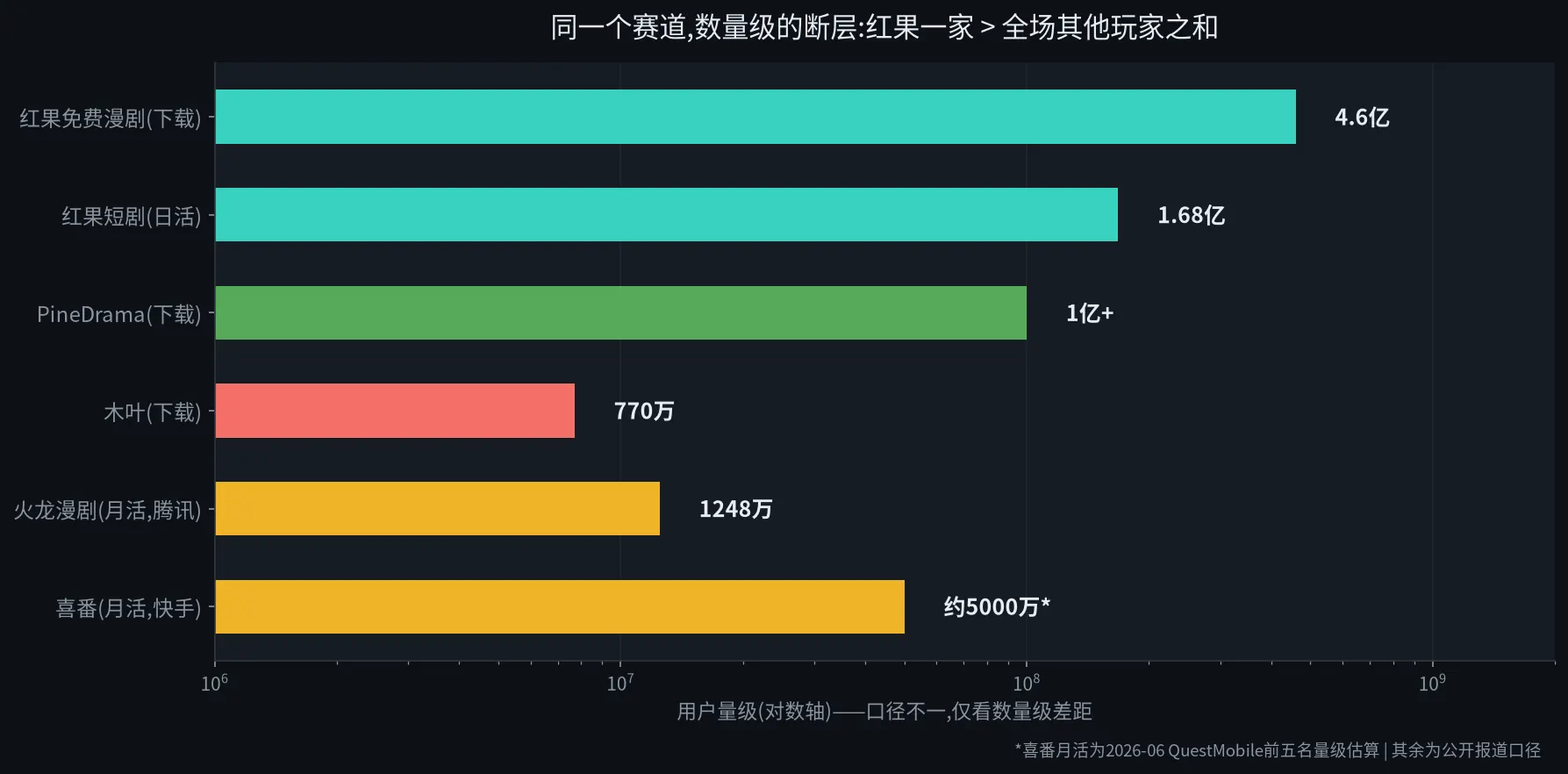
How dominant is Hongguo: QuestMobile data shows that as of July 2026, Hongguo Drama — less than three years after launch — has 168 million DAU, up 107% year-on-year, exceeding the combined DAU of iQiyi, Tencent Video, Youku, and Mango TV.
But the成绩单 of the other products in the matrix:
| Product | Status/Data |
|---|---|
| Hongguo Drama | 168M DAU, far ahead |
| Hongguo Free Manhua | Nearly 460M cumulative Android downloads |
| “Free Drama” | Launched Sep 2026, awaiting observation |
| Xian Nian | Taken down, upgraded to Hongguo Free Manhua |
| Mu Ye | Only 7.7M Android cumulative downloads, less than 2% of Hongguo Manhua |
| Melolo | Early overseas product, Southeast Asia validation |
| PineDrama | 100M+ cumulative downloads, ~7M DAU, 17M+ monthly downloads |
The contrast worth noting: domestic matrix entries are all quiet, while the ad-supported free model overseas has produced a second hit. PineDrama, launched in January this year, targets Indonesia, Brazil, and the US, ranking 7th on Sensor Tower’s Q2 2026 Chinese non-gaming app overseas download chart — the only new product on the list with less than a year on market. Its model also differs from the domestic grind — fully free, one-tap login via TikTok account, no in-app purchases, gradually introducing ad monetization. It essentially replicates Hongguo’s free logic overseas, with original overseas content (wealthy families, romance, vampire themes), creating错位 competition with ReelShort and DramaBox’s paid unlock model.
What’s hidden within this is the matrix’s true winning move: the overseas drama market is still in high growth, while the domestic market has already peaked. The 2026 overseas micro-drama market is approximately $3.6 billion, with cross-platform IAP revenue of $2.03 billion; Chinese companies hold over 90% of the overseas market share. The domestic 100 billion yuan (approx. $14 billion) market is growing at only double digits, while the overseas $3.6 billion market is still growing at triple digits — PineDrama’s 100 million downloads are capturing incremental growth, while Hongguo’s 168 million DAU is defending存量.
The remaining opportunities for the domestic matrix largely depend on the direction of regulation. With the NRTA clearly supporting live-action dramas and cracking down on “AI distortions,” officials are effectively tiering content for the industry. If ByteDance’s “second Hongguo” emerges domestically, it’s unlikely to come from a vertical app with shared-library distribution — it will more likely come from the directions the regulator has named: live-action + manhua.
Competitors Aren’t Sitting Idle: Tencent’s Multi-Pronged Encirclement
While ByteDance is building its matrix, competitors are making moves.
Tencent’s ecosystem is the most active. WeChat Video Accounts launched a native drama incentive program with up to 135% revenue share for breakout hits, and shortened billing cycles. Tencent Video launched a vertical drama section with uncapped incentives for quality works — up to 5 million yuan for studio partners. Tencent Music introduced an independent drama app, “Quanmin Drama,” in 2024. Yuewen launched an independent drama app, “Qidian Theater,” in July this year.
In the manhua drama space, Tencent Video’s Huolong Manhua is closing the gap noticeably. QuestMobile data shows that in June this year, the top five drama MAU were: Hongguo, Hongguo Manhua, Hemajuchang, Huolong Manhua, and Xifan. Huolong Manhua ranks second in manhua drama and fourth overall in short drama with 12.48 million MAU, and is signing tens of millions in content partnerships with creators like Chinese Allance to bolster its library.
Bilibili, Youku, and iQiyi have all collectively pivoted toward AI short dramas and AI video tools, and they’ve all simultaneously bet on AI creator competitions:
- Bilibili: AI drama creation support program + AI video tool updream, launched its first AI creation competition in January with 77 winning slots and a total prize pool exceeding 3 million yuan, with the first prize at 1 million yuan;
- iQiyi: Lowered barriers, increased revenue sharing, and AI video tool Nadu Pro, launched the Nadu · AIGC Venture Conference in March, and partnered with Alibaba’s Wanxiang Wan 3.0 in September for a Global AI Creator Challenge;
- Youku (Whale Culture): Self-developed “Whale AI Large Model,” launched the “Jingrui AI Creation Competition” on September 17 with a total prize pool of 10 million yuan, with a maximum single prize of 2 million yuan.
Kuaishou chose not to pile on independent apps, instead betting on premium drama manhua: 2026 daily drama exposure of 129 million, daily user watch time of 29 minutes, drama supply up 8×, and manhua ad spend growing nearly 20× in the past half year (Magnetic Engine data). Drama DAU has already broken 300 million.
The focus of platform competition has shifted from grabbing users to grabbing AI creators — they’re all betting on production capacity for the next content cycle. Tencent is surrounding with money and traffic ecosystem; long-form video platforms are吸附 creators with AI tools + competitions; Kuaishou is speaking through ad spend efficiency; ByteDance is using the app matrix plus Hongguo as the cash cow.
Full-Platform Entry Checklist: Which Platforms to Watch for AI Short Dramas
Gathering the scattered information from above into one table. If you’re planning to enter the AI short drama space, this is the full-platform landscape for autumn 2026 — organized by camp, with key policies and data:
| Platform | Camp | Format | Creator Policy | Key Data (2026) |
|---|---|---|---|---|
| Hongguo Drama | ByteDance | Independent App · Free | Daily earnings policy | 168M DAU, far ahead |
| Hongguo Free Manhua | ByteDance | Independent App · Manhua | Same as Hongguo system | Nearly 460M Android downloads |
| “Free Drama” | ByteDance | Independent App · Free | Awaiting observation | New Sep 2026 |
| Douyin / Toutiao / Fanqie | ByteDance | Embedded drama entry | Platform revenue share | Dozens of mini-programs (most inactive) |
| Xian Nian | ByteDance | Taken down | — | Merged into Hongguo Free Manhua |
| Mu Ye | ByteDance | Independent App | — | 7.7M downloads, marginalized |
| PineDrama | ByteDance Overseas | Independent App · Free + Ads | Gradually opening | 100M+ downloads, ~7M DAU |
| Melolo | ByteDance Overseas | Independent App · SE Asia | — | Early validation product |
| Video Accounts | Tencent | WeChat-embedded | Up to 135% incentive for breakout hits | Billing cycles shortened |
| Tencent Video Vertical Drama | Tencent | Within long-form platform | Uncapped, up to 5M for studios | — |
| Huolong Manhua | Tencent Video | Independent App · Manhua | Tens of millions in content procurement | 12.48M MAU, #2 in manhua |
| Quanmin Drama | Tencent Music | Independent App | — | Cross-sector launch in 2024 |
| Qidian Theater | Yuewen (Tencent) | Independent App | Web novel IP adaptation | Launched Jul 2026 |
| Kuaishou Drama | Kuaishou | Main app + Xingmang | Revenue share + Magnetic Engine | Drama DAU 300M+, daily exposure 129M |
| Hemajuchang | Dianzhong Tech | Independent App | — | #3 in drama MAU (above 12.48M) |
| Bilibili | Bilibili | Main app + AI tool updream | AI competition prize pool >3M | 1M first prize, 77 slots |
| Xifan | Kuaishou | Independent App | — | Top 5 MAU in industry |
| Nadu Pro | iQiyi | AI video tool | AIGC venture conference, increased sharing | — |
| Youku (Whale Culture) | Alibaba | Main app + Whale AI tool | Jingrui competition, 10M total | Max single prize 2M |
| ReelShort | Chinese Allance · Overseas | Independent App · Paid unlock | — | Leading overseas paid model |
| DramaBox | Dianzhong · Overseas | Independent App · Paid unlock | — | Leading overseas paid model |
Three entry routes emerge from this table:
- Mass-market route: Hongguo + Kuaishou — largest traffic but most competitive, revenue per 10,000 plays has already dropped to single digits, suitable for teams with mass-production capability;
- AI-friendly route: Bilibili, iQiyi, and Youku are all running AI creation competitions, providing AI tools and real money — the lowest-barrier, most subsidized entry for AI drama creators right now;
- Overseas route: PineDrama (free + ads) and ReelShort / DramaBox (paid unlock) — two different models, with overseas markets still in triple-digit growth and far less competitive intensity than domestic.
The regulatory variable must also be factored in: the NRTA is supporting live-action dramas and requiring AI works to be labeled and manually reviewed, meaning the approval cost for purely AI-generated dramas on domestic platforms is rising. AI + live-action hybrid production will be more stable.
Final Take
This article highlights three numbers worth re-reading together:
- 800 million users, 430,000 titles released, 100 billion yuan market size — this is the drama ceiling;
- 64% growth rate, a few yuan per 10,000 plays, favorites charts full of old dramas — this is the drama reality;
- 7 apps, 2 that can fight, 100M+ overseas downloads — this is ByteDance’s answer.
For ByteDance, whether 7 apps are a waste of resources doesn’t depend on the number of apps but on whether the traffic from those seven entry points ultimately flows into the same content library. If it does, more entries just dilute Hongguo’s存量; if not, every app in the matrix is helping ByteDance probe the next content format — just like how ByteDance once nurtured both Douyin and TikTok simultaneously.
For creators, the answer is colder: the process of revenue per 10,000 plays dropping from a few hundred yuan to a few yuan is the precise刻度 of an industry moving from blue ocean to red ocean. Entering the AI drama space today is like entering the WeChat public account space in 2021 — the platforms still need you, but only 2% of people are making money.
| |